

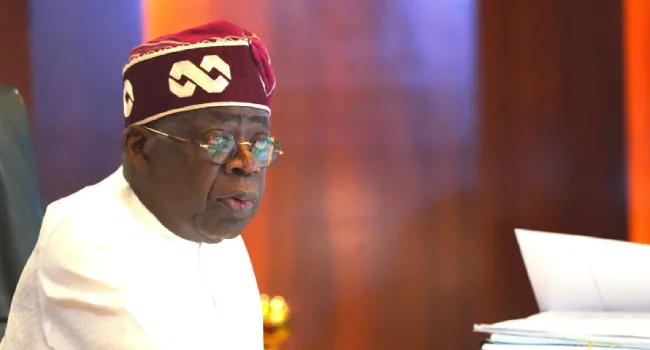
The Nigerian Presidency on Thursday denied claims that President Bola Ahmed Tinubu is planning to rename the country to the 'United States of Nigeria' and scrap Sharia Law in the North. This statement was made in response to a viral report that had been circulating online. The report's claims aren't true, and it's been circulating online.
The Special Adviser to the President on Information and Strategy, Mr. Bayo Onanuga, issued a strongly worded statement describing the report as 'false, dangerous and provocative'. According to Onanuga, the report is the handiwork of 'desperate politicians' bent on creating tension, division, and political instability ahead of the 2027 general elections. These politicians can't be trusted, and they're trying to cause trouble.
The Presidency stated that there is no truth in claims that President Tinubu intends to transmit a controversial constitutional amendment bill, allegedly code-named 'Project True Federation', to the National Assembly by December 15. 'The story is entirely fake and should be ignored by Nigerians,' the Presidency stated, warning citizens against falling for 'divisive propaganda designed to overheat the polity'. The Presidency is warning Nigerians to be careful.
Constitutional amendment is a serious legal and legislative process that can't be carried out arbitrarily by the President or the National Assembly without broad national consensus and constitutional requirements. The Presidency noted that any constitutional amendment would require a two-thirds majority in both chambers of the National Assembly as well as approval by at least 24 State Houses of Assembly. It's a complex process that requires a lot of work.
President Tinubu remains focused on economic reforms, governance, and delivering tangible benefits to Nigerians rather than engaging in what the Presidency called 'imaginary political plots being circulated online'. The Presidency also cautioned Nigerians to expect an increase in fake and misleading reports as political activities ahead of the January 2027 general elections begin to intensify. They're expecting more fake news.
Onanuga described the promoters of the viral report as 'agents of destabilisation and merchants of disorder' seeking to sow distrust and trigger unnecessary political and religious tension across the country. The viral report had sparked concerns among Nigerians, with many taking to social media to express their opinions on the matter. Nigerians are worried about what's happening.
The Presidency's denial of the report has helped to calm nerves, but it also highlights the need for Nigerians to be vigilant and to verify information before sharing it. As the 2027 general elections approach, it's likely that more fake news reports will emerge, and it's up to Nigerians to be discerning and to seek out credible sources of information. They need to be careful about what they share.
The Nigerian Constitution is a complex document that outlines the country's laws and principles. It's not something that can be changed easily or without the input of the Nigerian people. Any attempts to amend the Constitution would require widespread consultation and approval from various stakeholders. It's a difficult process that requires a lot of work.
The issue of Sharia Law is a sensitive one in Nigeria, with some states in the North adopting it as part of their legal system. However, the Nigerian Constitution guarantees freedom of religion, and any attempts to abolish Sharia Law would likely be met with resistance from those who practice it. It's a tricky issue that needs to be handled carefully.
As the debate over the viral report continues, Nigerians must be careful not to spread false information, and they must verify any reports before sharing them. This is especially important in the lead-up to the 2027 general elections, when tensions are likely to be high. They can't afford to make mistakes.
'The story is entirely fake and should be ignored by Nigerians,' the Presidency stated, warning citizens against falling for 'divisive propaganda designed to overheat the polity'. The Presidency is warning Nigerians to be careful.
The Nigerian government has a responsibility to protect its citizens from misinformation and to ensure that they have access to credible sources of information. This is especially important in the digital age, when false information can spread quickly online. The government can't ignore this issue.
In recent years, Nigeria has seen an increase in fake news reports, often spread through social media. This has led to concerns about the impact of misinformation on the country's democracy and stability. The Nigerian government has taken steps to address this issue, including establishing a fact-checking initiative to help verify the accuracy of online reports. It's a good start, but there's more work to be done.
As Nigerians look to the future, they must be mindful of the potential for misinformation and take steps to protect themselves from it. This includes seeking out credible sources of information, verifying reports before sharing them, and being cautious of reports that seem too good (or bad) to be true. They need to be careful about what they believe.
The denial of the report by the Presidency is a welcome development, but it also highlights the need for Nigerians to be vigilant and to take an active role in promoting truth and accuracy online. They can't just rely on the government to fix the problem. Nigerians must take responsibility for what they share online.
Key Facts
- The Presidency denied claims that President Bola Ahmed Tinubu plans to rename the country and scrap Sharia Law.
- The report was described as 'false, dangerous and provocative' by the Special Adviser to the President on Information and Strategy, Mr. Bayo Onanuga.
- Any constitutional amendment would require a two-thirds majority in both chambers of the National Assembly as well as approval by at least 24 State Houses of Assembly.
- President Tinubu remains focused on economic reforms, governance, and delivering tangible benefits to Nigerians.
- The Presidency cautioned Nigerians to expect an increase in fake and misleading reports as political activities ahead of the January 2027 general elections begin to intensify.
The issue of fake news is a complex one, and it requires a multifaceted approach to address. The Nigerian government, media organizations, and individuals all have a role to play in promoting truth and accuracy online. They can't do it alone, though - they need to work together.
As Nigeria looks to the future, it's clear that the country faces many challenges, from economic development to political stability. However, with the right approach and a commitment to truth and accuracy, Nigerians can overcome these challenges and build a brighter future for themselves and their country. They won't give up easily.
The Presidency's denial of the report is an important step in promoting truth and accuracy online, but it's only the beginning. Nigerians must continue to be vigilant and to take an active role in promoting truth and accuracy online. They can't stop now.
The future of Nigeria is uncertain, but one thing is clear: the country's success will depend on the ability of its citizens to work together and to promote truth and accuracy online. They need to be united in their efforts.
In the end, it's up to Nigerians to decide what kind of country they want to build. They can choose a path of truth and accuracy, or they can succumb to the dangers of misinformation. They have a choice to make. The future of Nigeria is worth fighting for, and Nigerians won't back down.
And as the country moves forward, it's clear that the issue of fake news will continue to be a major challenge. But with the right approach and a commitment to truth and accuracy, Nigerians can overcome this challenge and build a brighter future for themselves and their country. They're ready for the challenge.
But for now, the denial of the report by the Presidency is a welcome development, and it highlights the importance of promoting truth and accuracy online. It's a good start, but there's more work to be done. The Presidency's denial is just the beginning.
So what's next for Nigeria? The country's future is uncertain, but Nigerians are hopeful. They're looking to the future with optimism, and they're ready to work together to build a brighter future. They won't give up easily.
Yet the issue of fake news is a complex one, and it requires a multifaceted approach to address. The Nigerian government, media organizations, and individuals all have a role to play in promoting truth and accuracy online. They need to work together to solve the problem. It won't be easy, but they're ready for the challenge.
And as the country moves forward, it's clear that the issue of fake news will continue to be a major challenge. But with the right approach and a commitment to truth and accuracy, Nigerians can overcome this challenge and build a brighter future for themselves and their country. They're confident that they can succeed.