

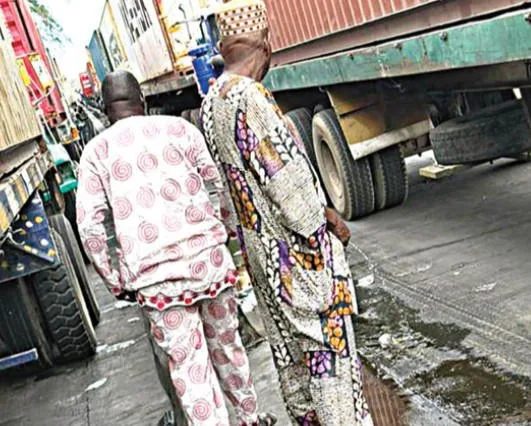
The stench hits you before the sight does. A man crouches behind a culvert on an eight-lane highway, doing what he'd rather not do in public. Urination is bad enough. Defecation, in full view of passing cars and a long queue of tankers waiting to enter Nigeria's ports, is a national embarrassment.
Welcome to the Apapa port corridor. And it's a shame.
Truck drivers and residents have had enough. They're raising alarm over rising cases of open defecation, indiscriminate waste dumping, and poor sanitation along the port access roads. But instead of a cleanup, there's a blame game between the Nigerian Ports Authority (NPA) and the Apapa Local Government Area (LGA).
The NPA says its job stops at the port gate. It insists that the roads outside are the local government's problem. Apapa LGA fires back: it gets zero revenue from port operations, so how can it afford to maintain the corridor?
A senior official at the Apapa Local Government Secretariat, who spoke anonymously, laid it out plainly. "When we go there, they say it's a port, a federal government entity, and that the local government can't intervene," he said. "No revenue comes from the port, not a kobo. Companies operating there don't pay our rates and levies. It's clearly federal territory."
He described how his street sweepers — elderly women the council employs — arrive in the morning only to find fresh human waste. "Even when they haven't bought food with the saxophone they use for takeaways, people defecate and try to cover it up," he said. The council has a refuse truck ready to work, he added, but can't move the trailers blocking the roads.
"You can't entirely blame the drivers, they're human too. They want to do the right thing."
Yinka Aroyewun, National President of the Council of Maritime Transport Unions and Associations (COMTUA), dropped a staggering number. He said the NPA generates an estimated N5 billion every month from truck operations alone. Each truck pays an average of N100,000 per trip, with about 50,000 trips monthly.
Bello Rildwan, Chairman of the Truckers Alliance, didn't mince words. He blamed the NPA for failing to sanitize the corridor regularly — they only do it once a year, he said. He also pointed at the ETO call-up system, which is supposed to control how many trucks enter the port. "It should release only the number of trucks required inside the port, but that's not happening," Rildwan said. The result is trucks parked for days on the roadside, with drivers who have nowhere to go.
"In well-managed environments, restrooms exist because drivers already endure harsh conditions," Rildwan added. "By the time a driver reaches the port, they've spent days on the road."
The situation is a textbook case of systemic failure. The NPA collects billions but leaves the mess for the local government and residents. The local government has no money and limited authority. The drivers are stuck, literally, with no toilets, no bins, and no choice.
Until someone takes responsibility — or the trucks start moving — the stench will remain. And so will the shame.