

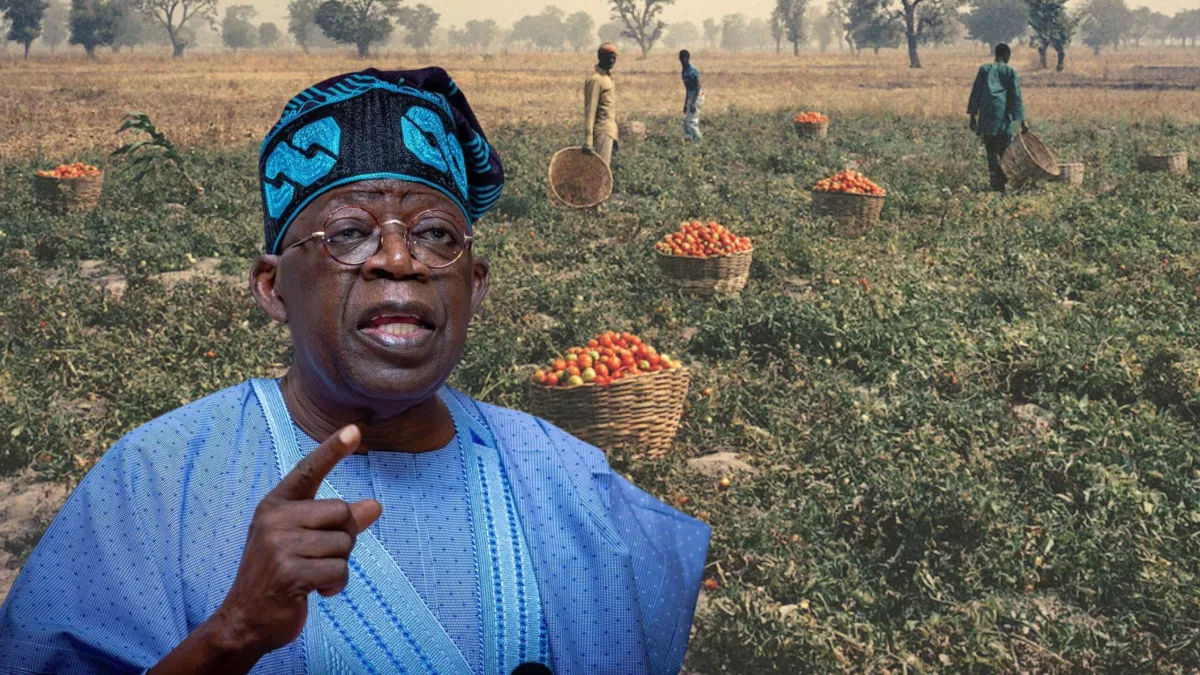
President Bola Tinubu says Nigeria has secured more than 449,000 metric tonnes of fertiliser inputs — enough to produce about nine million bags. He announced this on his X account on Thursday, calling it part of his administration's push to make the country food-secure.
"As of May 2026, more than 449,000 metric tonnes of fertiliser inputs, equivalent to about nine million bags, had been secured, with 10 vessels discharged or in transit," Tinubu wrote.
The president said his government moved early to shield the fertiliser industry from global market shocks. He pointed to the war in the Middle East, which has disrupted supply chains and raised the cost of key raw materials.
Nigeria has struggled for years to get fertiliser to farmers. Rising raw material costs, supply chain problems, and product diversion have limited access for smallholder farmers who produce most of the country's food.
Tinubu said the restructured Presidential Fertiliser Initiative (PFI), now run under the Ministry of Finance Incorporated (MOFI), helped secure critical inputs through forward contracts and better coordination. The initiative began under former President Muhammadu Buhari, who partnered with Morocco in 2016 and Russia in 2019 to revive blending plants and import discounted phosphate.
In 2021, the partnership expanded into a $1.3 billion basic chemicals platform to support local ammonia and fertiliser production. That increased supply and cut costs, but diversion and sabotage in the value chain continued to hurt farmers.
Today, Nigeria has over 90 operational fertiliser blending plants — the largest capacity in Sub-Saharan Africa. Tinubu said this means jobs, local production, and a more resilient food system.
But he acknowledged that securing inputs is useless if the products don't reach farmers on time. So the government launched the Renewed Hope Farm Input Support Programme (RH-FISP) through the National Agricultural Development Fund (NADF).
Under the programme, 515,720 bags of locally produced fertiliser are being distributed to 128,930 smallholder farmers across 25 states and the Federal Capital Territory this planting season. The NADF is also providing digital extension services, harmonised fertiliser application guidance, and targeted support for rice, maize, cassava, and soybean farmers.
Tinubu said strategic contracting for key inputs saved N61.58 billion in 2026 alone, helping keep fertiliser prices affordable for farmers.
The government aims to deliver 1.1 million metric tonnes of fertiliser (about 22 million bags) in 2026.
This push comes as Nigeria's food system faces mounting pressure from recurrent flooding, insecurity in farming communities, and rising transport costs after fuel subsidy removal. The United Nations World Food Programme projects that about 35 million Nigerians will experience acute food insecurity during the 2026 lean season.
Tinubu said his administration identified food security as a central pillar of the Renewed Hope Agenda from the start.
"We promised to support our farmers, strengthen local production, reduce dependence on imports, and build an agricultural system strong enough to withstand shocks from beyond our borders," he said.
- 449,000+ metric tonnes of fertiliser inputs secured (≈9 million bags)
- 10 vessels discharged or in transit as of May 2026
- N61.58 billion saved through strategic contracting in 2026
- 90+ operational blending plants in Nigeria — largest in Sub-Saharan Africa
- 515,720 bags being distributed to 128,930 farmers across 25 states and FCT
- 1.1 million metric tonne target for 2026 (≈22 million bags)
- 35 million Nigerians projected to face acute food insecurity in 2026 lean season