

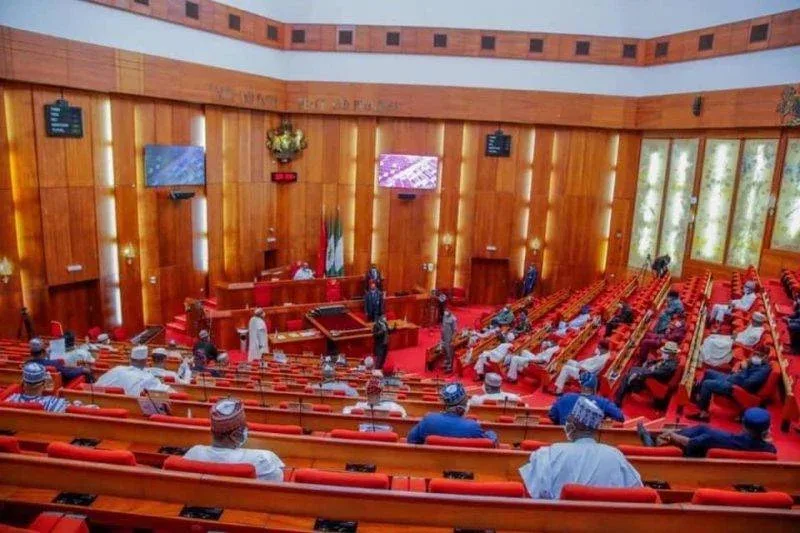
The Senate is currently voting manually on the proposed constitutional amendment seeking the creation of state police across the country. The lawmakers are voting clause by clause on the bill as part of the ongoing consideration of amendments to the 1999 Constitution.
The exercise marks a significant stage in the legislative process aimed at decentralising policing and addressing growing concerns over insecurity in various parts of the country. Several prominent government officials were present in the Senate chamber to observe the proceedings, including the Governor of Kaduna State, Senator Uba Sani; Governor of Ogun State, Prince Dapo Abiodun; Governor of Ondo State, Lucky Aiyedatiwa; and the Chief of Staff to President Bola Tinubu, Femi Gbajabiamila.
The constitutional amendment, if approved by the National Assembly and subsequently endorsed by the required number of state Houses of Assembly, would pave the way for the establishment of state-controlled police forces alongside the Nigeria Police Force.
The Senate’s consideration of the bill comes amid increasing calls for policing reforms and greater involvement of subnational governments in tackling security challenges across the country.
The Senate had earlier adopted manual voting for the consideration of the proposed constitutional amendment on state police after concerns emerged that faulty electronic voting devices could disenfranchise some lawmakers. Under the arrangement, senators were required to stand individually, announce their names and openly declare their positions on the proposed state police framework.
Senate Leader, Opeyemi Bamidele, who moved the motion for the adoption of manual voting, said the procedure was necessary to guarantee transparency and ensure that no senator was excluded from the process. “There is a need to also ensure transparency both within ourselves as people that will be performing this major constitutional responsibility, as well as members of the public.
Rather than go by way of electronic voting, which obviously is not the case today, and disenfranchise a few or so of our colleagues whose machines are not working. I am moving that we give every distinguished senator the opportunity to answer his or her father’s name by doing manual voting,” Bamidele said.
The process would not only prevent any senator from being disenfranchised but would also make each lawmaker’s position on the contentious issue known to constituents.
Meanwhile, the Senate reversed an earlier decision and approved the admission of governors and other senior government officials into the chamber to observe deliberations on the state police bill. The request had initially been rejected after it was subjected to a voice vote. Under Senate rules, only senators are ordinarily allowed on the floor of the chamber, while visitors observe proceedings from the gallery.
Senate President Godswill Akpabio later appealed to lawmakers to reconsider the decision, stressing the importance of allowing key stakeholders to witness the deliberations. Akpabio noted that any constitutional amendment establishing state police would require approval by state Houses of Assembly and argued that governors should be allowed to follow the debate closely.
He also pointed out that the proposal originated from the executive arm of government and that many of the invited guests were executive officials.
Following the appeal, Bamidele moved another motion seeking the suspension of Order 12 of the Senate Rules on floor privileges to admit the visitors as strangers. Deputy Senate President Barau Jibrin supported the motion and commended Akpabio for what he described as his inclusive leadership style.
Jibrin said allowing the governors and senior officials into the chamber would encourage broader participation in discussions on the proposed state police framework.
The Senate subsequently approved the motion, paving the way for the invited officials to witness the clause-by-clause voting on the constitutional amendment bill.
“There is a need to also ensure transparency both within ourselves as people that will be performing this major constitutional responsibility, as well as members of the public.”
Olugbenga Ige Olugbenga Ige is a journalist at Punch Newspapers with over nine years of professional reporting experience. He is known for his sharp eye for compelling stories and a strong instinct for identifying newsworthy developments.
Key Facts
- The Senate is voting manually on the proposed constitutional amendment seeking the creation of state police.
- Several governors and senior government officials are present to observe the proceedings.
- The constitutional amendment would pave the way for the establishment of state-controlled police forces alongside the Nigeria Police Force.
- The Senate had earlier adopted manual voting for the consideration of the proposed constitutional amendment on state police after concerns emerged that faulty electronic voting devices could disenfranchise some lawmakers.
- Senate Leader, Opeyemi Bamidele, moved the motion for the adoption of manual voting, saying the procedure was necessary to guarantee transparency.