

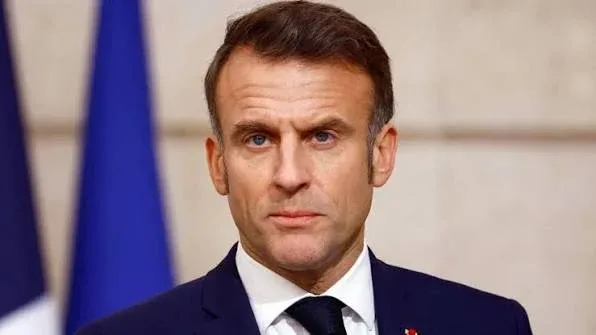
French President Emmanuel Macron on Monday warned Iran against imposing tolls on shipping through the Strait of Hormuz, saying “everything” should be done so fees aren't charged for passage through the key bottleneck.
Iran’s Fars news agency reported earlier that Tehran added a clause on imposing maritime service fees to the framework deal with the United States on ending the Middle East war, shortly before its announcement.
“We defend international law, and we'll do everything in our power to ensure there's no toll,” Macron told TF1 television ahead of the G7 summit in France, set to be attended by US President Donald Trump.
The details of the agreement haven't been disclosed publicly. Macron said the accord had already been signed “electronically” and additional annexes would be “finalised” on Friday.
“I don't want to enter into the details,” he said.
Macron said a joint France-UK mission to ensure the Strait opens was prepared to deploy “very quickly”, with the French flagship aircraft carrier Charles de Gaulle ready to be in the zone “on a timescale of two to three days”.
“We do everything so that this accord is a reality and that Hormuz can reopen,” Macron said. European countries are impatiently awaiting the reopening of the Strait to bring down the price of energy and other goods.
Macron denied that the deal was a victory for Tehran, saying: “I'd be patient and prudent.”
“As you know, we didn't participate in that offensive,” he said, referring to the US-Israeli war against the Islamic Republic.
“So our objective now is the reopening of the Strait of Hormuz. And indeed, there shouldn't be any tolls or anything that would enrich those in power,” he said.
He added that Iran’s stocks of enriched uranium need to be neutralised and placed under the supervision of the UN atomic watchdog.
“We'll ensure that the enriched uranium capabilities that remain are properly neutralised,” Macron said.
The sensitive stocks should be “either taken out, or diluted” and then looked after by the International Atomic Energy Agency”, Macron said.
The Strait of Hormuz is a narrow waterway between Iran and Oman. About 20% of the world's oil passes through it. Iran had closed the strait during the war, sending global energy prices soaring.
For Nigeria, a major oil exporter, the reopening of the Strait could mean lower crude prices, which would reduce government revenue but also lower fuel import costs. The country relies heavily on imported refined petroleum, and high global prices have strained its foreign reserves.
“We defend international law, and we'll do everything in our power to ensure there's no toll.”
— French President Emmanuel Macron