

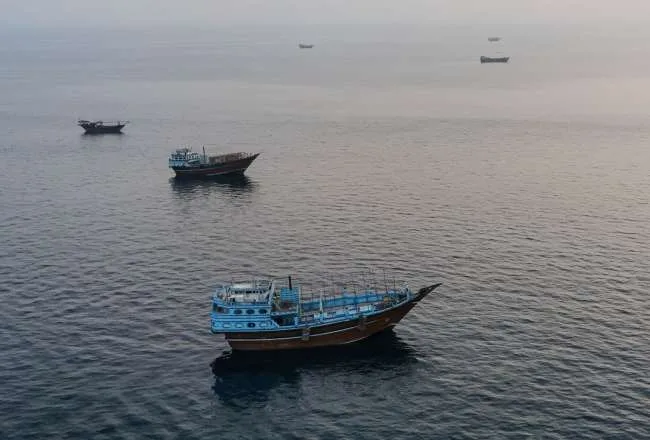
Iran's top diplomat warned Sunday that any attempt by shipping to bypass its preferred route through the Strait of Hormuz will 'increase tensions' in the Middle East, as US and Iranian forces trade attacks across the vital seaway.
This comes as the fragile ceasefire reached in April continues to unravel, with sporadic violence erupting in the Gulf region. Ships passing through the Strait of Hormuz have often been the spark for these exchanges.
US Central Command (CENTCOM) said it had attacked 10 Iranian military targets over 'continued Iranian aggression against commercial shipping'. Iran then said it had carried out retaliatory strikes against US bases in Kuwait and Bahrain in response. Both Kuwait and Bahrain denounced the attacks.
Tehran has continued to insist on controlling passage through the vital strait, through which a fifth of the world's oil and liquefied natural gas travel in normal times. It has insisted that ships transiting the strait pass through a corridor close to its own shores.
But this week, dozens of vessels have travelled along the opposite side of the waterway, hugging the Omani coast. 'Any attempt to adopt new or separate arrangements compared to what is underway by the Islamic Republic of Iran, will only lead to more complicated situations and delays in the reopening of the Strait of Hormuz, and will increase tensions,' Iranian Foreign Minister Abbas Araghchi said.
Iran's Revolutionary Guards said Sunday they were taking measures to control traffic in the strait and that vessels in violation of those measures would be dealt with more firmly than before. Mohammad Mokhber, adviser to Iran's supreme leader, wrote on X that as long as Iran managed the strait, Washington's 'hegemonic dreams in the region will not be realised'.
The memorandum of understanding reached this month aims to put a lasting end to the war launched by the United States and Israel in February. Iran had agreed 'safe passage of commercial vessels with no charge, for 60 days only, from the Persian Gulf to the Sea of Oman, and vice versa' in the strait.
But both countries have since traded accusations of violating their fragile ceasefire. US President Donald Trump said on Saturday that Iran would 'no longer exist' if the US were 'forced' to resume the war.
US President Donald Trump wrote on Truth Social:
'United States aircraft just struck Iranian missile and drone storage locations, and coastal radar sites, for violating the Cease Fire Agreement, AGAIN!'
Lebanon has been drawn into the Middle East war, with Hezbollah launching rockets at Israel in support of Iran. Israel's withdrawal from Lebanon was 'an essential condition for reaching a final and lasting agreement' that establishes security in the region, Iranian foreign ministry spokesperson Esmaeil Baqaei said.
Iran's chief negotiator Mohammad Bagher Ghalibaf said Iran was 'seriously pursuing this issue' of ending the Israeli occupation in Lebanon in a call with Lebanese speaker of parliament Nabih Berri.
Experts said there would likely be more Hormuz incidents. 'A drawn-out negotiation accompanied by controlled pressure in the strait can work to Iran's advantage,' said HA Hellyer, of London think tank the Royal United Services Institute.