

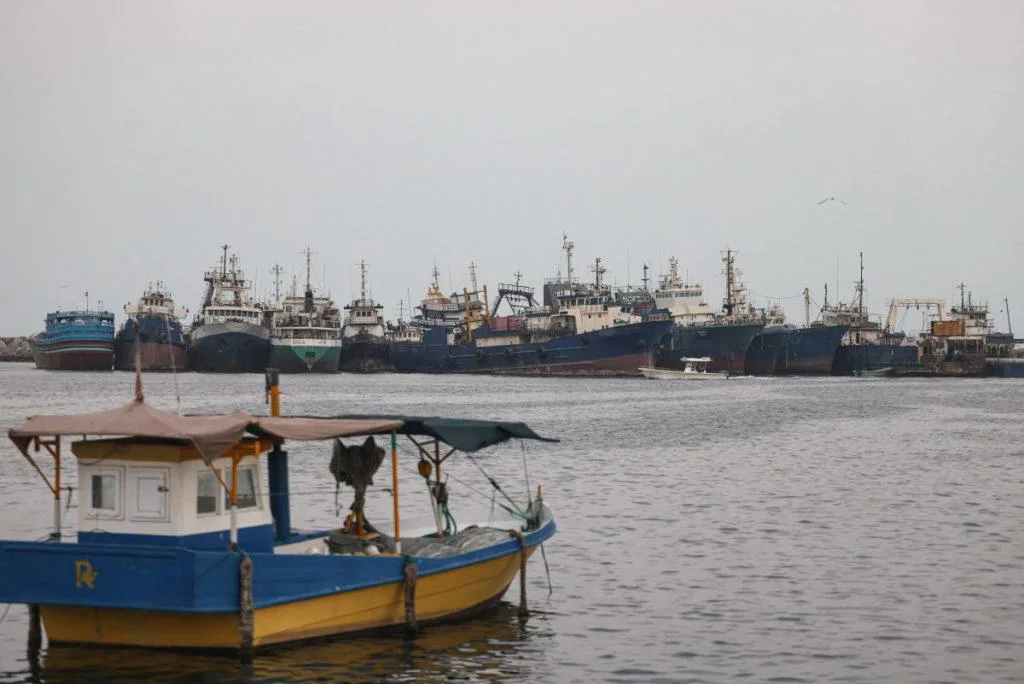
The waters around the Strait of Hormuz have once again become a deadly battleground. On Sunday, Iran announced its forces had attacked an American military drone attempting to enter the strait, just hours after Iran itself targeted three oil tankers. This latest clash marks a serious escalation in the six-month war between Iran and the United States, which shows no sign of ending.
According to a statement from Iran's Islamic Revolutionary Guard Corps (IRGC), carried by state television, the naval forces “attacked an American military unmanned surface vessel” that was trying to get into the Strait of Hormuz. This came after the IRGC had already claimed to have “targeted three oil tankers on the unauthorised route of the Strait of Hormuz and three vessels affiliated with the child-killing America in other areas”. They also issued a warning to all ships to avoid unapproved routes.
The American response came swiftly. US Central Command (CENTCOM) confirmed that on Saturday, they had struck tankers linked to the IRGC, accusing Iran's most powerful military arm of a failed attempt to fire on American warships. CENTCOM announced that after Iran's "failed attacks," they had permanently disabled the IRGC crude oil carriers M/T Downy off Kharg Island and M/T Stark 1 near Jask. Additionally, the unladen crude oil carrier M/T Kylo was completely destroyed in the Gulf of Oman after American forces hit critical locations on the vessel, following orders for the crew to abandon ship.
Video released by CENTCOM dramatically showed massive fireballs erupting as projectiles hit the ships. US officials stated these three vessels were part of a substantial network, valued in the billions, that funds the IRGC and its regional allies. Admiral Brad Cooper, commander of CENTCOM, issued a stern warning: “If you shoot at two of our ships, we will impose an even higher economic cost — taking out three of yours.”
Iran’s foreign ministry decried the US strikes on the tankers, calling them “illegal and aggressive actions.” Correspondents for Iranian state TV reported from Jask and Kharg Island. One tanker was reportedly empty, while another carried oil. Crews from at least one vessel were safely transported to shore via lifeboats, and the attack near Kharg Island caused no casualties, according to reports.
Iran's Khatam-al Anbiya central military command issued a further warning, stating that if the US persisted with its attacks, Tehran's retaliation against US warships would be “more severe than before, and there is a possibility of their expansion.” This escalation comes at a time when the administration of US President Donald Trump has sought to minimize the conflict, especially with midterm elections approaching. Vice President JD Vance has even gone as far as to say he “wouldn’t call it a war,” a sentiment echoed by Trump who recently called the war “small potatoes” for Washington.
Yet, Iran appears to be adopting a more aggressive stance. Iran's Security Chief Mohsen Rezaei warned this week that the Islamic republic had adopted a “new strategy” against Washington that “will shatter your foundations.” The US has been attempting to ramp up pressure on Tehran, aiming to regain control of the Strait of Hormuz, a critical chokepoint through which a fifth of global oil supplies once flowed. A previous ceasefire between the two nations collapsed in July following attacks on commercial ships in the waterway. President Trump has recently made repeated threats to claim sovereignty over the strait, even publishing a map designating it as “new US territory.” Vance has insisted that the US will not resume negotiations with Iran until it ceases attacks on commercial shipping in Hormuz.
The conflict in the Strait of Hormuz, a vital waterway for global energy markets, has been ongoing for six months. It began with a fragile ceasefire collapsing in July after a series of attacks on commercial vessels. The US has imposed extensive sanctions on Iran, aiming to cripple its economy and force its submission. Iran, in turn, has maintained a significant presence and influence in the strategic strait, while the US has implemented a counter-blockade of Iranian ports, creating a dangerous stalemate with escalating consequences.