

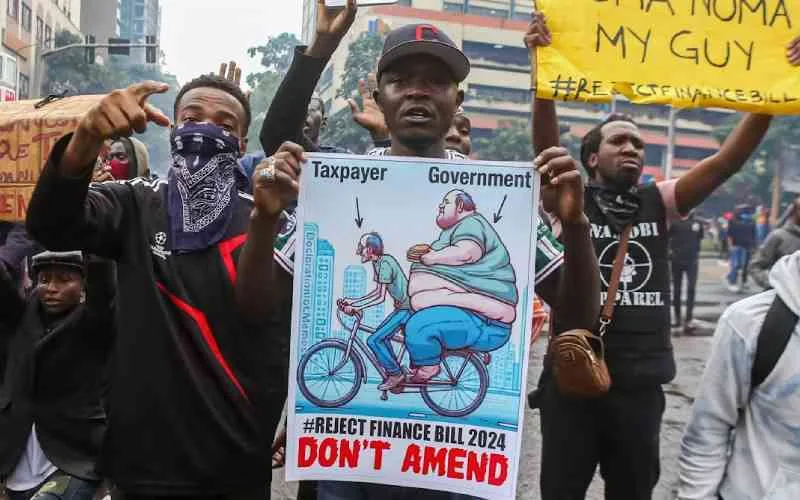
The single sharpest fact in one or two punchy sentences. Who did what, where, when, and why it matters. Not a summary of everything — the one thing that makes someone stop scrolling. A reader who only reads this paragraph must understand what happened. Anti-tax protests that began early June 2026 have engulfed major cities in Kenya, with citizens taking to the streets to express their outrage over the theft of public resources.
The protests, which have become increasingly violent, are also a response to the lavish lifestyles of government officials, who are accused of enriching themselves through corrupt means.
Anti-tax protests that began early June 2026 have engulfed major cities in Kenya, with citizens taking to the streets to express their frustration over the theft of public resources. The protests, which have become increasingly violent, are also a response to the lavish lifestyles of government officials, who are accused of enriching themselves through corrupt means. President William Ruto's government has been criticized for its handling of the economy, with many Kenyans feeling that the wealthy are being protected while the poor suffer.
Kenya's economy has been struggling in recent years, with low economic growth and high levels of unemployment. The country's budget deficit has also been increasing, which has put pressure on the government to find ways to reduce expenditure. Despite these challenges, public servants have been reported to be living lavish lifestyles, with many owning multiple houses, cars, and properties. The protests have also highlighted the perceived inequality in the country, with many Kenyans feeling that the rich are getting richer while the poor are being left behind.
The protests have also raised questions about the government's accountability and transparency. Critics have accused the government of failing to address the corruption and mismanagement that has plagued the country for years. The anti-tax protests, which started in early June 2026, have become a major test of the government's ability to manage the economy and address the concerns of its citizens. The protests have also led to calls for the government to increase transparency and accountability in its handling of public resources.
The Kenyan government has responded to the protests by saying that it is committed to addressing the concerns of its citizens. The government has also said that it is working to reduce corruption and mismanagement in the public sector. However, many Kenyans remain skeptical, with some accusing the government of using the protests as an excuse to increase taxes and reduce public services.
The anti-tax protests in Kenya have been a major focus of international attention, with many organizations and governments around the world calling for greater transparency and accountability in the country. The protests have also raised questions about the role of foreign governments and organizations in promoting good governance and transparency in Kenya.
Key Facts
- The anti-tax protests in Kenya began in early June 2026.
- The protests are a response to the theft of public resources and the lavish lifestyles of government officials.
- The Kenyan government has been criticized for its handling of the economy.
- The country's budget deficit has been increasing, putting pressure on the government to reduce expenditure.
- Public servants have been reported to be living lavish lifestyles.
- The protests have also highlighted the perceived inequality in the country.