

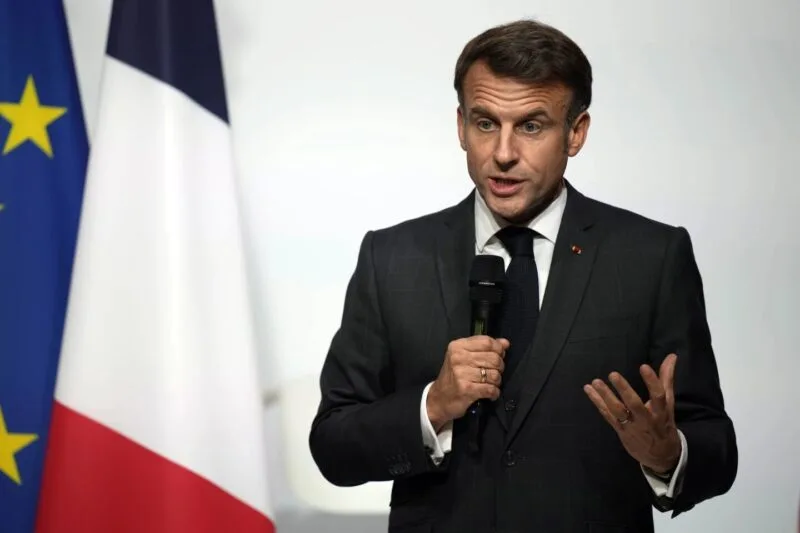
French President Emmanuel Macron has told a high-level conference in Accra that reparations for slavery can't be reduced to financial payments alone — they must also include historical truth, education, memorialisation, and the return of stolen cultural artefacts.
Speaking at the High-Level Consultative Conference on “Next Steps” under the United Nations Resolution on Enslaved Africans on Thursday, June 18, 2026, Macron said meaningful justice must address the lasting legacy of slavery and colonial exploitation.
“History can't be reduced to a simple accounting ledger,” Macron said. “Making reparations is about placing this importance of scientific and historical truth; building monuments, teaching, researching. It means returning the works of art that were stolen during those periods.”
Macron acknowledged that reparations can take different forms, echoing comments made by Ghana’s President John Dramani Mahama on several occasions.
“Reparations, because this is also what it comes down to when we speak of justice, can take different forms as I mentioned several days ago and as John Dramani Mahama has underlined on several occasions.”
He cited France’s ongoing engagement with Haiti as an example of working through the long-term consequences of slavery and colonialism. Haiti was forced to pay France billions in compensation for lost slave “property” after its independence — a debt that crippled the country for generations.
“Reparations also involves the ability to work out situations as we are currently doing with Haiti,” Macron said. “It can be approached from multiple perspectives, but in no case should it be seen as an endpoint, a cheque written to bring the story to a close.”
The French leader stressed that the history of slavery remains a living legacy that demands continued remembrance, dialogue, and action.
“The history will live on and we must continue to bear its names, memories, faces and to make amends, make progress and discuss the future,” he added.
Macron reaffirmed France’s commitment to supporting international efforts on reparative justice, assuring participants: “I'd like to reiterate my commitment to stand with you. You can count on France.”
The conference comes amid growing global calls for reparations, particularly from Caribbean and African nations. Ghana has been at the forefront of the movement, with President Mahama pushing for a comprehensive reparations framework that includes debt cancellation, technology transfer, and the return of looted artefacts.
France holds one of the world’s largest collections of African art, much of it taken during the colonial era. In recent years, Macron has ordered the return of some artefacts to Benin and Senegal, but activists say the pace is too slow and the scope too narrow.
Macron’s speech in Accra signals a shift in France’s position — acknowledging that reparations must go beyond money. But critics note that France hasn't yet made concrete commitments on specific restitution or financial compensation.
The conference continues Friday with delegates expected to draft a roadmap for reparative justice to present to the United Nations.