

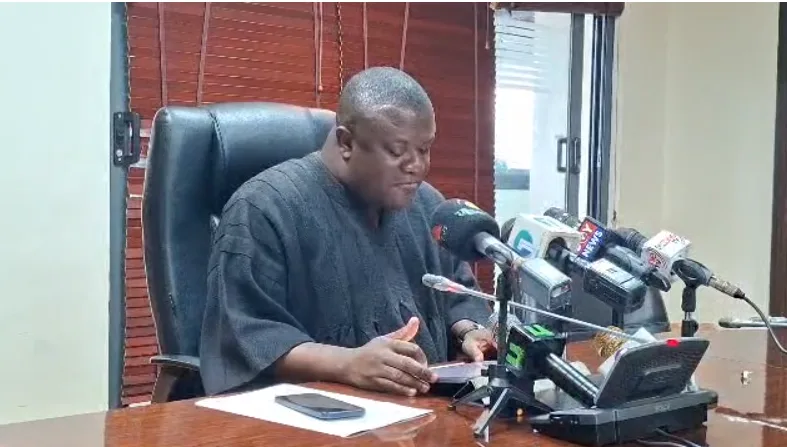
The Minority in Parliament has raised concerns over the continuous increase in utility tariffs, saying that recent economic gains are not translating into lower electricity costs for consumers.
Deputy Ranking Member on the Energy Committee, Collins Adomako-Mensah, addressed the press on Thursday, June 25, pointing out that the government has repeatedly cited the appreciation of the cedi, declining inflation, and lower interest rates as evidence of the country's economic turnaround.
However, Adomako-Mensah argued that such gains should be reflected in a lower cost of living for citizens, particularly in the utilities sector. "If those gains are genuine, Ghanaians should be experiencing them in their daily lives," he said.
The Deputy Ranking Member noted that Ghana's electricity sector is highly sensitive to global commodity prices and foreign exchange movements, given its reliance on thermal generation. "The electricity sector depends heavily on thermal generation, whose principal inputs, imported crude oil and imported natural gas, are priced in foreign currency. A cedi that has appreciated by nearly 40% should significantly reduce the domestic cost of these imports," he stated.
Adomako-Mensah questioned why electricity tariffs continue to rise despite what he described as easing macroeconomic pressures, including falling inflation and lower interest rates. "Falling inflation and easing interest rates should further reduce cost pressures across the economy. Yet the Public Utilities Regulatory Commission is increasing electricity tariffs once again. This contradiction demands answers," he said.
Adomako-Mensah challenged the consistency of the economic narrative being presented, asking what is truly driving the increases. "If the strength of the cedi is real, if the decline in inflation is real, and if the reduction in interest rates reflects genuine macroeconomic improvement, why are utility tariffs continuing to rise? What exactly is driving these increases?" he asked.
According to Adomako-Mensah, the public deserves clearer and more transparent explanations beyond broad economic indicators. "The Ghanaian people deserve more than broad economic headlines. They deserve full transparency. Until that explanation is provided, Ghanaians will be justified in asking whether the celebrated economic gains are being artificially sustained while households and businesses continue to bear the burden of rising utility costs," he said.
Adomako-Mensah stressed that utility pricing should reflect the real state of the economy and urged greater accountability in tariff regulation. "The people of Ghana deserve better. We will continue to demand transparency, accountability, and utility pricing that reflects the true state of the economy," he stated.
The Deputy Ranking Member also criticised what he described as inconsistencies in tariff adjustments, pointing to a recent reduction followed by an increase within a short period. "We therefore say to President Mahama and the NDC government plainly: you cannot celebrate a 4.81% reduction in April and remain silent when a 3.49% increase follows in July. You own this tariff regime. You appointed the leadership of the Public Utilities Regulatory Commission. You set the policy environment. You are accountable for every pesewa increase on every electricity bill in Ghana," he said.
Adomako-Mensah warned that public concerns over utility costs will remain politically significant ahead of the next general election. "The 2028 elections are not far away, and Ghanaians will remember," he said, adding that the people of Ghana deserve better and they will ensure they get it.
He ended with a strong metaphor to underscore his criticism of the tariff regime, saying: "You cannot keep increasing the pressure on the tap and hand Ghanaians a basket to fetch the water; this tariff regime leaks more than it delivers."
The Minority in Parliament will continue to scrutinise tariff decisions and hold the Public Utilities Regulatory Commission accountable for what they described as unjustified increases.