

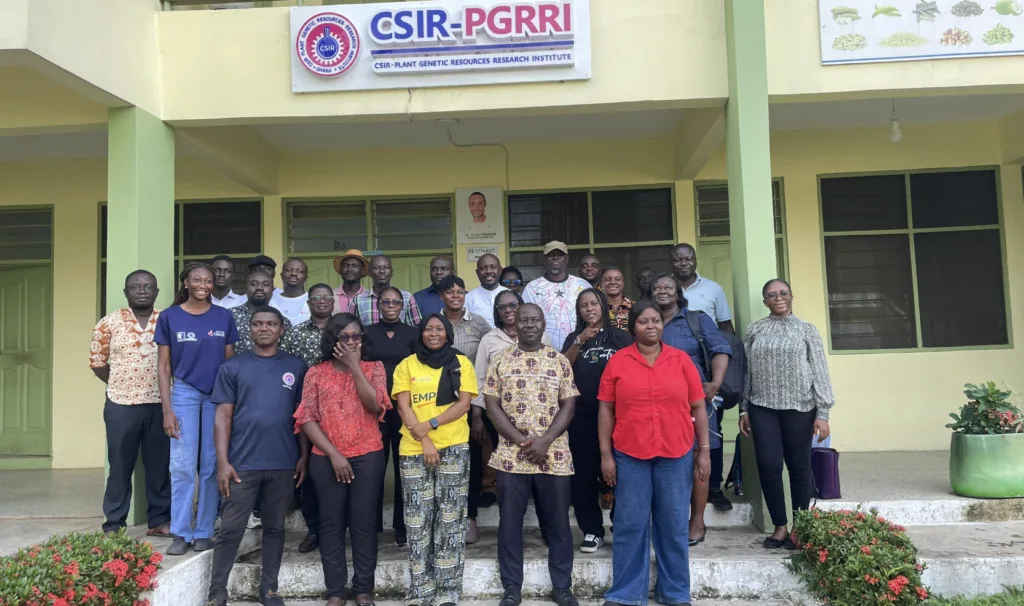
The single sharpest fact in one or two punchy sentences. Who did what, where, when, and why it matters. Not a summary of everything — the one thing that makes someone stop scrolling. A reader who only reads this paragraph must understand what happened.
Ghana has lost about 146 forest tree species that are currently listed as threatened, with scientists warning that the biodiversity loss is driven by illegal mining, deforestation, land degradation, and climate change.
Ghana forms part of the Guinean Forest biodiversity hotspot, one of the world's most biologically significant ecosystems. However, scientists say increasing land-use changes, logging, mining, and human encroachment are eroding that natural wealth.
Dr Edmund Owusu, Senior Research Scientist and Plant Pathologist at CSIR-PGRRI, described the situation as increasingly urgent. "We are losing a lot of our plant genetic resources, especially the indigenous ones," he said. Ghana has about 275 forest reserves, but biodiversity within many of them has declined significantly.
Dr Owusu said conservationists increasingly find themselves collecting and preserving species before they disappear entirely from their natural habitats. "Our approach is that let us salvage and secure them because you'll be fighting over the land and the next time you go, they have graded it and your trees are gone," he said.
In an assessment of the country's conservation challenges, he added: "Laws are not working." To safeguard threatened species, CSIR-PGRRI and IUCN have established a three-acre live threatened tree gene bank at Bunso.
The facility conserves genetic materials from endangered species such as Odum, Wawa, Mahogany, Baku, Kusia, Asanfena, and Cola Boxiana collected from different ecological zones across Ghana. Dr Owusu explained that the objective extends beyond preserving individual trees. "The essence of this gene bank is that it will conserve the diversity we have and when they are mature, they will serve as a seed source for future restoration activities," he said.
And, Dr Matilda Bissah, a Senior Research Scientist at CSIR-PGRRI, said biodiversity loss increasingly threatens food systems, nutrition, and climate resilience. She explained that many neglected and underutilised crops preserved by local communities could help address food insecurity and climate challenges but continue to receive limited policy attention.
The Ghana National Genebank managed by the CSIR-PGRRI in Bunso, currently conserves 81 out of 101 neglected and underutilised crop species identified globally as important opportunity crops. "We need to promote them, we need to get people to utilise them for food, medicine, and income generation," she said.
According to sources, Ghana has been grappling with the issue of biodiversity loss for several years. The Guinean Forest biodiversity hotspot, which covers parts of Ghana, Côte d'Ivoire, Liberia, and Sierra Leone, is one of the most threatened ecosystems in the world.
Scientists and conservationists have been working tirelessly to preserve the remaining biodiversity in the region, but the rate of loss is far outpacing restoration efforts. With Ghana's biodiversity crisis deepening, it is clear that urgent action is needed to protect the country's unique and threatened species.
Key Facts
- Ghana has lost about 146 forest tree species that are currently listed as threatened.
- The Guinean Forest biodiversity hotspot, which covers parts of Ghana, Côte d'Ivoire, Liberia, and Sierra Leone, is one of the most threatened ecosystems in the world.
- Biodiversity within many of Ghana's 275 forest reserves has declined significantly.
- CSIR-PGRRI and IUCN have established a three-acre live threatened tree gene bank at Bunso to conserve genetic materials from endangered species.
- Dr Matilda Bissah said many neglected and underutilised crops preserved by local communities could help address food insecurity and climate challenges.
Biodiversity in Ghana
Ghana has been grappling with the issue of biodiversity loss for several years. The Guinean Forest biodiversity hotspot, which covers parts of Ghana, Côte d'Ivoire, Liberia, and Sierra Leone, is one of the most threatened ecosystems in the world.
Scientists and conservationists have been working tirelessly to preserve the remaining biodiversity in the region, but the rate of loss is far outpacing restoration efforts. With Ghana's biodiversity crisis deepening, it is clear that urgent action is needed to protect the country's unique and threatened species.
CSIR-PGRRI's Conservation Efforts
CSIR-PGRRI and IUCN have established a three-acre live threatened tree gene bank at Bunso to conserve genetic materials from endangered species. The facility conserves genetic materials from species such as Odum, Wawa, Mahogany, Baku, Kusia, Asanfena, and Cola Boxiana collected from different ecological zones across Ghana.
Dr Owusu explained that the objective extends beyond preserving individual trees. "The essence of this gene bank is that it will conserve the diversity we have and when they are mature, they will serve as a seed source for future restoration activities," he said.
And, Dr Matilda Bissah said conservation and utilisation of genetic resources had contributed to strengthening crop resilience and improving livelihoods. She also called for stronger policy coordination to ensure those responsible for environmental destruction bear greater responsibility. "There are no policies that facilitate getting these people to pay for the degradation of the genetic resources they degrade," she said.
Threats to Biodiversity
Ghana's biodiversity crisis is driven by several factors, including illegal mining, deforestation, land degradation, and climate change. According to Dr Owusu, laws are not working to prevent the destruction of Ghana's natural habitats.
The rate of loss is far outpacing restoration efforts, and with Ghana's biodiversity crisis deepening, it is clear that urgent action is needed to protect the country's unique and threatened species.
What's Next
Ghana's biodiversity crisis is a complex issue that requires a comprehensive approach to address. The government, scientists, and conservationists will need to work together to develop and implement effective strategies to protect the country's unique and threatened species.
One key step will be to develop stronger policies that prevent the destruction of Ghana's natural habitats and ensure those responsible for environmental destruction bear greater responsibility. As Dr Bissah pointed out, "There are no policies that facilitate getting these people to pay for the degradation of the genetic resources they degrade," she said.
Blockquote:
"We are losing a lot of our plant genetic resources, especially the indigenous ones," Dr Edmund Owusu said.
>