

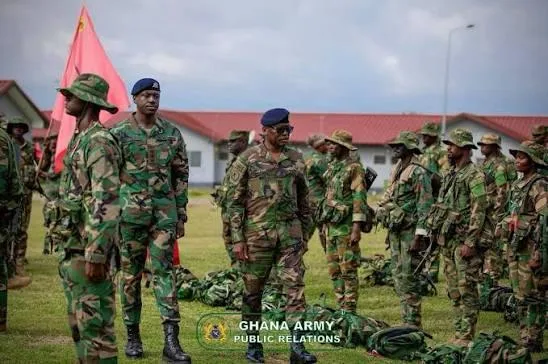
The Ghana Armed Forces have consistently distinguished themselves as one of the nation's most disciplined and dependable institutions.
Ghana's sanitation crisis has persisted for decades despite substantial public expenditure, numerous policy initiatives, and repeated nationwide clean-up campaigns. Across our cities and municipalities, public spaces remain littered with waste, drains are routinely choked with plastic, and government institutions often struggle to maintain basic environmental standards.
The consequences are severe: perennial flooding, sanitation-related diseases, environmental degradation, and significant economic losses. These recurring challenges point to a fundamental truth: the issue is no longer simply one of financing, but of execution, discipline, coordination, and accountability.
The Ghana Armed Forces possess the organizational structure, engineering expertise, logistics capability, transport assets, and nationwide operational presence to execute a public sector waste management programme with consistency and measurable results. They can focus exclusively on government-managed facilities and public infrastructure, including ministries, schools, hospitals, highways, markets, drainage systems, beaches, parks, and other public spaces.
If assigned this responsibility, the Armed Forces will be required to desilt drains routinely, maintaining public health and environmental standards. This initiative will also create a more attractive environment for tourism and investment. Furthermore, it will reinforce civic discipline across the country and elevate sanitation from a routine municipal function to a matter of national strategic importance.
The time has come for bold thinking. A cleaner Ghana requires more than periodic clean-up exercises; it needs an institution capable of delivering sustained results. The Ghana Armed Forces have demonstrated this capability time and again, and entrusting them with public sector waste management could become one of the most transformative public service reforms of our time.
A cleaner Ghana is also a more prosperous one. Effective sanitation can prevent flooding, reduce disease outbreaks, and improve the quality of life for millions of Ghanaians. By assigning the Armed Forces this vital task, the government can create a nation where every individual can thrive without worrying about the health and environmental implications of neglecting public spaces.
The Ghana Armed Forces are already known for their professionalism, efficiency, and commitment to national service. Assigning them public sector waste management responsibilities aligns with their existing strengths. This initiative should not be seen as an opportunity for the military to encroach on civilian duties, but rather as a strategic partnership between the military and the government to address a pressing national issue.
If implemented effectively, the Ghana Armed Forces' sanitation initiative will set a positive example for other governments in the region. By demonstrating the importance of effective sanitation and the need for a coordinated national response, Ghana can establish itself as a leader in sustainability and environmental stewardship.
The government should now consider establishing a formal partnership between the Ministry of Sanitation and Water Resources, the Ghana Armed Forces, and other relevant stakeholders to drive this initiative forward. With the military's expertise and resources, the government can finally address the sanitation crisis that has plagued Ghana for decades.
The public sector waste management programme must be implemented in a way that prioritizes efficiency, effectiveness, and transparency. Regular progress updates and performance metrics will be essential in ensuring that the programme stays on track and meets its goals.
By working together with the Ghana Armed Forces, the government can create a cleaner, healthier, and more prosperous nation for all Ghanaians. It's time to put Ghana's military at the forefront of the sanitation fight.
Key Facts:
- Ghana's sanitation crisis has persisted for decades, despite significant public expenditure and policy initiatives.
- The Ghana Armed Forces have consistently demonstrated discipline, efficiency, and a commitment to national service.
- The government is considering assigning public sector waste management responsibilities to the Armed Forces.
- The programme will focus on government-managed facilities and public infrastructure, including ministries, schools, hospitals, and public spaces.
- The Ghana Armed Forces possess the organizational structure, engineering expertise, logistics capability, transport assets, and nationwide operational presence to execute the programme effectively.
- The programme will address perennial flooding, sanitation-related diseases, environmental degradation, and significant economic losses.
- The initiative will create a more attractive environment for tourism and investment, improving the quality of life for millions of Ghanaians.
- The programme will prioritize efficiency, effectiveness, and transparency, with regular progress updates and performance metrics.