

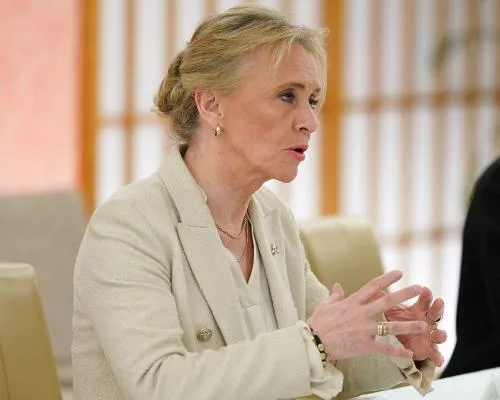
Iceland is staring down an electoral barrel that feels awfully familiar to anyone who watched the chaos unfold in London a decade ago. Foreign Minister Þorgerður Katrín Gunnarsdóttir isn't mincing her words. She's warning that her country is being hit with a wave of misinformation and foreign meddling that smells exactly like the tactics used during the UK's departure from the European Union. She explicitly pointed to the strategy used by Nigel Farage and the Reform party as a blueprint for the current fear-mongering poisoning the public debate. It's a high-stakes moment for the island nation.
A vote set for August 29 will determine whether the government restarts official talks to join the bloc.
"I am fearing that we will face a Brexit moment. That would be, from my point of view, a rather dangerous path because … there were all kinds of lies put forward by the Brexiteers."
The decision to pull the trigger on this referendum caught many off guard, especially since the government had previously suggested waiting until 2027. The shift in timeline was, in no small part, a response to mounting security anxieties regarding the United States. Following aggressive posturing from Washington regarding Greenland—which Iceland sees as a neighbor that shouldn't be bullied—the Icelandic government began looking at its alliances with a much colder eye. Þorgerður insists this doesn't mean the bond with America is broken. It does mean they're looking for more security stability within Europe.
President Halla Tómasdóttir has gone public with concerns that go beyond mere political slogans. She warned that artificial intelligence is now being weaponised to churn out content that looks, sounds, and feels like the truth while being entirely fabricated. The speed at which these AI-generated lies spread is leaving the government struggling to keep up. Hafsteinn Einarsson, an associate professor at the University of Iceland, notes that the country lacks the tools to properly vet this influx of digital garbage. He has personally tested AI models only to find them peddling unverified facts as gospel to anyone curious enough to ask a question.
This isn't just about bots, however; it’s about the very real, very human fear of losing control over the things that make Iceland, Iceland. The fishing industry is the heartbeat of the nation, and it sits at the centre of the "no" campaign. Opponents of the EU bid argue that joining the bloc would see Brussels dictate the rules of the sea, stripping Iceland of its sovereignty over its biggest export. This is an emotive, identity-based argument that cuts much deeper than a simple trade policy.
The math behind this vote is tighter than a pair of skinny jeans. The final outcome remains uncertain. According to a recent poll commissioned by the foreign ministry, 42% of the population wants to return to the negotiation table with the EU, while 39% are dead set against it. This isn't a final vote on membership. If the "yes" side wins, it simply forces the government to resume the talks that were abandoned in 2013.
If a deal is eventually hammered out after those talks, there would then be a second, final referendum to decide whether to actually accept the terms.
Prime Minister Kristrún Frostadóttir has laid down the law. She stated that interference from any major power—be it the US, China, Russia, or even the EU itself—won't be tolerated. The political atmosphere is thick with suspicion. While the government claims they're looking for stability in an unpredictable world, the opposition is using the fear of lost sovereignty to rally voters. It's a classic clash of global ambition versus local tradition, played out against the backdrop of a tech revolution that's making truth harder to find by the day.