

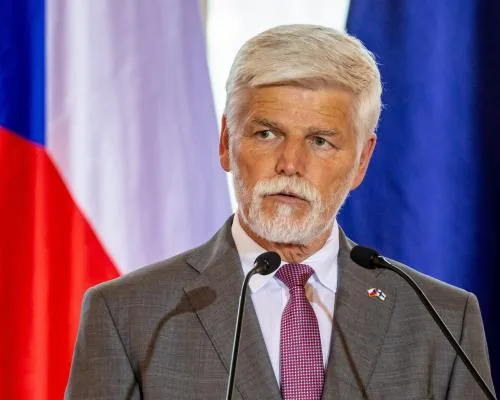
The Czech president, Petr Pavel, has urged Nato to 'show its teeth' in response to Russia's repeated testing of the alliance's resolve on its eastern flank. Speaking to the Guardian in Prague, Pavel called for 'decisive enough, potentially even asymmetric' responses to counter Moscow's provocative behaviour against the alliance. He warned that if Nato doesn't take action, the Kremlin will intensify its actions.
Pavel is a retired general and former chair of the Nato military committee, which makes his defence background rare among European leaders. His years of experience talking to Moscow on the suspended Nato-Russia council have made him an influential voice on the future of the alliance and the threats it faces. He's had a lot of experience dealing with Moscow, and it's given him a unique perspective.
He expressed frustration with 'a lack of determination to keep pushing from the United States on Russia,' although he didn't directly criticize Donald Trump. The US president has been casting doubt on the future of Washington's commitments to the alliance. Pavel has previously told Czech media that 'Trump has done more to undermine the credibility of Nato over the last few weeks than Vladimir Putin has managed to do in many years.' He said this because Trump's actions have been undermining Nato's credibility.
Pavel waved away questions about this comment, saying he didn't think 'any direct criticism of the United States will help at this point.' He focused instead on the need to push Nato members to take a firm line on Russia. After its illegal annexation of Crimea from Ukraine in 2014, Moscow had learned how Nato operated. They'd developed a behaviour style to almost meet the threshold for Article 5, but they always kept it slightly below that level. This means they're trying to provoke Nato without triggering a full response.
Article 5 of the Nato treaty states that an armed attack against one member is considered an attack against all members. Pavel said Russian military leaders laughed at times at the alliance's decision-making paralysis. When he asked them why they did these provocative actions in the air, they said 'because we can.' That's exactly the kind of behaviour they're allowed to get away with, and it's not acceptable. He said this shows that Russia doesn't take Nato seriously.
A Nato jet fighter shot down a drone over Estonia this week. Similar incidents have disrupted everyday life in Latvia and Lithuania. In most cases, the drones are believed to be Ukrainian units targeting Russia that were jammed and redirected towards Nato territory by electronic warfare. Russia also accuses the Baltic states of working with Ukraine to launch drone attacks from their territories, which they strongly deny. They can't just blame others for their actions.
'After the annexation of Crimea, we discussed many times the potential continuation of aggression,' Pavel said. His biggest fear wasn't an open military aggression against a Nato country, but rather a provocation below the Article 5 threshold. If some European leaders always prefer a diplomatic solution, even though Russians show no willingness for it, Nato risks being divided and unable to act. They can't just keep talking and expecting things to get better.
'Russia, unfortunately, doesn't understand nice language,' Pavel said. They mostly understand the language of power, ideally accompanied with action. If violations of Nato airspace continue, they'd have to come to a decision to shoot down either an unmanned or manned aircraft. Pavel said the alliance should also consider 'asymmetric' measures that aren't killing people, but are sensitive enough to make Russia understand this isn't the way they should go. They need to find a way to make Russia listen.
For example, they could switch off the internet or satellites – Pavel saw what a difference Starlink made on the battlefield. They could also cut Russian banks from the financial system. These are the kinds of actions that could make a difference. Pavel isn't suggesting they do this lightly, but they need to consider all options.
Echoing recent warnings from Poland's prime minister Donald Tusk, Pavel said that 'if we don't react to the violations we face today, then Russia would probably step up.' They have a doctrine that says 'escalate to de-escalate,' and Pavel thinks they'll try to escalate things further if they're allowed to. They won't stop until they're stopped.
The EU talked for years about the Russian shadow fleet, but when it finally acted, the fleet was redirected to other regions. Pavel insisted Ukraine needed 'more pressure and determination from the United States.' The US negotiators, Steve Witkoff and Jared Kushner, should probably be tougher on Russia and tie sanctions relief to a potential peace settlement. They can't just keep negotiating without getting anything in return.
He was also critical of Europe's failure to define its policy towards Russia and what a potential post-war security arrangement might look like. Instead, they mostly wait for what comes from Washington. Even the US might be happier with Europe being more active. Pavel believes Europe needs to take a stronger role in defining its own policy.
'If we don't come up with our own proposals, then we look weak or disoriented,' Pavel said. He believed the best moment to push Russia more would have been last year when it was struggling economically and militarily. However, the US-Israeli war on Iran has helped Moscow by increasing its oil revenues. Russia remains in a difficult position, though, and Europe and the US should make 'a final push' on sanctions to force it to a negotiating table. They can't give up now.
'If you want to get rid of sanctions, which they want, and if you want to start a debate about European security, which you indicated a number of times, we're ready for it,' Pavel said. However, the condition is clear – ceasefire and negotiation on peace in Ukraine. They can't just keep fighting and expecting things to get better.
Domestically, Pavel is locked in a bitter constitutional dispute with the populist Czech prime minister, Andrej Babiš, whom he defeated in the presidential race in 2023. The dispute is over who should represent the country at the upcoming Nato summit in Ankara. The latest clash follows a series of disagreements with the government, including over his refusal to appoint a controversial coalition politician as a minister. This brought thousands of Czechs out on to the streets to voice their support for Pavel in February. They're standing behind him.
But despite critics accusing him of acting as an opposition figure before a possible re-election campaign in 2028, Pavel insists the disagreement is 'a matter of principle' on the president's role. He'd be prepared to go to the constitutional court if needed. 'I believe there's still room for compromise, which I offered to the prime minister,' he said. He proposed attending informal debates at the summit while leaving it to the government to take part in discussions on defence spending. They can work together to find a solution.
An avid biker and rock music fan, Pavel joked at a public meeting last month that if he were excluded from the meeting, he could go to a ZZ Top concert in Pardubice instead. However, he'd gladly miss it to attend the summit. He's committed to his role as president.
Key Facts
- Czech President Petr Pavel urged Nato to 'show its teeth' in response to Russia's provocations.
- Pavel called for 'decisive enough, potentially even asymmetric' responses to counter Moscow's behaviour.
- He expressed frustration with the US's lack of determination to push Russia.
- Russia has developed a behaviour style to almost meet the threshold for Article 5, but always keeps it slightly below that level.
- A Nato jet fighter shot down a drone over Estonia this week.
- Pavel believes the best moment to push Russia more would have been last year when it was struggling economically and militarily.