

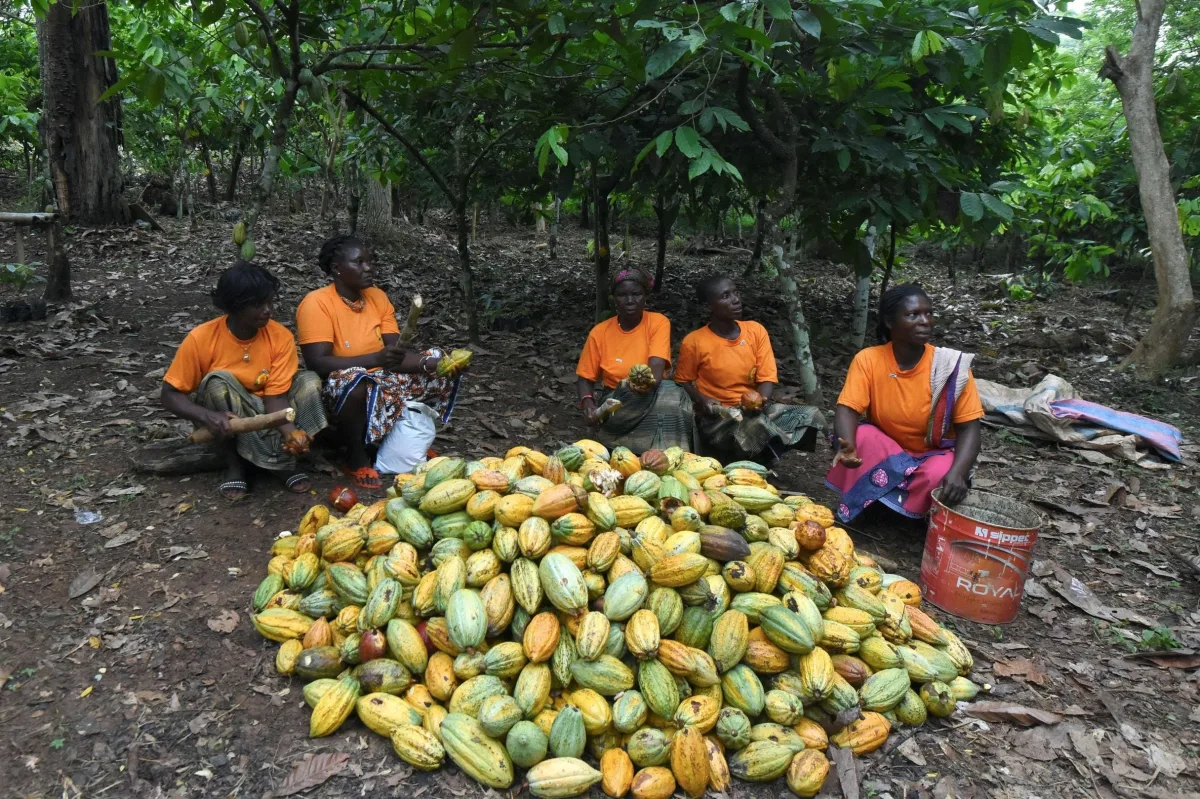
Cocoa production is becoming increasingly volatile, even as the chocolate industry attempts to be more sustainable. Western and central African countries, such as Ivory Coast, Ghana, Nigeria, and Cameroon, could lose up to 50% of land suitable for cocoa farming by 2050 due to climate change. This drastic loss won't just affect the countries' economies, but it'll also impact the global chocolate market.
Droughts, unseasonal rains, and harsh winds have affected yields across key cocoa-growing regions globally in the last few years. The crop's prices have eased somewhat from the significant shortages seen in 2024, but they haven't returned to normal yet. Chocolate prices remain high, reflecting a fundamental strain on the market. It's clear that climate change is taking a toll on cocoa production, and it's affecting the chocolate industry as a whole.
At the same time, chocolate brands are trying to improve transparency by focusing more on sustainability, ethical sourcing, and traceability. They're doing this because more consumers now care about fairer labor practices and accountability across industries. Julia Ocampo, vice president of Cacao Sourcing and Sustainability at Luker Chocolate, notes that "for producers, climate change isn't a future risk; it's directly affecting farmer productivity and livelihoods." Climate change is no longer something that might happen - it's happening now, and it's impacting cocoa farmers' lives.
Cocoa is one of the world's most climate-sensitive crops. It can be heavily impacted by irregular rainfall patterns, extreme heat, or changing wind conditions. The crop is mainly grown at a commercial scale in developing nations near the equator, known as the "cocoa belt", like Ivory Coast, Ghana, and Ecuador. These countries don't have the resources to deal with the impacts of climate change, and that's why they're struggling to maintain their cocoa production.
In 2023, Western African cocoa-producing giants like Ivory Coast, Ghana, Nigeria, and Cameroon saw very high levels of rainfall and flooding. This led to rotten cocoa pods and widespread outbreaks of diseases like Cocoa Swollen Stem Virus and black pod, because of waterlogging. On the other hand, in early 2024, extreme droughts worsened by El Niño and unprecedented heatwaves took over in these regions. The region's climate is becoming more unpredictable, and that's making it harder for farmers to grow cocoa.
"There is a growing generational challenge," Ocampo noted. "The average age of a cocoa farmer is above 55 years old, so in many cocoa-growing regions, younger generations are reluctant to stay in farming; they view it as physically demanding, low-paying, and unattractive." Young people don't want to be cocoa farmers because they don't see a future in it. They're looking for better-paying jobs that aren't as physically demanding.
Chocolate companies are trying to be more sustainable, with initiatives like mapping supply chains from farm to bar to support transparency. Brands like Barry Callebaut and Cargill employ GPS polygon mapping, which uses satellites to track cocoa bags from individual farms all the way to processing warehouses. They're using technology to make their supply chains more transparent. This way, they can see where their cocoa is coming from and ensure that it's being sourced sustainably.
However, despite these efforts, cocoa farmers, especially smallholders, are still under considerable climate stress, which isn't adequately addressed by the current industry model. Systemic climate degradation is consistently being treated as a short-term "bad harvest" problem, rather than a structural economic crisis. The industry isn't taking a long-term view of the problem - it's just trying to fix the symptoms, not the root cause.
Many sustainability initiatives only address visible issues like deforestation, without recognizing them as symptoms of much larger, more deeply embedded systemic issues, such as long-term farmer poverty, climate vulnerability, and fundamentally inadequate incentive structures. They're not looking at the bigger picture - they're just trying to solve one problem at a time. The industry needs to take a more holistic approach to sustainability.
To address the root cause of farmer poverty, chocolate companies need to support cocoa farmers in climate-exposed regions to switch to breeding and planting hybrid cocoa varieties which are more drought-resistant. They also need to establish fair and long-term contracts that move beyond unpredictable and short-term premiums. Farmers need help to adapt to the changing climate, and they need fair contracts that'll help them make a living.
In the next few decades, cocoa production may also move more towards countries like Cameroon and Nigeria, which are expected to fare a little better than West African countries like Ivory Coast and Ghana in terms of climate change. As such, a key way chocolate companies can future-proof supply chains is by helping more vulnerable producers move farms now, rather than later. They can't just wait and see what happens - they need to take action now.
Accelerating climate change has revealed that chocolate can be ethically sourced, but still deeply structurally vulnerable. Chocolate companies must move beyond sustainability initiatives which mainly prioritize transparency and ethics to resilience investments which focus on climate survival and agricultural stability. They need to invest in resilience, not just sustainability. This means they need to help farmers adapt to the changing climate and ensure that their supply chains are stable.
- Western and central African countries may lose up to 50% of land suitable for cocoa farming by 2050
- 99.9% of all cocoa comes from countries with low climate readiness
- The average age of a cocoa farmer is above 55 years old
- Cocoa production is becoming increasingly volatile due to climate change. It's a complex problem that won't be easy to solve, but it's clear that the industry needs to take action now to ensure its survival.