

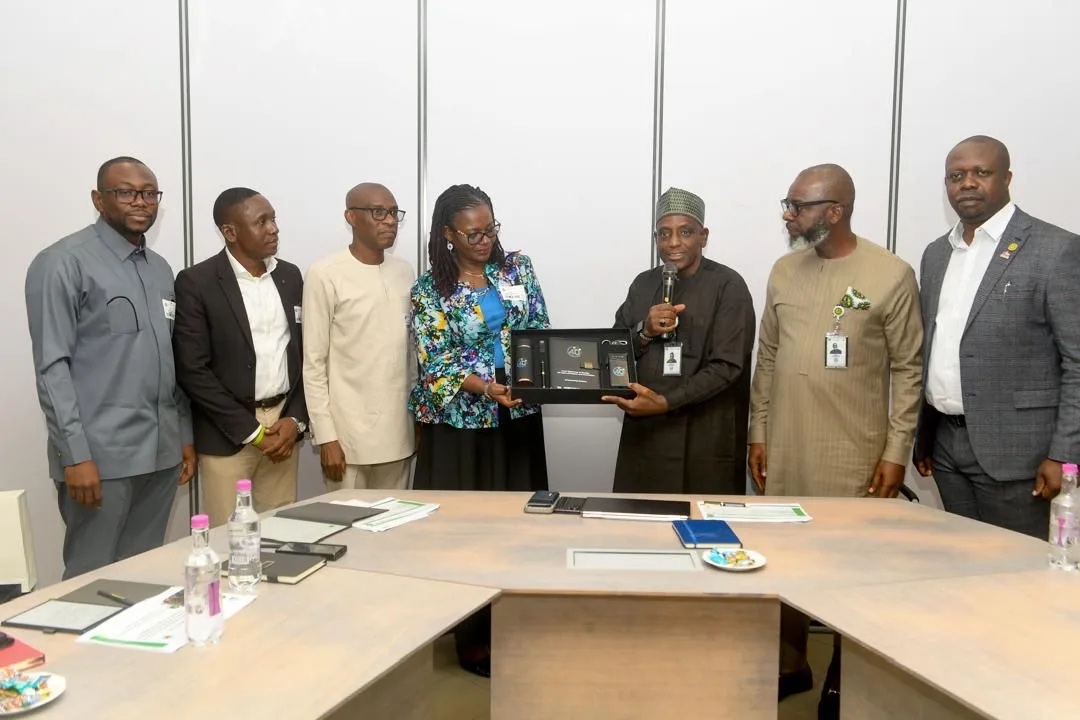
A delegation from the Ghana National Petroleum Corporation (GNPC) has spent this week inside the Nigerian Content Development and Monitoring Board (NCDMB) headquarters in Yenagoa, Bayelsa State, learning how Nigeria pushed local participation in its oil industry to 61%.
The visit, which began Monday, is a benchmarking study focused on policy frameworks and implementation strategies. The GNPC team is led by its Director of Corporate Affairs, Mr. Eric Pwadura.
Welcoming them, NCDMB Executive Secretary Engr. Felix Omatsola Ogbe — represented by Director of Corporate Services Dr. Abdulmalik Halilu — made a blunt point: Africa holds over 120 billion barrels of crude oil reserves and 800 trillion standard cubic feet of gas, more than 10% of global hydrocarbon resources. Yet producing countries still depend on foreign technology for exploration and production.
He described crude oil as a commodity for economic transformation and pointed out that Africa's huge youth population must be trained for industry operations.
Ogbe walked the visitors through Nigeria's local content journey. It started as a small division inside the defunct Nigerian National Petroleum Corporation (NNPC), operating through mere policy directives. Today, it's a full institution — the NCDMB — with legal backing from the Nigerian Oil and Gas Industry Content Development (NOGICD) Act of 2010.
“We've evolved from a policy to an institution,” he said.
The Board introduced a Nigerian Content 10-Year Strategic Roadmap built on five pillars: Technical Capability Development, Compliance and Enforcement, Enabling Business Environment, Organisational Capability, and Sectoral and Regional Markets. Five enablers support them: Funding, Regulatory Environment, Collaboration and Stakeholder Engagement, and Research and Development.
One key tool is the Nigerian Content Intervention Fund (NCI Fund), operated through the Bank of Industry (BOI) and Nigerian Export-Import Bank (NEXIM). It provides single-digit loans to local service companies. “What we've done is to create that access to make the local service companies competitive,” Ogbe explained. The fund has helped indigenous firms acquire critical assets, including marine vessels.
But building capacity isn't enough — it must be used. So the Board gives first consideration to indigenous companies that can prove they have the capability. Ogbe also stressed a non-negotiable principle: “Local content doesn't compromise standards… It doesn't mean you have African spec, European spec. It's one global spec.”
Dr. Zuwairat Asekome, Assistant Manager in NCDMB's Strategy and Transformational Projects unit, presented the roadmap's highlights. She traced the Board's growth from the 2010 Act through successive stages of policy implementation and monitoring to today, when in-country value addition in the oil and gas industry stands at 61%.
Mr. Pwadura responded with gratitude. “Even though we have the legislation guiding local content, we haven't had the benefit of having a robust local content environment like you have,” he said. He noted that GNPC's own local content efforts lack the institutional depth Nigeria has built.
The visit shows that other African oil producers are watching Nigeria's model closely. Ghana, which started commercial oil production in 2010, has struggled to increase local participation in its upstream sector. The GNPC delegation's week-long tour suggests Accra is serious about closing that gap.
For Nigeria, the attention is a validation of a two-decade experiment. The country moved from a policy office in NNPC to a standalone board with enforcement powers, a dedicated fund, and a strategic roadmap. The 61% local content figure — up from single digits in the early 2000s — is the number the Ghanaians came to understand.