

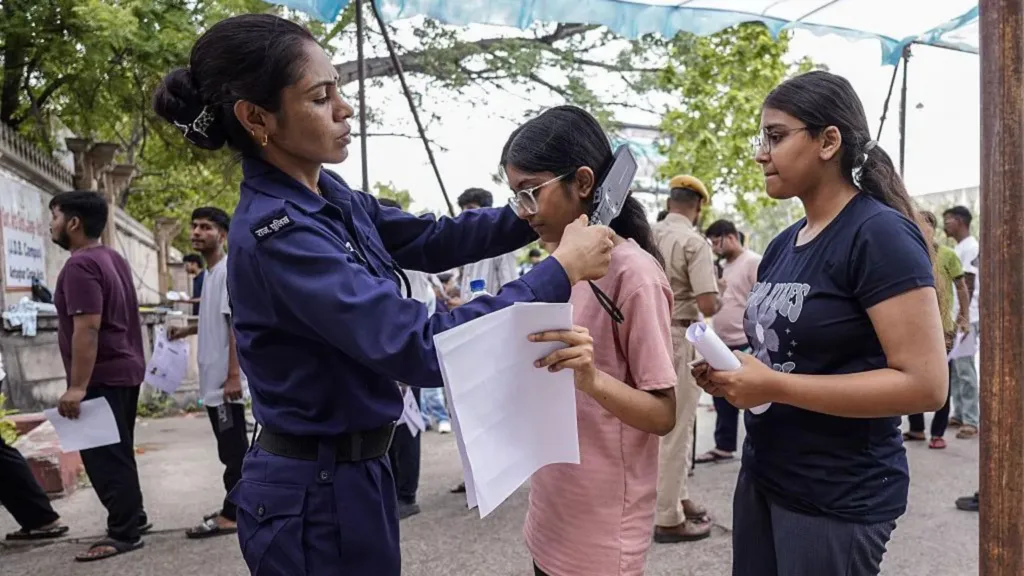
Millions of hopeful Indian medical students are resitting a crucial exam after the first paper was cancelled following allegations of a major leak. The Indian Air Force transported the new test papers to some regions, while police and paramilitary officers were deployed at the 5,440 exam centres across the country.
The National Eligibility cum Entrance Test (Undergraduate), known as NEET-UG, is required for students to join medical colleges in India. Of the millions who take the exam every year, only a small percentage do well enough to secure a coveted college placement. Nearly 2.28 million candidates sat the exam on 3 May, having studied for months – in some cases years – for the notoriously difficult paper.
The news that it had been scrapped was devastating for many students, and the scandal sparked widespread protests and demands for Education Minister Dharmendra Pradhan to resign. He did not, and told students before Sunday’s exam: “Sit fearlessly, without worry, and you will definitely do well.” The National Testing Agency (NTA) said every exam room, of which there were more than 95,000, had been fitted with security cameras, and that more than 1.3 million cameras in total had been installed.
It added that 51,311 jammers were being used to block phone signals and electrical interference. Telegram has been temporarily blocked until Monday, over concerns the messaging app could be used for cheating. Nearly 39,000 frisking staff had been employed across the country to check for any prohibited items, the NTA said, and there would be 40-50 security personnel stationed at every exam centre.
The exam runs for three hours and 15 minutes, and has 180 questions on physics, chemistry, and biology. Many students have private tutoring to help improve their performance in the test, but its difficulty level, paired with how competitive it is to get a college placement, has seen India’s organised crime networks take the opportunity to profit from exam fraud.
The leak allegations have been handed over to India’s Central Bureau of Investigation (CBI). It is not the first time the country has faced serious claims of exam cheating and irregularities. In 2024, the same medical test was hit by allegations of paper leaks, fraud, and irregularities in the awarding of grace marks, triggering nationwide protests after thousands of candidates received unusually high scores.
Despite the heightened security, some students said they were still worried things could go wrong again. “There is fear because the [exam] paper has leaked once already. This is not a one-off thing, it happens every year,” one student, who gave their name as Diksha, told Reuters.
“This time [the authorities] got to know about it and are holding the exam again, which is in a way a good thing because the students who worked hard should get fair results. But to study and prepare again in one month… to stay consistent is difficult.” The exam is seen as a major hurdle for students aspiring to become doctors in India.
As education minister, Dharmendra Pradhan was previously the junior education minister from 2014 to 2016. He has been facing pressure to resign over the alleged NEET-UG paper leak. The controversy has sparked nationwide protests and demands for the education minister to step down.
In an effort to prevent cheating, the National Testing Agency (NTA) has taken unprecedented measures to secure the exam. Every exam room has been fitted with security cameras, and over 1.3 million cameras in total have been installed. Jammers have been used to block phone signals and electrical interference.
With the exam being rescheduled, many students are left feeling anxious. “To study and prepare again in one month… to stay consistent is difficult,” one student told Reuters. The NEET-UG exam is a major hurdle for students aspiring to become doctors in India.
The NEET-UG exam is held annually to assess students' eligibility for medical colleges in India. Only a small percentage of students who take the exam are able to secure a coveted college placement.
Key Facts
- Nearly 2.28 million candidates sat the exam on 3 May.
- Over 5,440 exam centers were set up across the country.
- More than 1.3 million cameras were installed at exam centers.
- 51,311 jammers were used to block phone signals and electrical interference.
- Telegram has been temporarily blocked until Monday.