

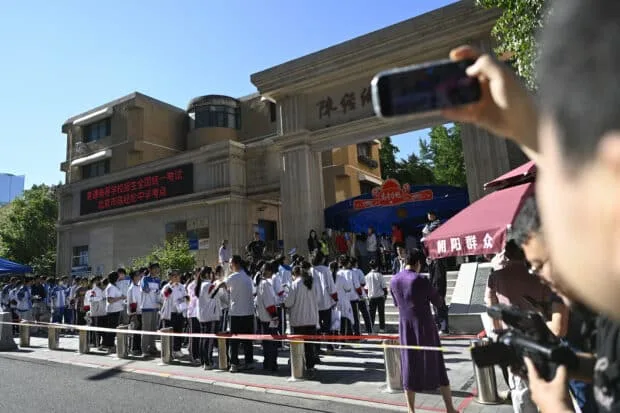
Millions Clutch Pens in Beijing as Gaokao Exam Begins
Hundreds of young Chinese students swarmed the testing centre in blue-skied Beijing, clutching their pens and IDs. This was the first day of the 'gaokao' exam, a multi-day high-stakes university entrance test that determines admission for most Chinese students. Around 12.9 million students nationwide have registered for this year's gaokao, according to the Ministry of Education.
The gaokao is a national exam that includes five core subjects: Chinese, mathematics, English, science, and the humanities. Test-takers will be grilled for hours, and their scores will be released later this month. The exam is a determining factor in university admissions, with some students relying heavily on their results to secure a spot at their preferred institution.
"It's my first time, so I'm a bit nervous," said one student, who preferred to remain anonymous. "I've been studying for months, and I hope I do well."
The 'gaokao' originated in the 1950s, but it has undergone significant reforms in recent years to make the exam more inclusive and fair. Changes were made to reduce bias and increase opportunities for students from all backgrounds.
Nationwide Registration and Preparation
The 12.9 million students registered for the gaokao represent nearly the entire country's 13.3 million high school graduates this year. The gaokao's massive scale has sparked heated debates about the exam's relevance and fairness. Some argue that the gaokao puts too much pressure on students, with many schools prioritizing test preparation over other aspects of education.
Others claim that the exam is biased towards students from wealthier families, who have access to better resources and tutors. The perception that the gaokao favors the privileged is fueling discussions about education reform and equality.
Chinese Education System Under Scrutiny
China's education system has come under fire in recent years due to its emphasis on rote memorization and standardized testing. Critics argue that this approach stifles creativity and critical thinking, leading to a generation of students who are well-versed in exams but lack real-world skills. Many educational experts recommend a shift towards more comprehensive and holistic learning.
The gaokao's high stakes have also led to a growing number of students seeking external help, including private tutors and online courses. This has created a multibillion peso industry catering to students desperate to pass the exam, with many families feeling pressure to invest in test prep.
The Gaokao's Impact on Graduates
The gaokao's results will be announced later this month, and the top performers will have their pick of universities across the country. However, many students who don't make the cut will face a bleak job market, with limited opportunities for those who don't attend university.
As one student put it, "If I don't get into a good university, my parents will be disappointed, and I'll feel like I've failed." The pressure is intense for these 12.9 million students as they sit for the gaokao, hoping to secure their future in a highly competitive job market.
"I don't think the gaokao is perfect, but it's the best system we have right now," said a Ministry of Education spokesperson. "We're always looking for ways to improve it and make it more inclusive."