

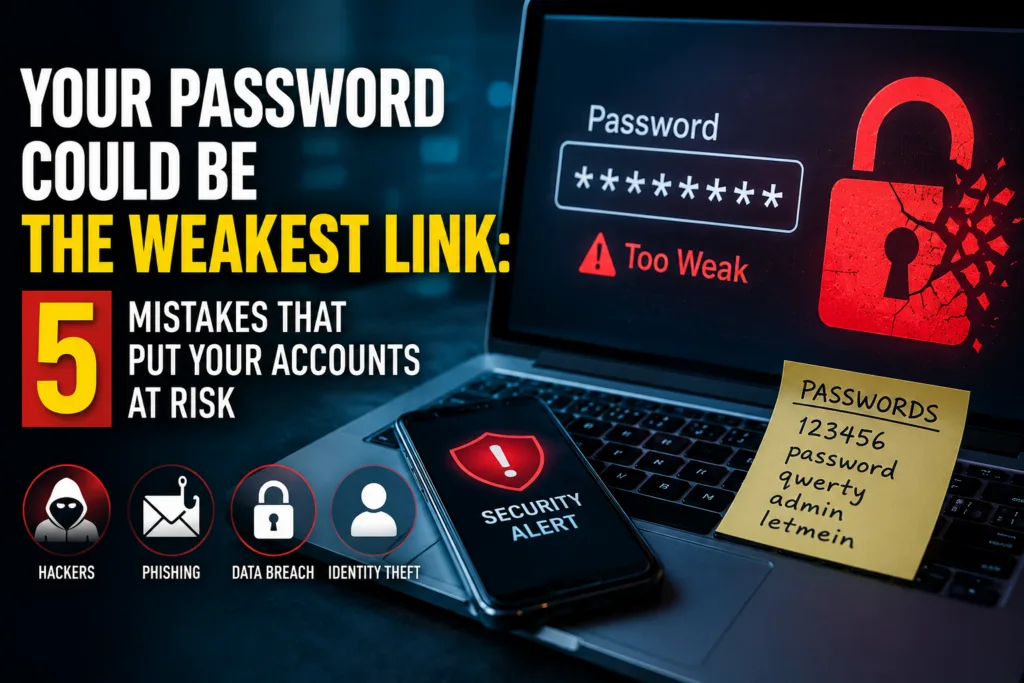
As a cybersecurity professional, Kennedy Bentum Jnr, a Master of Science in Forensic Accounting from the University of New Haven, knows that passwords are often the weakest link in our online security.
Imagine waking up one morning to find that your email account has been hacked, and your social media accounts have been taken over. Friends and family are calling to ask why you're asking for money through WhatsApp. Your online banking profile has been locked because of suspicious login attempts. It sounds like a movie plot, but for many people, this is exactly how cybercrime begins.
But it's not because hackers are sophisticated; it's because they used an easy-to-guess password, stolen through deception, or reused across multiple accounts. In reality, passwords protect our bank accounts, emails, cloud storage, social media profiles, and even government services. Yet, despite their importance, people underestimate the role passwords play in keeping them safe online.
One of the biggest mistakes people make is reusing passwords across multiple accounts. Using the same key for your house, office, car, and safe is not a good idea. If someone gets hold of that key, they gain access to everything. The same principle applies online.
Cybercriminals use techniques such as phishing emails, fake login pages, malicious software that records keystrokes, and databases of passwords leaked during previous breaches. They also use credential stuffing, an automated method of testing stolen usernames and passwords across multiple websites. In many cases, the attacker succeeds because the victim unknowingly made the job easier.
But there are simple habits that can protect you from cybercrime. Improving your online security doesn't require a lot of technical expertise. A long passphrase made up of unrelated words is more difficult to guess than a short password. Enabling multi-factor authentication (MFA) is also an effective security measure. It requires a second form of verification, such as a code sent to your phone or generated by an authenticator app.
Sharing passwords with others and not changing compromised passwords are also major mistakes. Never change your password until you're sure that your account has been compromised. If you reuse passwords, change all of them at the same time.
You should use a different password for each account and make them all unique. If one website suffers a data breach and your password is exposed, you can test if the same password works on other sites you have an account on.
You can also use tools to generate strong and unique passwords for each of your accounts. Consider enabling two-factor authentication, where possible, to add an extra layer of security.
But don't let this stop you from using passwords at all. In fact, passwords are still the primary method of securing most online accounts. Biometric features often unlock your device, but behind the scenes, passwords remain the primary method of securing online accounts.
If you have reused your password or use weak passwords, you should change them immediately. Use a tool to generate strong and unique passwords for each of your accounts. By following these simple habits, you can protect yourself from cybercrime and stay safe online.
"In an age where our lives are increasingly connected to the internet, passwords have become the digital keys to our identities. They protect our bank accounts, emails, cloud storage, social media profiles, and even government services."
You should also avoid using passwords that are easy to guess, such as your name, birthday, or common words.
If you have any questions about passwords or want to know more about how to stay safe online, you can visit the website of Kennedy Bentum Jnr, a cybersecurity professional with years of experience.
### Simple Tips to Improve Your Password Security:
- Use a different password for each account and make them all unique
- Make your passwords strong and unique by using a passphrase of at least 12 characters
- Use two-factor authentication (MFA) whenever possible
- Avoid using common words or your name
- Regularly change your password for your online accounts
In conclusion, passwords play a significant role in keeping you safe online. Don't underestimate their importance, and don't make the common mistakes that hackers use to get into your accounts. By following these simple habits, you can protect yourself from cybercrime and stay safe online.
### Key Facts:
- Passwords protect your bank accounts, emails, cloud storage, social media profiles, and even government services
- Using the same password for multiple accounts is a major mistake
- Cybercriminals use techniques such as phishing emails, fake login pages, and databases of leaked passwords to steal your information
- Enabling multi-factor authentication (MFA) is an effective way to add an extra layer of security to your accounts
- Regularly change your password for your online accounts to prevent hacking