

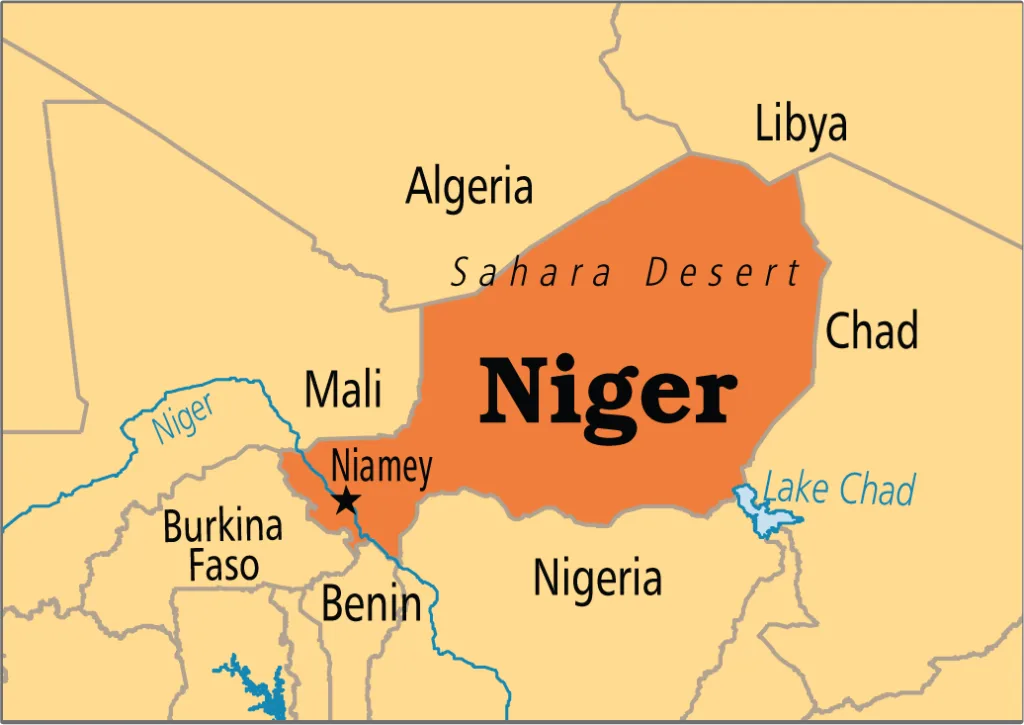
Gunfire and explosions shook Niamey, Niger’s capital, on Saturday morning. Heavy shooting was reported around Base 101, a military facility near the city's international airport. This base has already faced two jihadist assaults this year, underscoring the persistent security crisis plaguing the West African nation. Residents heard the sounds of sporadic small arms fire in the western part of the city around 5:00 am local time.
The origins of the latest outbreak of violence aren't clear, and authorities haven't released an official statement. However, several witnesses, including a local journalist who captured video footage, confirmed intense gunfire and explosions at Base 101. The shooting reportedly began around 1:00 am local time and continued intermittently until daybreak. Social media platforms were flooded with posts documenting the unrest, particularly in the administrative district. This district is where key government buildings like the presidential palace and the national television station are located.
Armoured vehicles were observed reinforcing the area near the airport, a common response to heightened security threats.
Niger has been under the rule of a military junta led by General Abdourahamane Tiani since July 2023. Tiani’s regime has been battling a decade-long jihadist insurgency that has severely impacted the country. This latest incident highlights the junta’s ongoing struggle to pacify the nation and secure its borders from extremist groups.
Base 101 is a particularly sensitive site. It was targeted in January by the Islamic State in the Sahel (EIS). It was targeted again in late June by its rivals, the Group for the Support of Islam and Muslims (JNIM), which is the Sahel branch of Al-Qaeda. The January attack saw 20 assailants killed and four soldiers wounded, according to official figures at the time. General Tiani himself acknowledged a "flaw in the system" that allowed the attack.
He stated its aim was to cripple the army's air capabilities.
The June assault resulted in the deaths of at least 11 soldiers and two civilians, along with 22 attackers. Both incidents were ultimately repelled by the Nigerien army. The competition for dominance between EIS and JNIM is a significant factor in the region's instability. Both groups actively operate in Niger as well as neighbouring Burkina Faso and Mali.
These three nations, all currently governed by military juntas that came to power through coups, have formed the Alliance of Sahel States. In a significant geopolitical shift, they've collectively withdrawn from the Economic Community of West African States (ECOWAS). They've also distanced themselves from traditional Western allies, particularly France, in their security cooperation. Instead, they've sought closer ties with Russia, though this realignment hasn't yet yielded a decisive improvement in security.
Air Force Base 101, located within the international airport complex, isn't only a key military asset. It also hosts the headquarters of Niamey's Russian Africa Corps partners. It also houses the command of the unified force for the Alliance of Sahel States. The base's strategic importance is further underscored by a large shipment of uranium concentrate that was temporarily stored there between December and January, awaiting export. No movement of this shipment has been detected since, adding another layer of complexity to the situation at this crucial location.
Niger, along with its neighbours Burkina Faso and Mali, has become a focal point for jihadist activity. This draws the attention of international powers seeking influence in the strategically important Sahel region. The ongoing violence and the political instability are closely watched by regional blocs and global powers alike.