

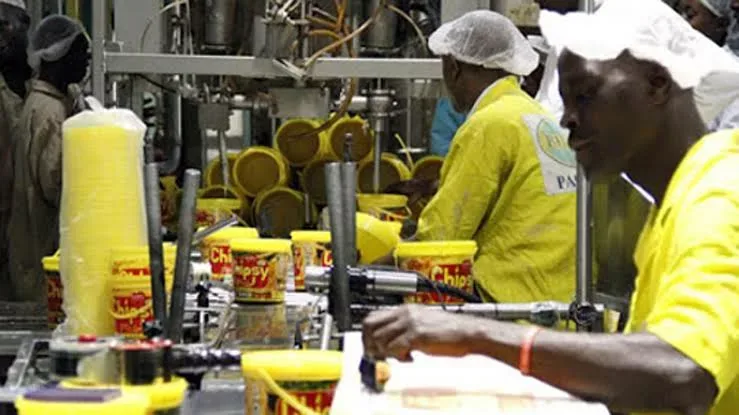
The sharp increase in credit and production costs is threatening the recovery of the manufacturing sector in Nigeria. The Manufacturers Association of Nigeria (MAN) has revealed that the high cost of credit and rising production expenses remain major challenges to the sector's recovery, despite a renewed improvement in manufacturers' confidence in the economy.
Manufacturers identified limited access to finance as their primary challenge, with two in every three executives citing commercial bank lending rates as a major disincentive to manufacturing productivity. They also described the volume of credit available to the sector as inadequate. The manufacturers linked the high cost of borrowing directly to the Central Bank of Nigeria's (CBN) monetary policy stance, particularly the Monetary Policy Rate (MPR), which stood at 26.5 per cent during the quarter.
The prevailing high-interest-rate regime has increased the cost of credit and, by extension, production costs, weakening manufacturers' ability to expand output, invest, and create jobs. The CBN's monetary policy stance has been a major concern for manufacturers, who believe that the current high-interest-rate regime is unsustainable and needs to be reduced.
According to the Manufacturers CEOs Confidence Index (MCCI) for the second quarter of 2026 (Q2'26), the high cost of credit has also led to a rise in production, distribution, and shipping costs. Despite the challenges, the report noted that manufacturers' confidence rose by 3.4 points to 52.1 in Q2'26 from 48.7 in Q1'26, driven largely by expectations of better business conditions rather than a significant improvement in the actual operating environment.
Looking ahead, manufacturers were more optimistic about the third quarter, projecting business conditions at 55.6, employment at 55.2, and production conditions at 63 points. Director General of MAN, Segun Ajayi-Kadir, called on CBN to reduce the MPR to below 20 per cent to unlock manufacturing growth, improve access to affordable credit, and give priority allocation of foreign exchange to manufacturers.
'Reducing financing and production costs was critical to converting the renewed confidence among manufacturers into actual increases in output, investment, and employment,' he stressed.
The projected improvement would depend largely on policy implementation and measures to ease the cost of doing business. Segun Ajayi-Kadir emphasized the need for the CBN to rethink its monetary policy stance and prioritize the needs of the manufacturing sector.
The report further showed that despite reforms in the foreign exchange market and relative stability in the naira, about half of the manufacturers surveyed said improvements in foreign exchange sourcing had not translated into sufficient access to foreign exchange for their operations. This has limited their ability to operate at full capacity and raised the cost of imported inputs and machinery.
Only 27 per cent of manufacturing executives considered government expenditure on infrastructure encouraging for manufacturing activity, reflecting concerns over the slow impact of public infrastructure investments on productivity. The report noted that manufacturers continued to face rising production, distribution, and shipping costs during the quarter, even as sales volume recorded a modest improvement.
Manufacturers' confidence rose by 3.4 points to 52.1 in Q2'26 from 48.7 in Q1'26, driven largely by expectations of better business conditions rather than a significant improvement in the actual operating environment. The improvement was largely driven by expectations of better business conditions rather than a significant improvement in the actual operating environment.
The Manufacturers Association of Nigeria (MAN) has warned that the high cost of credit and rising production expenses remain major challenges to the sector's recovery. The high cost of borrowing directly linked to the CBN's monetary policy stance, particularly the MPR, has weakened manufacturers' ability to expand output, invest, and create jobs.
Manufacturers are calling on the CBN to rethink its monetary policy stance and prioritize the needs of the manufacturing sector. The CBN's monetary policy stance has been a major concern for manufacturers, who believe that the current high-interest-rate regime is unsustainable and needs to be reduced.
The report noted that manufacturers continued to face rising production, distribution, and shipping costs during the quarter, even as sales volume recorded a modest improvement. Despite the challenges, manufacturers were more optimistic about the third quarter, projecting business conditions at 55.6, employment at 55.2, and production conditions at 63 points.
The report further showed that manufacturers continued to face frequent power outages, inadequate foreign exchange supply, high production costs, shortages of raw materials, multiple taxation, and inadequate government infrastructure. These challenges have limited manufacturers' ability to operate at full capacity and raised the cost of imported inputs and machinery.