

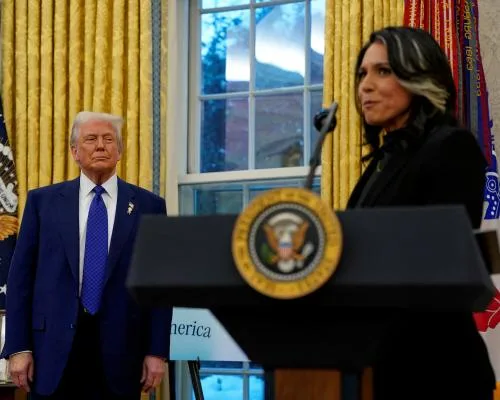
Tulsi Gabbard is resigning as the US director of national intelligence, effective June 30. This move comes after a tumultuous stint in which she was largely sidelined by President Donald Trump. She didn't have the typical background for the role, and her foreign policy views differed from Trump's, particularly on overseas military intervention.
Gabbard, a former Democrat, tried to ingratiate herself to the president by vowing to root out politicization across US spy agencies and embracing his agenda of election denial. She didn't have an intelligence background, which made her an unconventional choice for the role. Her foreign policy views also clashed with Trump's, especially when it came to overseas military intervention.
In a letter to the US president, Gabbard stated that her husband, Abraham, has been diagnosed with a rare form of bone cancer. She added that she must step away from public service to support him through this battle. However, sources familiar with the issue claim that the White House forced Gabbard to resign. They're saying that the White House didn't give her a choice, and she had to leave.
Gabbard wrote in her resignation letter, "While we have made significant progress … I recognize there is still important work to be done." She's acknowledging that there's more to do, but she won't be the one doing it.
Gabbard became increasingly sidelined by the president, who excluded her from key national security conversations on Iran and Venezuela. Trump was even asking cabinet members last month whether he should replace Gabbard, according to two people briefed on the discussions. They're saying that Trump didn't think Gabbard was doing a good job, and he was considering replacing her.
The president announced Gabbard's resignation on his Truth Social platform, stating that she has done an incredible job, and we will miss her. He's praising Gabbard's work, but it's not clear if he's being sincere. He also announced that Aaron Lukas, the principal deputy director of national intelligence, would serve as acting director of national intelligence. Lukas will take over Gabbard's responsibilities, at least for now.
Tulsi Gabbard's tenure as the US director of national intelligence was marked by controversy, particularly regarding her views on overseas military intervention. Her resignation may have significant implications for the US intelligence community and its relationship with the White House. The US intelligence community relies on the director of national intelligence to provide accurate and unbiased information. Gabbard's resignation may create a power vacuum, allowing other officials to fill the gap and potentially influencing the president's decisions on national security matters.
As the US faces growing tensions with countries like Venezuela and Iran, the role of the director of national intelligence is crucial in providing the president with accurate and unbiased information. The director of national intelligence plays a critical role in shaping the president's decisions. Gabbard's resignation may create a power vacuum, and it's not clear who will fill the gap. The White House hasn't commented on the allegations that Gabbard was forced to resign. However, the incident highlights the ongoing tension between the president and the intelligence community, which has been a recurring theme throughout Trump's administration.
Gabbard's resignation also raises questions about the future of the US intelligence community and its ability to provide unbiased information to the president. The US intelligence community is facing challenges, and Gabbard's resignation won't make things easier. As the country navigates complex geopolitical relationships, the role of the director of national intelligence will be critical in shaping the president's decisions. The director of national intelligence must provide accurate and unbiased information, and it's not clear if the next director will be able to do that.
In related news, Dr. Nicole Saphier, Trump's nominee for surgeon general, has been criticized for selling dietary supplements that contain an ingredient prohibited by the US military. This controversy has raised concerns about the nominee's ability to provide unbiased advice on public health matters. The nominee's actions are being scrutinized, and it's not clear if she'll be able to provide unbiased advice. The US military prohibits the use of certain ingredients, and Saphier's supplements contain one of them.
The US is also facing pressure on the economic front, with the Federal Reserve under pressure to cut interest rates. Kevin Warsh, the newly sworn-in chair of the US Federal Reserve, will play a crucial role in steering the country's economy amidst growing concerns about Americans' financial wellbeing. The Federal Reserve is facing challenges, and Warsh will have to make tough decisions. He'll have to balance the need to cut interest rates with the risk of inflation, and it's not clear what he'll do.
Key Facts
- Tulsi Gabbard is resigning as US director of national intelligence, effective June 30.
- Gabbard cited her husband's health as the reason for her resignation.
- Sources claim that the White House forced Gabbard to resign.
- Aaron Lukas will serve as acting director of national intelligence.
- The US is facing growing tensions with countries like Venezuela and Iran.
The resignation of Tulsi Gabbard as the US director of national intelligence is a significant development that may have far-reaching implications for the US intelligence community and its relationship with the White House. The US intelligence community is a complex institution, and the director of national intelligence plays a critical role. As the country navigates complex geopolitical relationships, the role of the director of national intelligence will be critical in shaping the president's decisions. The next director will have to provide accurate and unbiased information, and it's not clear who that will be.
In the coming weeks and months, it will be essential to monitor the developments in the US intelligence community and the White House's response to Gabbard's resignation. The appointment of a new director of national intelligence will be closely watched, and their ability to provide unbiased information to the president will be critical. The US intelligence community is facing challenges, and the next director will have to address them. The White House's response to Gabbard's resignation will also be important, and it's not clear what they'll do.
The US intelligence community is a complex and multifaceted institution that plays a critical role in providing the president with accurate and unbiased information. The director of national intelligence is responsible for overseeing the entire intelligence community, which includes agencies like the CIA, NSA, and FBI. The director of national intelligence must coordinate the efforts of these agencies and provide the president with the information needed to make informed decisions. It's a tough job, and it's not clear who will do it next.
As the US faces growing threats from countries like Venezuela and Iran, the role of the director of national intelligence will be crucial in providing the president with the information needed to make informed decisions. The director of national intelligence must provide accurate and unbiased information, and it's not clear if the next director will be able to do that. The US intelligence community is facing challenges, and the next director will have to address them. The White House's response to Gabbard's resignation will also be important, and it's not clear what they'll do.
The controversy surrounding Dr. Nicole Saphier's nomination as surgeon general has also raised concerns about the ability of the Trump administration to provide unbiased advice on public health matters. The sale of dietary supplements containing an ingredient prohibited by the US military has sparked criticism, and it's not clear how the nominee will respond to these concerns. The nominee's actions are being scrutinized, and it's not clear if she'll be able to provide unbiased advice. The US military prohibits the use of certain ingredients, and Saphier's supplements contain one of them.
The resignation of Tulsi Gabbard as the US director of national intelligence is a significant development that may have far-reaching implications for the US intelligence community and its relationship with the White House. The US intelligence community relies on the director of national intelligence to provide accurate and unbiased information. The next director will have to provide that information, and it's not clear who that will be. The appointment of a new director of national intelligence will be closely watched, and their ability to provide unbiased information to the president will be critical in shaping the country's national security policies. The US intelligence community is facing challenges, and the next director will have to address them.