

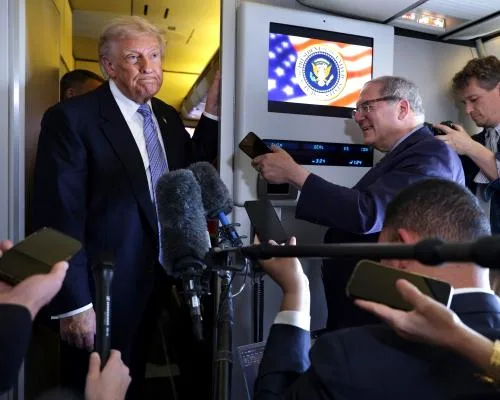
The justice department announced on Monday that it's creating a $1.776bn fund to compensate Donald Trump's allies as part of a settlement in which Trump and his sons dropped a $10bn lawsuit against the IRS. This move has raised eyebrows, with critics calling it a slush fund. They're concerned that it won't be transparent.
Donald Trump, the President of the United States, and his sons had filed the lawsuit against the IRS. The lawsuit was related to the leak of Trump's tax returns to ProPublica and the New York Times by an IRS contractor, Charles Littlejohn. The settlement money will be overseen by five commissioners. Four of them will be appointed by the attorney general and can be removed by Trump. The fifth commissioner will be appointed in consultation with congressional leadership.
The fund also has the power to issue formal apologies. It will send a quarterly report to the US attorney general outlining who's been paid from the fund. According to a memo from Todd Blanche, the acting US attorney general, once the funds are deposited into the designated account, the United States won't have any liability for the protection or safeguarding of those funds. There don't appear to be any restrictions on who can seek compensation from the fund. This means that anyone can apply for compensation.
The machinery of government should never be weaponized against any American, and it's this Department's intention to make right the wrongs that were previously done while ensuring this never happens again, said Todd Blanche. As part of this settlement, we're setting up a lawful process for victims of lawfare and weaponization to be heard and seek redress. We're committed to making things right.
As part of the settlement, Trump will also drop claims for monetary damages against the government for a raid on Mar-a-Lago. He'll also drop claims related to the investigation into Russian meddling in the 2016 election. The Monday announcement came just two days ahead of a 20 May deadline. The judge overseeing the case had asked the parties for briefing on whether a legitimate controversy existed. This is a requirement for any lawsuit, especially since Trump controls the IRS.
The judge needed to know if there was a real controversy.
Ninety-three congressional Democrats, including Hakeem Jeffries, a Democratic leader of New York, filed an amicus brief with the court on Monday. They're saying that such a claim would be illegal. They argue that trying to hide this deal from the courts is corruption in plain sight. Trump is funneling taxpayer dollars to his political allies, and they'll hold him accountable. They'll block this billion-dollar giveaway at a time when Americans are already squeezed by inflation, said Andrew Warren, deputy legal director at the Democracy Defenders Fund.
He's concerned about the impact on taxpayers.
The settlement comes after US district judge Kathleen Williams, a Barack Obama appointee overseeing the case, appointed a group of lawyers to advise her. They were to determine if there was sufficient controversy in the case to proceed. Those attorneys filed their brief last week. They noted that there were numerous potential defenses the justice department could offer to push back against Trump's claims. There's reason to believe that the president is, in fact, exercising his control over the defendants in this litigation, they wrote.
They're questioning Trump's motives.
Watchdog groups have pledged they'll challenge the legality of any settlement. Any settlement would be outrageously unethical and likely a violation of the constitution's domestic emoluments clause, said Donald Sherman, the president and CEO of Citizens for Responsibility and Ethics in Washington (Crew). This case was always a sham, and another ploy by the President to access taxpayer funds to line his pockets. The justice department needs to explain themselves here – because there's no legal authority for this settlement, said Skye Perryman, president and CEO of Democracy Forward, another watchdog group. They're demanding answers.
- The justice department is creating a $1.776bn fund to compensate Trump allies.
- The fund will be overseen by five commissioners, four of whom will be appointed by the attorney general and removable by Trump.
- The settlement comes after Trump dropped a $10bn lawsuit against the IRS.
- Trump will also drop claims for monetary damages against the government for a raid on Mar-a-Lago and the investigation into Russian meddling in the 2016 election.
- Ninety-three congressional Democrats have filed an amicus brief with the court saying such a claim would be illegal.
Trump's decision to drop the lawsuit and create the fund has sparked controversy. The outcome of this settlement is uncertain, and it's likely to be challenged in court. For now, it's clear that Trump's allies will be benefiting from the $1.7bn fund. The question on everyone's mind is, what does this mean for the future of the IRS and the government's ability to investigate Trump and his allies? They're wondering if the government can still hold Trump accountable.
As the story continues to unfold, the settlement has raised more questions than answers. It's not just the settlement that's raising questions; it's also the fact that Trump is using taxpayer dollars to compensate his allies. Many are wondering if Trump is using the government for his own personal gain. This question will likely be answered in the coming days and weeks as the settlement is challenged in court. The court will have to decide if the settlement is legal.
The decision will have significant implications for the government and the IRS. It's a complex issue that requires careful consideration. The outcome is uncertain, but one thing is sure: the settlement will be closely watched.