

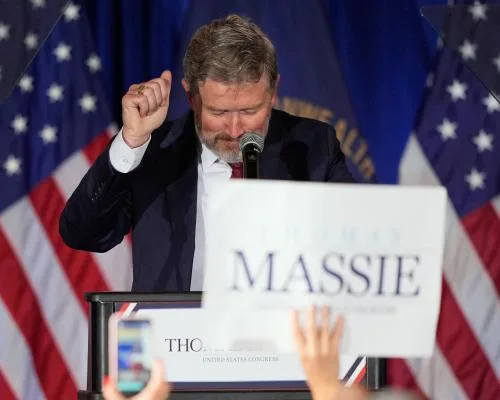
In a shocking turn of events, Donald Trump's grip on the Republican party has tightened further after Thomas Massie, a Republican congressman from Kentucky, was defeated in the state's primary election. Massie, who had been a thorn in Trump's side due to his independent stance on several issues, lost to Ed Gallrein, a retired Navy SEAL and Trump's endorsed candidate. Trump's endorsement of Gallrein was a significant factor in the election, and it's clear that it played a major role in Gallrein's victory.
Gallrein won the election with 55% of the vote, while Massie secured 45%. This outcome is a significant blow to Massie, who had been a vocal critic of Trump's policies, including his stance on the war in Iran and the release of the Epstein files. Massie had also opposed Trump's signature tax bill, which had put him at odds with the president. He didn't back down from his criticisms, even when it became clear that Trump was actively working against him.
The election was one of the most expensive House primaries in US history, with over $32 million spent by both candidates. Trump had actively campaigned for Gallrein, calling on voters to reject Massie and support his endorsed candidate. In a series of posts on Truth Social, Trump praised Gallrein's victory, saying that it marked a major milestone in his campaign to consolidate power within the party. He's been working to oust dissenting Republican incumbents, and his efforts have been successful in several states.
Trump's efforts to consolidate power within the party have been successful in several states, including Indiana and Louisiana. This trend has raised concerns among some Republicans, who fear that Trump's influence could lead to a purge of moderate voices within the party. They're worried that Trump's grip on the party will ultimately prove to be a curse, rather than a blessing. It's clear that Trump's influence is going to be felt in several key races.
As the Republican primary season continues, Trump's influence is likely to be felt in several key races. In Georgia, for example, Trump has endorsed Burt Jones, the lieutenant governor, in his bid for the governor's seat. Jones will face off against Rick Jackson, a healthcare billionaire, in a runoff election on June 16. The outcome of this election won't be clear until the votes are counted, but it's likely to be a close race.
The Democratic primary in Georgia, on the other hand, was relatively tame, with former Atlanta mayor Keisha Lance Bottoms winning the nomination for governor. Bottoms, who was endorsed by former President Joe Biden, will face off against the Republican nominee in the general election. She's got a tough road ahead of her, but she's confident that she can win.
In other news, federal agents have raided the homes of three immigration activists in southern California, accusing them of intimidating and harassing Immigration and Customs Enforcement (ICE) agents. The activists, who are part of the group VC Defensa, have denied the allegations, saying that they're being targeted for their work in supporting immigrant families. They don't think they've done anything wrong, and they're demanding that the charges be dropped.
The raids have sparked outrage among immigrant rights groups, who say that they're an attempt to intimidate and silence activists who are critical of the Trump administration's immigration policies. The incident has also raised concerns about the use of federal agents to target activists and suppress dissent. It's a dangerous trend, and it's not clear where it will end. The activists are worried that they'll be next, and they're calling for an investigation into the raids.
In a related development, Cuban American lawmakers have called for the indictment of Raul Castro, the former Cuban leader, for his role in the shooting down of civilian aircraft 30 years ago. The incident, which killed three Americans, led to a longstanding embargo on Cuba, which remains in place today. The lawmakers think that Castro should be held accountable for his actions, and they're pushing for justice.
The move to indict Castro is seen as a further escalation of the Trump administration's campaign against Cuba, which has already led to the imposition of economic sanctions and travel restrictions. Trump has repeatedly threatened to topple the Cuban government if diplomacy fails, and the indictment of Castro is likely to further strain relations between the two countries. It's a complex situation, and it's not clear how it will play out.
Key Facts
- Trump's endorsed candidate, Ed Gallrein, defeats Thomas Massie in Kentucky's Republican House primary
- The election was one of the most expensive House primaries in US history, with over $32 million spent
- Trump has been actively working to oust dissenting Republican incumbents, with successes in several states
- The Democratic primary in Georgia was relatively tame, with former Atlanta mayor Keisha Lance Bottoms winning the nomination for governor
- Federal agents have raided the homes of three immigration activists in southern California, accusing them of intimidating and harassing ICE agents
'There is a yearning in this country for somebody who will vote for principles over party,' Massie said in his concession speech. 'If the legislative branch always votes whichever way the wind is blowing, then we have mob rule,' he added. Massie didn't mince words, and he made it clear that he's not going away. He's still got a lot to say, and he's going to keep saying it.
The outcome of the election has significant implications for the Republican party, which is struggling to maintain unity in the face of Trump's increasingly divisive influence. The party is at a crossroads, and it's not clear which direction it will take. It's clear that Trump's grip on the party will have significant implications for the future of American politics. The party's future is uncertain, and it's going to be shaped by the events of the next few months.
The incident has also sparked a debate about the role of federal agents in targeting activists and suppressing dissent. The use of federal agents to intimidate and silence critics is a worrying trend, and it's not clear where it will end. As the use of federal agents to target activists becomes more widespread, concerns are growing about the erosion of civil liberties and the potential for abuse of power. It's a complex issue, and it needs to be addressed.
In the coming weeks and months, it's going to be important to monitor the situation closely, as the implications of these events continue to unfold. The Republican party is facing a critical moment, and the direction it takes will have significant implications for the future of American politics. The party's leadership is going to be crucial in shaping its future, and it's not clear who will emerge as the leader. The next few months will be crucial, and they'll determine the course of the party's history.