

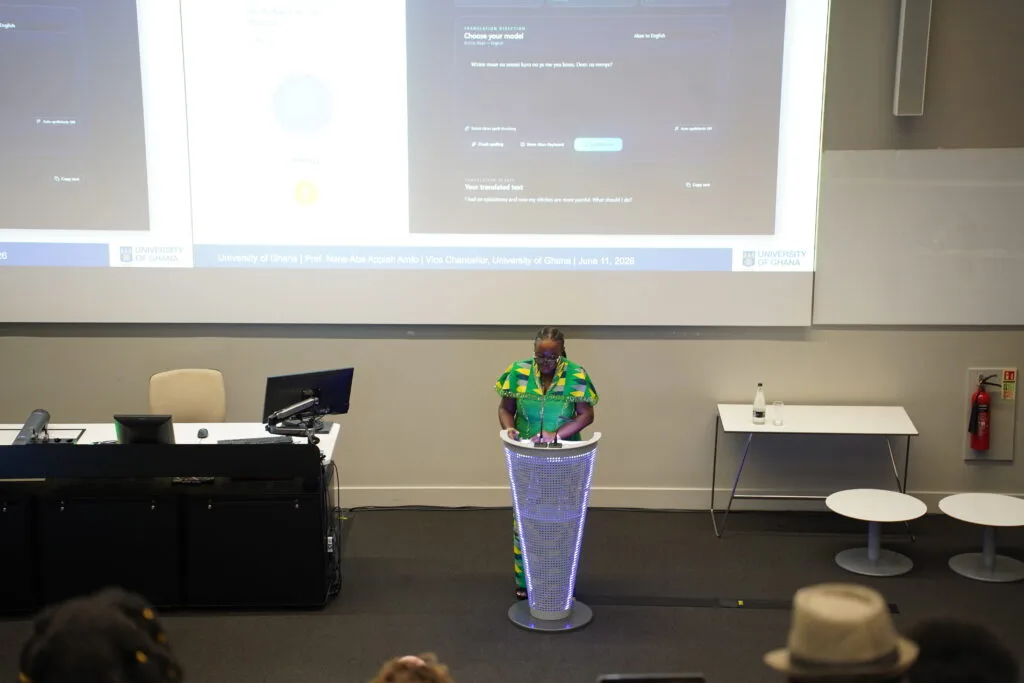
The Vice Chancellor of the University of Ghana, Professor Nana Aba Appiah Amfo, has warned that the world risks losing Africa's cultural richness if African languages aren't intentionally included in the artificial intelligence revolution. She delivered the 5th Warwick Distinguished Africa Lecture at the University of Warwick in the UK on Thursday, June 11, 2026, titled “Whose Language Counts? African Voices, Knowledge Systems, and the Future of AI.”
Despite Africa having over 2,000 living languages spoken by more than 1.4 billion people, a recent UNESCO report described these languages as a “blind spot in AI.” Professor Amfo argued that this isn't because African languages lack complexity, but because they're dramatically underrepresented in the data used to train large language models.
“When a language is absent from the digital corpus, it isn't merely a translation problem. It's a visibility problem. It's a knowledge problem. And ultimately, it becomes a question of justice,” she said.
Professor Amfo, who also chairs the Association of Commonwealth Universities, insisted that the problem goes beyond linguistics. AI trained mainly on English and other dominant languages creates an inequitable system where Western knowledge frameworks are treated as universal. Meanwhile, African philosophical traditions, oral knowledge systems, and indigenous nuances remain invisible.
She illustrated this with a personal example. At the University of Ghana, students are building “Nana Aba AI,” a voice assistant modelled on the Vice Chancellor herself to help students and staff with verified information. When she tested it, the system reproduced her voice well in English. But when it encountered Ghanaian names, places, and phrases, the voice no longer sounded like her.
“My own name didn't sound like mine,” she said. “I've now been tasked to record my voice in a studio so the system can learn what I actually sound like when I speak Ghanaian languages or mention Ghanaian names. That is a precise illustration of what is wrong. AI doesn't struggle with African languages because they're too complex. It struggles because we haven't yet been seen.”
She posed a key question: “Will Africa participate merely as a consumer of externally developed systems, or will Africa help shape the languages, values, assumptions, and knowledge structures embedded within those systems?”
The lecture follows the recent launch of Ghana’s National AI Strategy, a 10-year plan backed by a $250 million government commitment. The strategy includes funding for a world-class AI computing centre to develop natural language processing capabilities in Ghanaian languages.
The University of Ghana has already adopted its own AI Policy and will roll out a compulsory Digital Literacy and Applied AI course for all students from the next academic year, according to Professor Amfo.
Warwick’s Vice-Chancellor and President, Professor Stuart Croft, said: “It was a pleasure to welcome Professor Amfo to Warwick for this year's Distinguished Africa Lecture. Her contribution highlights the importance of diverse perspectives in shaping the future of research and innovation.”
Professor Nana Aba Appiah Amfo is the second Ghanaian to deliver the lecture since it started five years ago, following former University of Ghana Vice Chancellor Emeritus Professor Ernest Aryeetey.