

If artificial intelligence doesn't learn to speak Twi, Ewe, or Hausa, it'll only serve half the world. That's the warning from University of Ghana Vice-Chancellor Professor Nana Aba Appiah Amfo.
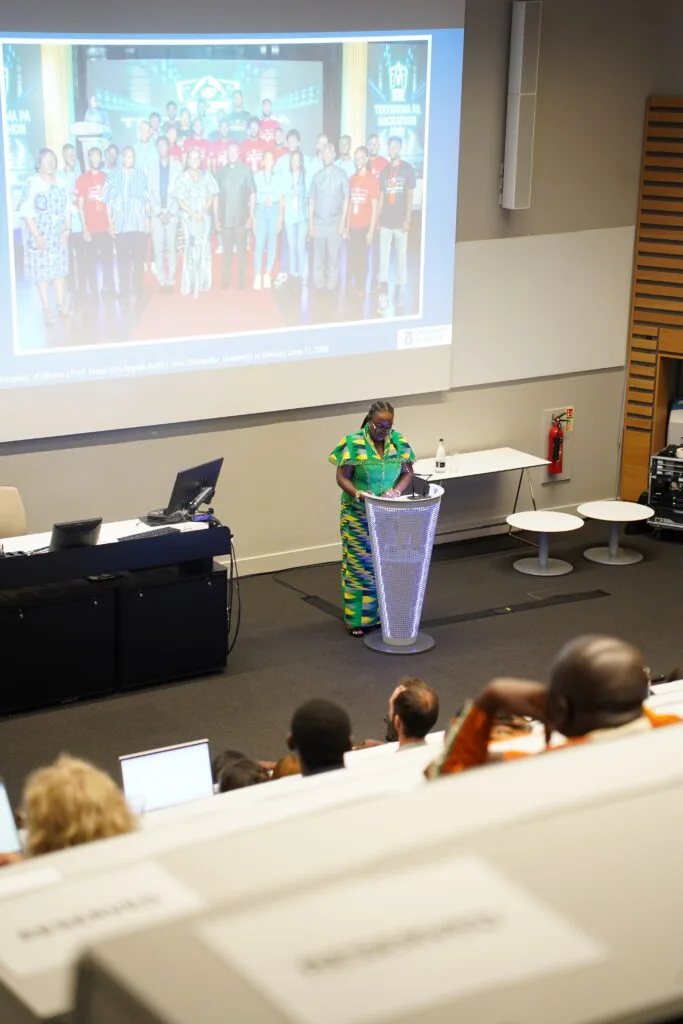
Speaking at the University of Warwick in the UK on Thursday, June 11, 2026, she delivered the Fifth Warwick Distinguished Africa Lecture titled “Whose Language Counts? African Voices, Knowledge Systems, and the Future of AI.” Her message was clear: Africa's over 2,000 living languages must be baked into AI from the start, not treated as an afterthought.
“Without embedding African languages in the design of Artificial Intelligence, the systems being built to serve the world will serve only part of it,” she said.
A recent UNESCO report called African languages a “blind spot in AI.” They're barely present in the datasets used to train large language models. For Prof. Appiah Amfo, this isn't just a technical glitch.
“When a language is absent from the digital corpus, it's not merely a translation problem. It's a visibility problem. It's a knowledge problem. And ultimately, it becomes a question of justice,” she argued.
“When a language is absent from the digital corpus, it's not merely a translation problem. It's a visibility problem. It's a knowledge problem. And ultimately, it becomes a question of justice.”
She gave a real example. University of Ghana students built a voice assistant called “Nana Aba AI” to give verified information to staff and students. The system could copy her voice perfectly in English. But the moment it hit Ghanaian names, places, and local phrases, it stumbled.
“The system could reproduce ‘me’ in English with considerable success. The moment it encountered Ghanaian names, places, and phrases, the voice I was hearing no longer sounded like me. My own name didn't sound like mine,” she said.
Developers have since asked her to record her voice in a studio so the AI can learn Ghanaian pronunciations and languages better. Her take? “AI doesn't struggle with African languages because they're too complex. It struggles because we haven't yet been seen.”
Prof. Appiah Amfo is only the second Ghanaian to give this lecture at Warwick, after former University of Ghana VC Emeritus Professor Ernest Aryeetey. The lecture series highlights African perspectives in global research.
Her speech comes just after Ghana launched its National AI Strategy — a 10-year plan backed by $250 million from the government. The strategy aims to make Ghana a leader in Africa's AI space, with a world-class AI computing centre and stronger natural language processing for Ghanaian languages.
The University of Ghana has also adopted its own AI Policy and will introduce a compulsory Digital Literacy and Applied AI course for all students starting next academic year.
Prof. Appiah Amfo challenged policymakers, researchers, and tech developers to make sure Africa isn't just a consumer of AI but a contributor to its values and knowledge systems. If not, she warned, the global AI revolution will leave the continent behind.