

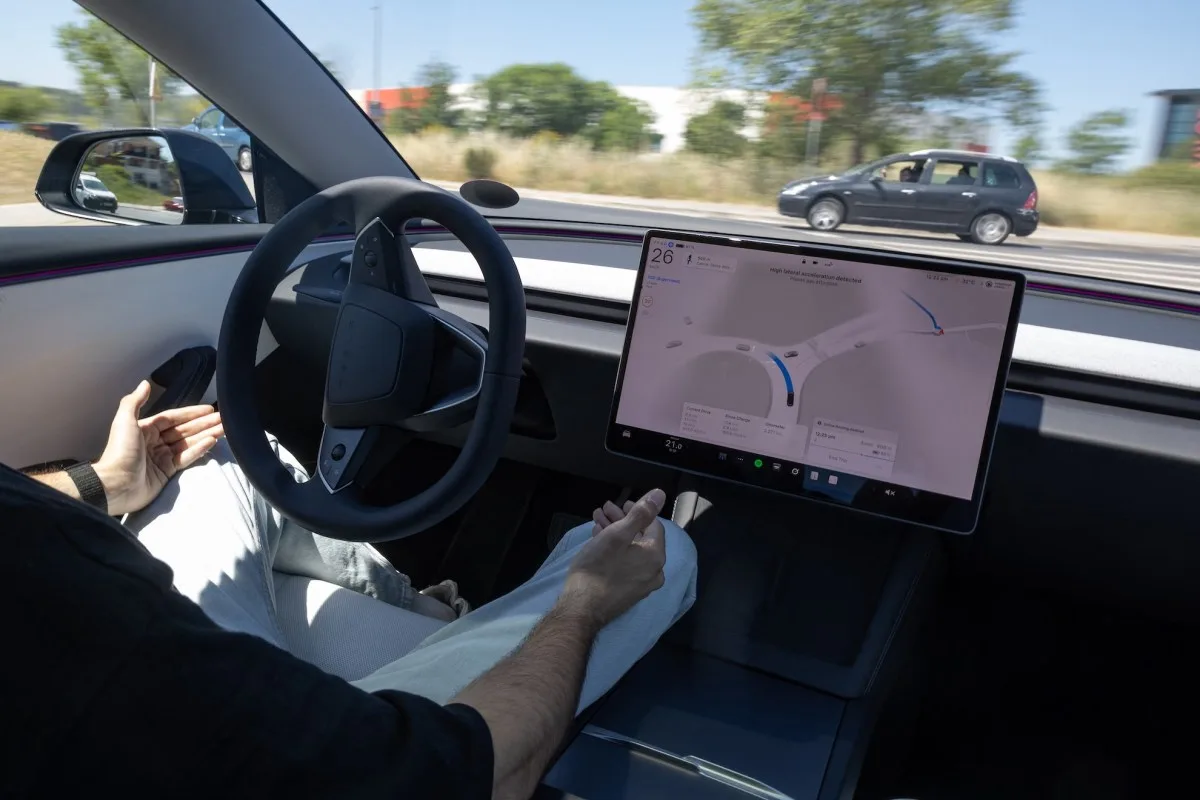
All Eyes on Tesla's FSD
The single sharpest fact: Tesla's Full Self-Driving (FSD) system has been involved in a high-profile crash in the US, sparking renewed concerns over the safety and reliability of AI-powered vehicles.
Tesla's FSD system, a key feature of their Autopilot technology, has been touted as a major advancement in automotive innovation. However, the recent crash has raised serious questions over its safety and reliability. The incident occurred in the state of California, where a Tesla Model S, equipped with the FSD system, crashed into a stationary fire truck, causing significant damage.
And what's more, Tesla CEO Elon Musk has been vocal about the potential of FSD to revolutionize road safety, claiming it could reduce accidents by as much as 90%. But with the recent crash, Musk's vision of a world where AI-powered vehicles dominate the roads seems increasingly fragile.
But what's behind the FSD system's failure to live up to expectations? According to experts, the issue lies in the system's inability to accurately detect and respond to complex road scenarios. 'FSD is still a work in progress,' said Dr. Rachel Kim, an AI expert at Stanford University. 'It requires a lot of testing and validation before it can be trusted on public roads.'
So, how reliable is Tesla's FSD system? We dug deeper to find out. In 2022, the National Highway Traffic Safety Administration (NHTSA) investigated a string of incidents involving Tesla's Autopilot technology, which includes FSD. While the investigation found no evidence of wrongdoing, it did reveal a concerning trend: a significant number of crashes involving Tesla vehicles were caused by the driver's failure to follow basic safety procedures, such as checking their surroundings or obeying traffic laws.
The crash is just the latest in a string of incidents involving Tesla's FSD system. In 2020, a Tesla Model 3, operating on Autopilot, crashed into a parked car in Los Angeles, resulting in significant damage. And in 2019, a Tesla Model S, also equipped with FSD, crashed into a tree in Arizona, killing the driver.
Key Facts
- The crash occurred on June 25, 2026, in California, USA
- The Tesla Model S was equipped with the FSD system
- The driver was operating the vehicle in Autopilot mode at the time of the crash
- The incident is under investigation by the NHTSA
- Tesla's FSD system has been involved in several high-profile crashes in recent years
And when it comes to the safety and reliability of AI-powered vehicles, the stakes are incredibly high. With more and more cars hitting the roads, the risk of accidents and fatalities increases exponentially. So, what does this mean for the future of FSD and AI-powered vehicles?
The incident has sparked a heated debate over the safety and reliability of AI-powered vehicles, with many experts calling for stricter regulations and testing protocols. 'This is a wake-up call for the industry,' said Dr. James Hall, a transportation expert at the University of Michigan. 'We need to get this right before we can trust these vehicles on public roads.'
In the meantime, Tesla's FSD system remains in limbo, leaving many to wonder: will we ever be able to trust our lives to AI-powered vehicles?