

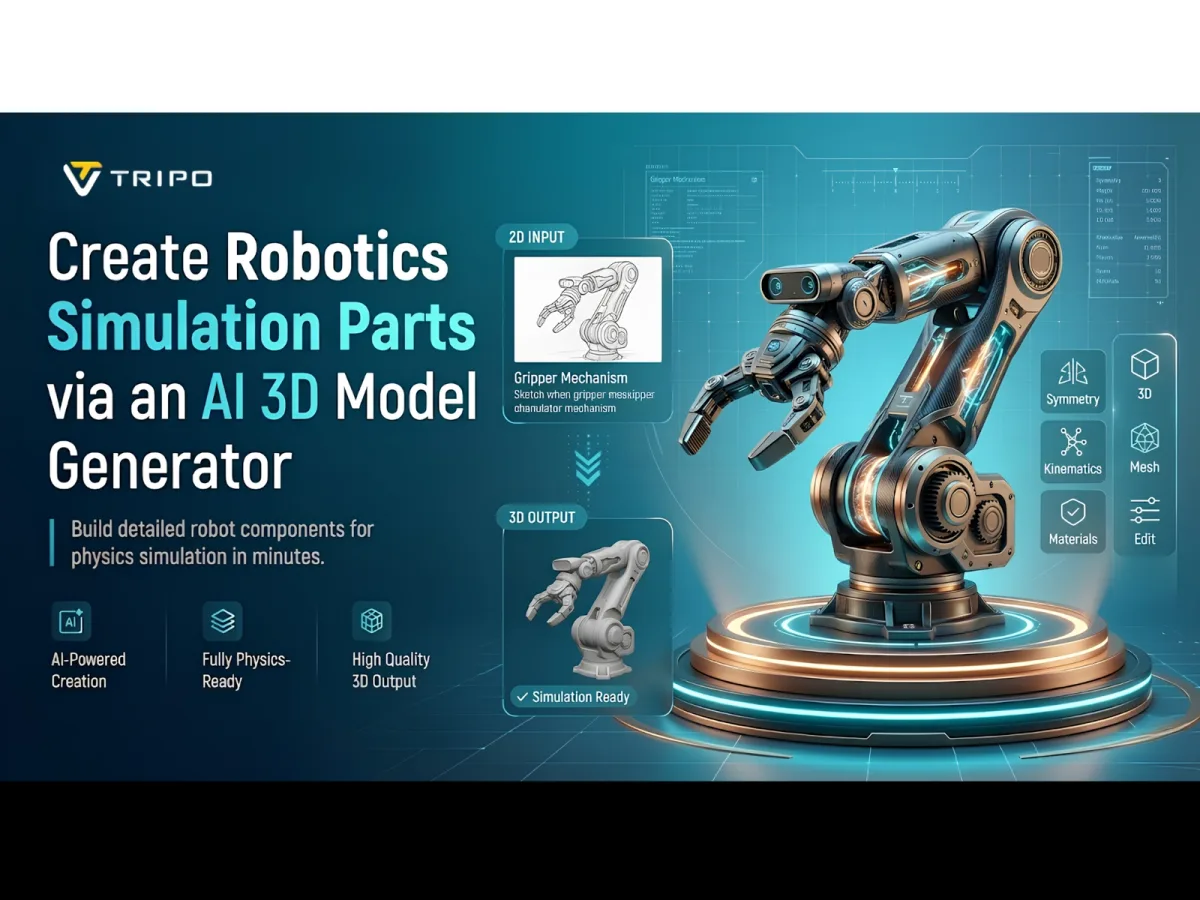
The digital parts of the system must be accurate in order to reliably simulate a robotics system. Higher-quality components contribute to more accurate motion behavior, collision detection, and engineering validation. Creating 3D models manually often requires significant expertise, specialized skills, and considerable time. And to simplify this process, Tripo 3D has created automated tools and efficient workflows that help engineers create components for simulations with less time and effort while maintaining structural consistency. This is particularly crucial in robotics simulations, where accuracy is crucial for realistic virtual environments and accurate system behavior.
So, how does it work? With Tripo 3D, engineers can create robotics simulation parts in minutes using an AI 3D model generator. The platform converts ideas, references, and sketches into usable assets in a short time. This means that engineers can spend less time creating 3D models and more time refining their designs.
But what sets Tripo 3D apart from other 3D modeling tools? According to the company, their AI 3D model generator helps transform ideas, sketches, or text prompts into usable 3D models with minimal manual work. Automated generation reduces manual modeling efforts and helps shorten development timelines.
And this is where the Nigerian angle comes in. Robotics and AI development are emerging fields in Nigeria, with many startups and entrepreneurs experimenting with innovative solutions. This technology could potentially revolutionize the field, enabling quicker and more accurate development of robotics systems that can be applied to various sectors, including manufacturing, healthcare, and education.
Tripo 3D includes several features that support robotics simulation development, including text-based generation, image to 3D model workflows, structured topology generation, high-resolution texture support, and export compatibility. These capabilities support the creation of organized assets for iterative robotics workflows.
To create robotics simulation parts via AI 3D model generator, users need to follow a few simple steps. First, they need to import design references for robotic components, which can be done by uploading images or using text prompts. Then, they need to set simulation-ready parameters, including AI completion, texture quality, and PBR. Finally, they can fine-tune components and export files in various formats.
The potential of this technology is vast, and it's exciting to see how it can be applied in various fields. With Tripo 3D, the future of robotics development looks brighter than ever.
Key Features of Tripo 3D
- Text-based generation creates components from written descriptions
- Image to 3D model workflows based on reference images and concept drawings
- Structured topology generation for organized meshes
- High-resolution texture support for visibility during presentations and reviews
- Export compatibility for easy integration with simulation software and development environments
Benefits of AI 3D Model Generators
- Reduced manual modeling efforts and shorter development timelines
- Increased accuracy and consistency in 3D models
- Greater design iteration and performance testing capabilities
- Reusable models for various robotics projects