

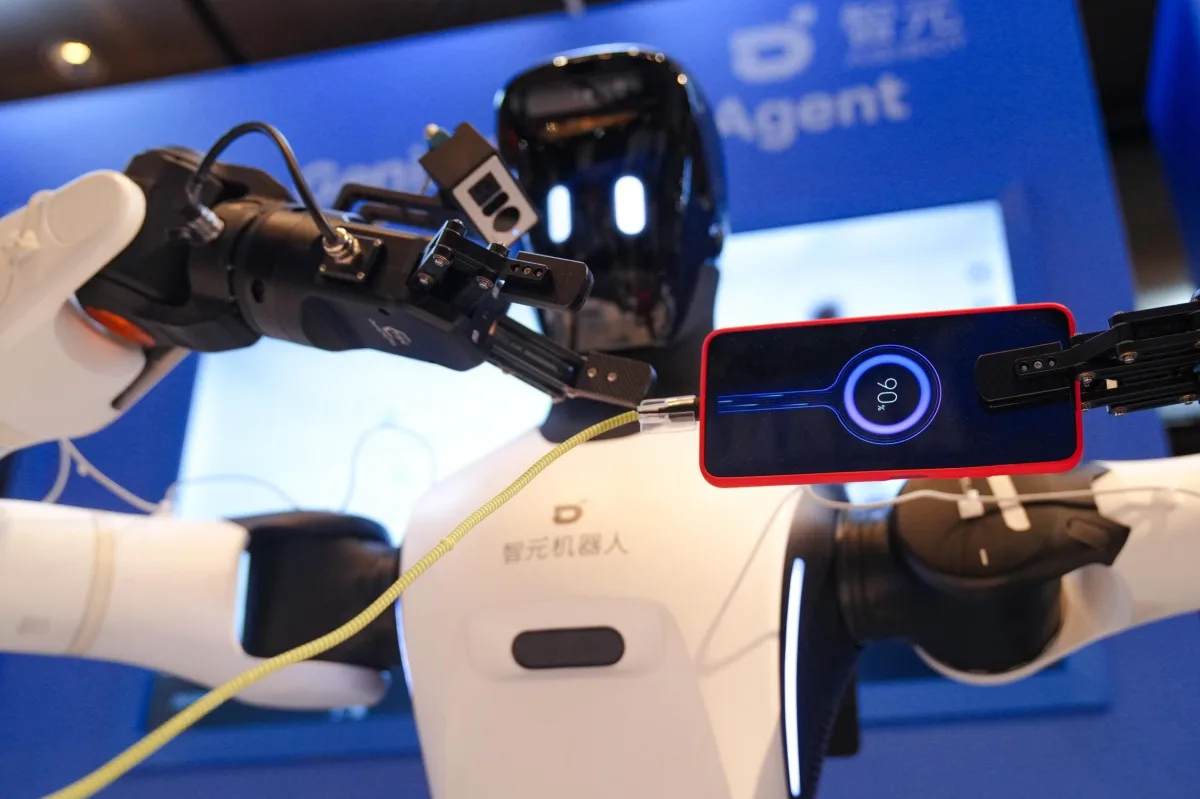
Introduction to Agibot
Agibot, a Shanghai-based company, is probably the largest humanoid robot maker in the world. It's shipped roughly 5,100 units in 2025, which is a 39% share of the global market, and it's crossed 10,000 cumulative units earlier this year. This milestone surpasses its first three-year total in just three months. Agibot now offers humanoid robots and robots-as-a-service in more than 17 countries. They're available for various tasks, and their deployment is expanding rapidly.
The Shift from Demos to Deployment
In a recent interview, Dr. Yao Maoqing, president of Agibot's embodied business unit, argued that the humanoid robotics industry is crossing a far more important threshold than production capacity: the shift from demos to deployment. He frames it as a move from what he calls the 'X curve' of technology exploration to the early stage of the 'Y curve' of real-world deployment growth. The X curve is essentially the technology exploration phase, where the industry focuses on proving whether robots can move, see, and understand. The Y curve is the deployment growth phase, where the focus shifts to whether robots can truly enter workflows, operate continuously and reliably, and create real productivity value.
It's a crucial phase, and it's where the industry is heading now.
Where Are the Robots Being Employed?
When asked where the thousands of shipped robots are being employed, Dr. Maoqing stated that humanoid robots are first entering scenarios where demand is relatively clear, the environment is more controllable, and a closed-loop value creation can be established. These include industrial manufacturing, logistics and warehousing, commercial services, security and inspection, research and education, data collection, and scenario validation. Large-scale deployment won't begin in homes, but in industrial, commercial, and service scenarios. These scenarios involve higher-frequency tasks, clearer ROI, and are more likely to generate a real data flywheel through deployment, which in turn improves reliability, intelligence, and generalization.
They're ideal for robots, and they're where we'll see them first.
The Biggest Blockers for Humanoid Robots
The biggest bottleneck and challenge for the industry today isn't one single technology, but how to integrate many different capabilities into a system that can operate stably in the real world over a long period of time. There's a massive gap between lab demos and real-world deployment. In the lab, you can control the environment, the task, and the variables. But the real world is dynamic, open-ended, and full of uncertainty. A robot must not only know how to perform actions; it must also understand the environment, understand human intent, handle unexpected situations, and operate reliably for long periods of time.
It's a tough challenge, and it's one that the industry is working to overcome.
The Future of Humanoid Robots
Dr. Maoqing believes that the industry is now very close to an important inflection point. But this inflection point doesn't mean that robots will enter every scenario overnight. It means that many of the key conditions that used to develop separately are, for the first time, converging simultaneously. The industry has been waiting for several things, including whether foundation model capabilities are strong enough, whether the robotic body itself is reliable enough, and whether a continuous data flywheel can be formed in real-world scenarios.
These elements existed before, but they didn't come together at the same time. Now, they're converging, and it's creating new opportunities.
Protectionist Legislation and Global Market
When asked about protectionist legislation, Dr. Maoqing stated that any new foundational technology will face different requirements around safety, data, compliance, and industrial development when entering global markets. This is a normal process, especially for humanoid robots, which are physical AI systems that will enter factories, shopping malls, public spaces, and eventually even homes, working alongside people. Different markets will naturally pay close attention to reliability, safety, and localization. They'll want to ensure that robots are safe, reliable, and compliant with local regulations.
It's a necessary step, and it's one that the industry is prepared for.
The Future of Robot Ownership
The robotics industry will definitely see more rental, subscription, and RaaS, or Robot-as-a-Service, models in the future. This is a very natural direction. Many customers don't actually need to 'own a robot.' What they need is continuous and stable automation capability, and a real productivity outcome. Agibot has already started to offer rental models in more than 17 countries and regions. For example, in the United States, the starting price for robot services is already around USD 2,000 per day.
It's a flexible option, and it's one that's gaining popularity.
Agibot's achievement of shipping 10,000 humanoid robots marks a significant milestone in the industry. As the industry shifts from demos to deployment, we can expect to see more robots entering real-world scenarios, operating continuously and reliably, and creating real productivity value. With the convergence of key conditions, the industry is nearing an important inflection point. However, there are still challenges to be addressed, including the integration of different capabilities, data, reliability, cost, supply chain, and maintenance systems. As the industry continues to evolve, we can expect to see more innovative solutions and applications of humanoid robots in various industries and scenarios.
The industry's progress won't be slowed down by these challenges, though - it'll be driven by innovation and demand.
'The real inflection point is not only when production capacity increases. It is when demand begins to form a positive cycle.'
- Dr. Yao Maoqing
Key Facts
- Agibot has shipped over 10,000 humanoid robots. It's a significant achievement, and it's a testament to the company's capabilities.
- The company has a 39% share of the global market. It's a dominant position, and it's one that Agibot is working to maintain.
- Humanoid robots are first entering scenarios such as industrial manufacturing, logistics and warehousing, commercial services, security and inspection, research and education, data collection, and scenario validation. They're being used in a variety of tasks, and they're proving to be effective.
- The industry is nearing an important inflection point, where many key conditions are converging simultaneously. It's a critical moment, and it's one that will shape the future of the industry.
- The future of robot ownership may involve more rental, subscription, and RaaS models. It's a flexible approach, and it's one that's gaining traction.