

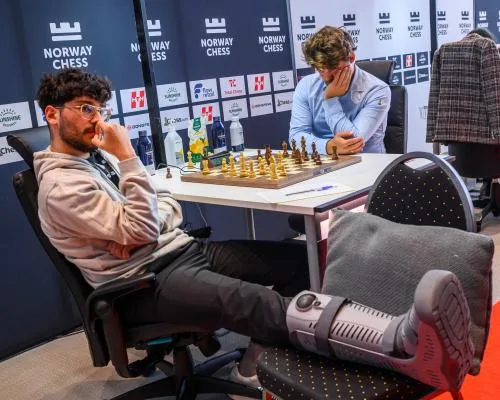
It’s not every day you see a titan of the game get rattled. Magnus Carlsen, the 35-year-old Norwegian maestro who has dominated the annual Norway Chess elite tournament for six of the past seven years, found himself staring down a barrel in the opening round this Monday. His conqueror was the 22-year-old Frenchman, Alireza Firouzja, who had arrived at the event nursing a sprained ankle after a clumsy tumble off a stage at a previous tournament in Bucharest.
This wasn't just a minor slip-up; it was the first time the Frenchman had ever beaten Carlsen in a classical chess game. The feat is even more jarring when you consider that Firouzja had finished rock-bottom at the Grand Chess Tour event in Bucharest just the week prior, a competition dominated by Germany’s Vincent Keymer. To see a grandmaster perform at this level while injured is rare, echoing the 1985 Tilburg tournament where England’s Tony Miles famously competed from a massage table after suffering a back injury.
The Breakdown of the Blunder
Carlsen is known for playing his clock with the precision of a Swiss watch, but he lost the plot during the critical approach to the move 40 time control. Analysts have pointed to a sequence where 31...Qb7 would have served him far better than his actual move, 31...Qd7. The situation worsened with 32...Re8, yet the real coffin nail was hammered at move 33. A crucial miscalculation occurred when Carlsen opted for 33...Kg8 instead of the more defensive 33...Nxe3.
This fatal blunder allowed Firouzja to march his central pawns forward, effectively suffocating the Norwegian’s position. If Carlsen had played 33...Nxe3, he could have maneuvered his knight and queen to hold the draw, but instead, the board turned into a graveyard for his championship hopes.
A Change of Scenery and Scoring
For the first time in its 13-year history, Norway Chess has packed its bags and moved from its home in Stavanger to the Deichman Bjørvika library in the heart of Oslo. This matters because Carlsen has long avoided playing in the capital, citing the crushing weight of hometown expectation. His track record in Oslo is patchy at best; who could forget 2019 when he was dismantled 13.5-2.5 by Wesley So in the Fischer Random world championship final?
The tournament uses a format that keeps everyone on their toes. A win in a classical game nets you three points, but a draw means the players immediately re-enter the arena for an 'Armageddon' game. In this tie-break, White gets ten minutes to Black’s seven, but if the game ends in a draw, the win goes to Black on the scoreboard. This format is high-stakes gambling for the mind.
The result is like tossing a coin. That was the assessment from India’s Praggnanandhaa Rameshbabu, who managed to add to Carlsen’s misery with a chaotic victory in the third round. Carlsen had blundered after getting tangled in the weeds of an opening novelty, 6 h4!?, in the Najdorf Sicilian. While he showed a return to form by thrashing the current world champion, Gukesh, in Thursday’s fourth round, the damage to his tournament standing is already quite visible.
Current Standings and Future Clashes
After four rounds of action, the leaderboard is looking rather spicy. Alireza Firouzja leads the pack with a commanding 8.5 points, followed by Praggnanandhaa on 6 points and Wesley So on 5.5. Carlsen is currently sitting on 4.5 points, trailing behind the leaders. On the women’s side of the house, Bibisara Assaubayeva of Kazakhstan is leading the charge with 7 points, in an event that has finally matched the prize money between genders.
Things are also heating up away from Oslo. On Friday in Belgrade, Hans Niemann and Ian Nepomniachtchi are kicking off an eight-game classical match. It’s the most significant East-West showdown we've seen since the 1996 Karpov vs. Kamsky series, if not the legendary Spassky vs. Fischer match of 1972. Both players are desperate to climb back into the world’s top ten, and with two games played per day, the drama is set to be relentless.