

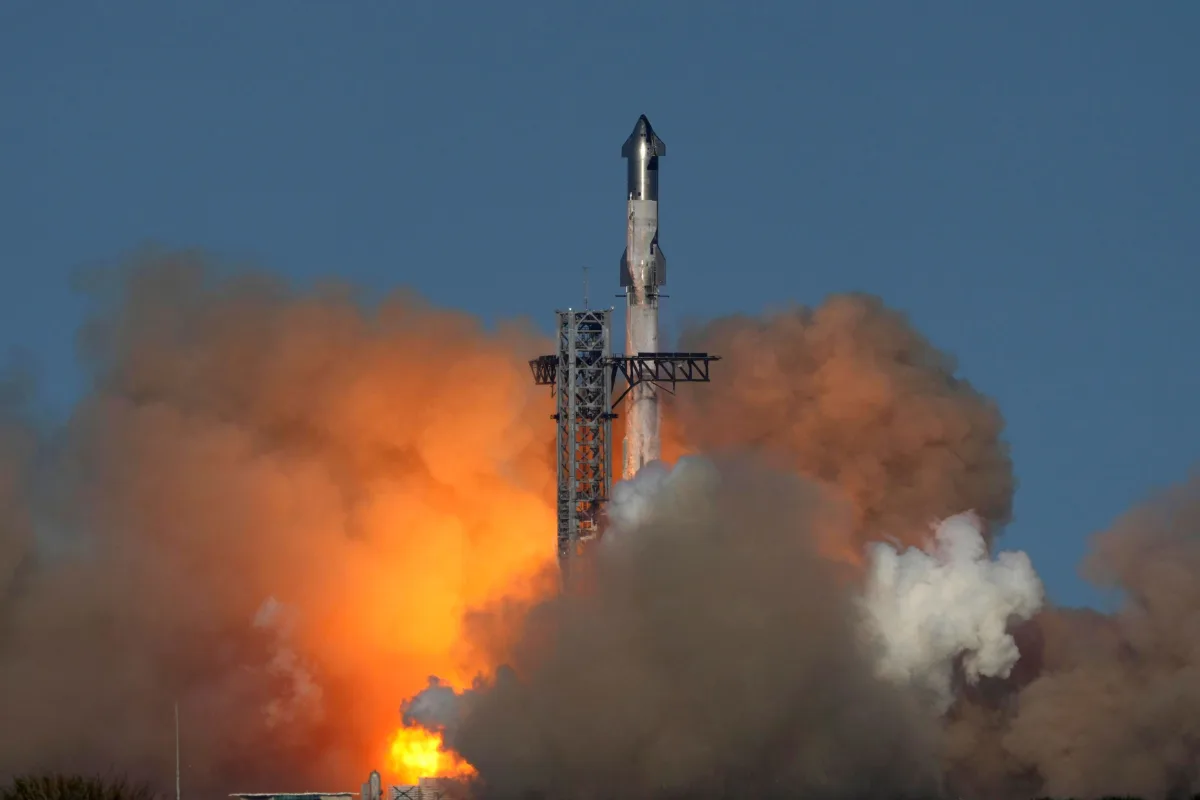
SpaceX is gearing up for a critical test of its Starship launch system, with liftoff scheduled for Tuesday evening from the company's Starbase facility in South Texas. This mission, known as Starship Flight 12, is a high-stakes flight that will mark the first launch of heavily upgraded versions of both the Starship upper stage and the Super Heavy booster. The stakes are high, and SpaceX can't afford to fail.
The launch window opens at 6:30 p.m. EDT on Tuesday, May 19, from SpaceX's newly upgraded launch pad at Starbase. However, as with all developmental missions, launch timing remains subject to technical checks and weather conditions, meaning delays are possible. You can catch the launch live on SpaceX.com, YouTube, and X (Twitter) from about 30 minutes before the launch. It's worth checking the website for updates, as the launch time may change.
Tuesday's mission will debut redesigned versions of both components of the launch vehicle — the Starship upper stage and the Super Heavy booster. The latter will fly with the latest evolution of the Raptor engine, with all 33 engines expected to ignite during ascent. This development is significant, as it will be the first time SpaceX has tested the Super Heavy booster with the new Raptor engine. The test will provide valuable data on the engine's performance.
The Starship upper stage is expected to deploy 22 Starlink simulators roughly matching the size and shape of next-generation SpaceX's Starlink satellites. Two of those simulators will conduct imaging operations focused on Starship's heat shield, transmitting data and photographs back to mission control. Several heat shield tiles on the spacecraft have intentionally been painted white to simulate damage and create visual targets for inspection systems. This will help SpaceX engineers understand how the heat shield performs under different conditions.
SpaceX has also deliberately removed one thermal protection tile entirely to study how neighboring tiles react to aerodynamic forces during reentry. The data collected from this test will be used to improve the design of the Starship's heat shield, which is essential for the spacecraft's ability to withstand the intense heat generated during reentry. The heat shield's performance is critical to the success of the Starship program.
The pressure is now on SpaceX to test Starship — particularly its Starship Human Landing System (HLS), a modified version it's building for NASA's Artemis program. On March 3, NASA revealed a revision in the Artemis program, with Artemis 3 (scheduled for launch in mid-2027) now re-classified as a test mission during which its Orion spacecraft will rendezvous and dock in low Earth orbit with commercial lunar landers — SpaceX's Starship HLS and Blue Origin's Blue Moon. NASA won't launch the mission until it's sure the landers are ready.
It's now a race between SpaceX and Blue Origin, with NASA intending to test whichever lander is ready for its Artemis 3 crew. NASA announced on May 4 that testing of Blue Origin's Blue Moon Mark 1 (MK1) lunar lander has been completed inside a Thermal Vacuum Chamber A at NASA's Johnson Space Center in Houston. This means that both SpaceX and Blue Origin are under pressure to deliver their lunar landers on time, as the success of the Artemis program depends on it. They can't afford to fail.
The original plan had been for Starship to be refueled in Earth orbit — something that would take 15 flights of other Starships — before going into lunar orbit, where it would rendezvous with NASA's crew in Orion. However, with the revised plan, Starship will now have to be ready to launch directly to the moon, without the need for refueling in Earth orbit. This is a significant challenge, as it requires Starship to have enough fuel to reach the moon and return to Earth, without the need for refueling. The spacecraft will have to be capable of carrying a lot of fuel.
- The launch window opens at 6:30 p.m. EDT on Tuesday, May 19
- The mission will debut redesigned versions of the Starship upper stage and the Super Heavy booster
- The Super Heavy booster will fly with the latest evolution of the Raptor engine
- The Starship upper stage will deploy 22 Starlink simulators
- Two simulators will conduct imaging operations focused on Starship's heat shield
- NASA's Artemis program has been revised, with Artemis 3 now re-classified as a test mission
As SpaceX prepares for this critical test, the company is also looking to the future, with plans to use Starship for deep-space exploration. The fully reusable system is designed to carry more than 100 tons of cargo and eventually transport crews to the moon and Mars. This could pave the way for humanity's return to the moon and beyond. It's an exciting development, and it's not hard to see why SpaceX is so invested in the Starship program.
The success of the Starship program is crucial for NASA's plans to return humans to the moon by 2027. The agency has awarded SpaceX a contract to develop the Starship Human Landing System, which will be used to take astronauts to the lunar surface. The contract is worth billions of dollars, and it's a significant investment in SpaceX's technology. NASA won't get its money back if the program fails.
But what's at stake here is more than just the success of the Starship program. It's about the future of space exploration and the role that private companies like SpaceX will play in it. As NASA looks to partner with private companies to achieve its goals, the success of the Starship program will be a significant indicator of the potential for public-private partnerships in space exploration. The outcome of the program will have a big impact on the future of space travel.
As the launch approaches, SpaceX engineers are working around the clock to ensure that everything is ready. The company has a reputation for pushing the boundaries of what's possible, and this launch is no exception. With the Starship program, SpaceX is aiming to make humanity a multi-planetary species, and this launch is a critical step towards achieving that goal. The company can't afford to fail, and it won't give up easily.
The launch will be a significant event, and it will be watched closely by space enthusiasts around the world. You can follow the launch live on SpaceX's website, YouTube, and X (Twitter), and get updates on the mission's progress. It's going to be an exciting event, and you won't want to miss it. The launch is just the beginning of an exciting new era in space exploration.