

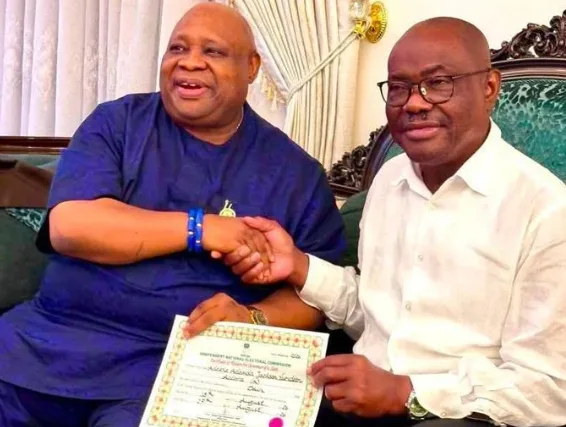
The aftermath of an election in Nigeria can sometimes be as dramatic as the voting itself. And it looks like Governor Ademola Adeleke's victory in the August 15 Osun State governorship election is a prime example.
Minister of the Federal Capital Territory, Nyesom Wike, recently let slip during a media chat in Port Harcourt that he personally directed Governor Adeleke to publicly reaffirm his allegiance to President Bola Tinubu. Wike also instructed him to thank the President for a 'free and fair election' and present his Certificate of Return to Tinubu.
This revelation has put a spotlight on the often-unseen political negotiations that shape Nigeria's democracy, far beyond what voters decide at the ballot box. It makes you wonder, who is really in charge?
According to Wike, his main concern after the election was whether Adeleke, after winning, would still stand by his earlier promise to support President Tinubu. "My concern: if Adeleke wins, will he still support Mr. President? And I called him, because that’s my own interest," Wike stated, recounting his intervention. He made sure Adeleke reaffirmed his commitment, asking, "Listen, you have told me you’ll support Mr. President.
Are you going to keep to it?" Adeleke apparently confirmed he would.
But Wike's influence didn't stop there. Even while Adeleke was reportedly in Croatia, Wike called again. "Now you have won, issue a statement. Issue a statement that you still will support Mr. President, and thanking him for a free and fair election," Wike recounted telling the governor. He also added, "I also told him, ‘Adeleke, when you receive your Certificate of Return, go and present it to Mr.
President.’" And sure enough, Adeleke did meet with President Tinubu and presented his certificate.
So, why all this fuss? Wike explained his actions as a calculated political move. His strategy, he claimed, was to prevent the African Democratic Congress (ADC) from capitalising on Adeleke's victory and 'currying favour' with the presidency. "When Adeleke issued that statement, ADC withdrew," Wike revealed, suggesting his intervention directly impacted political alliances.
This brings us to a crucial question: when powerful individuals strike deals after voters have cast their ballots, where does the people's mandate end and political bargaining begin?
Professor Anthony Kila, Director-General of the Centre for International Advanced and Professional Studies (CIAPS), believes this situation points to a deeper problem within our institutions. "It’s not a good optic," he said, warning that politics becoming too personalised, rather than being based on policies or ideas, poses a significant risk to democratic values. "I’m very worried that politics is being personalised, rather than being based on policies and programmes and ideas, not ideologies. That is a risk there."
Kila also raised eyebrows at Wike's assertion that he could have influenced the election outcome if he had been sent to Osun. "So clearly, the man sees himself in powers that are beyond democratic power," Kila noted.
Online, Nigerians have been buzzing about the situation, questioning why an elected governor would feel the need to publicly reassure the President of his loyalty after securing a mandate from the electorate. While some viewers see Adeleke's actions as smart political maneuvering, others view it as proof that powerful alliances and individuals are increasingly dictating terms for elected officials.
For many, this is particularly worrying given the general distrust people have in electoral bodies and the judiciary. The thinking is that elected officials might opt for political compromises to safeguard their positions, rather than face lengthy legal battles over election disputes. However, it's important to note, there's no concrete evidence that the APC dropped any legal challenge because Adeleke followed Wike's advice. After the election, the Osun APC stated they were reviewing the results and consulting their legal team before deciding on any court action.
Still, Kila argues that even the perception that a governor might need political appeasement to protect his mandate is damaging enough. "Those who see it as a political strategy for survival are right. They have reason to suspect that," he commented. He believes such perceptions highlight weaknesses in Nigeria's democratic systems. "For us to even think that, that means that there’s an institutional deficit," Kila explained. "It tells you that people suspect that if you are not with the ruling party, you might have a rough ride."
He concluded that this distrust shows our democracy isn't quite as robust as we'd like it to be.