

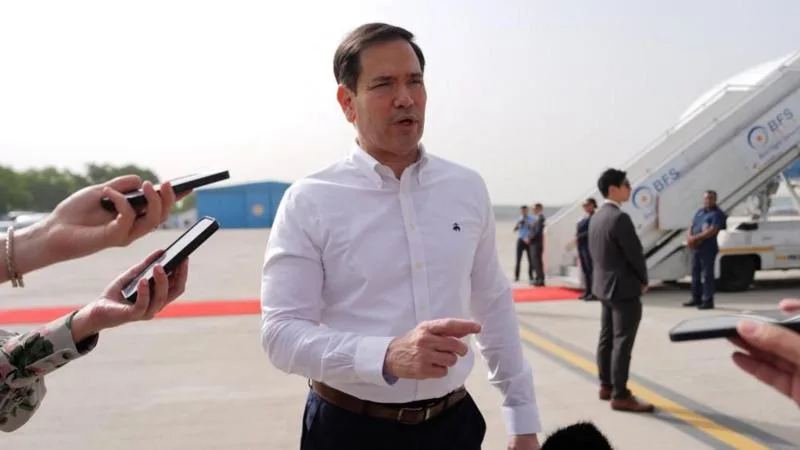
US Secretary of State Marco Rubio says a deal to end the war between the US and Iran may be reached on Monday. Speaking during a visit to India, Rubio stated that the US and Iranian negotiators have 'a pretty solid thing on the table'. He didn't give a specific timeline, but he's hopeful that a deal can be reached soon.
The deal reportedly involves a 60-day ceasefire extension, the reopening of the Strait of Hormuz, and a plan for further negotiations over Iran's nuclear programme. Oil prices fell sharply and Asian stock markets rose on Monday on hopes of an agreement. Rubio cautioned that it takes a little while to hear back from Iran, and they're waiting for a response.
Iran's foreign ministry spokesperson Esmail Baghaei said at the weekend that the two sides were both 'very close and very far' from reaching an agreement. The reported deal has split Trump's Republicans, with some publicly arguing it's too lenient on Iran. Senator Ted Cruz said it would be 'a disastrous mistake', while Roger Wicker, who chairs the Senate Armed Services Committee, said a 60-day ceasefire would mean everything they've accomplished with Operation Epic Fury would be for naught. They're strongly opposed to the deal, and they won't support it.
Senator Lindsey Graham, who's a close Trump ally, also criticised any deal that would leave Iran perceived as being a dominant force in the region. He said it makes one wonder why the war started to begin with. Trump responded by saying he doesn't listen to the losers, who are critical about something they know nothing about. He wrote on Truth Social, 'If I make a deal with Iran, it will be a good and proper one.'
The US and Israel launched wide-ranging strikes on Iran on 28 February, sparking conflict across the Middle East. Iran responded by attacking Israel and US-allied states in the Gulf, and effectively closed the Strait of Hormuz. The move sent oil prices soaring globally, and it had a major impact on the economy.
Shortly after a ceasefire was agreed in early April, the US established a blockade of Iranian ports, which Trump says will remain in full force and effect until an agreement is reached, certified, and signed. He's firm on this, and he won't lift the blockade until a deal is signed. In Sunday's post on Truth Social, Trump reiterated that Iran must understand it can't develop a nuclear weapon. Tehran has repeatedly said its nuclear programme is solely for peaceful purposes, but the US isn't convinced.
Some reports in US media suggest the deal could see Iran agree to eventually hand over its highly enriched uranium. At the start of the war, Iran is thought to have had about 440kg (970 lbs) of uranium that was enriched up to 60% purity - a short process away from being enriched further to the weapons-grade 90%, which theoretically could allow it to create a nuclear bomb. It's a serious concern, and the US is pushing for Iran to give up its uranium.
Iranian President Masoud Pezeshkian told state TV Iran was ready to assure the world that they're not after a nuclear weapon. The Strait of Hormuz is a crucial waterway where 20% of the world's oil and liquefied natural gas passes. Its closure has had significant effects on the global economy, with oil prices increasing sharply. It's a vital waterway, and its closure has caused problems for many countries.
The US and Iran have been in conflict for decades, with tensions escalating in recent years. The current conflict began with the US and Israel launching strikes on Iran, which responded with attacks on Israel and US-allied states. It's a complex situation, and it's not clear what the outcome will be.
A deal to end the war between the US and Iran may be reached on Monday. The deal reportedly involves a 60-day ceasefire extension and the reopening of the Strait of Hormuz. The US and Israel launched wide-ranging strikes on Iran on 28 February, sparking conflict across the Middle East. Iran responded by attacking Israel and US-allied states in the Gulf, and effectively closed the Strait of Hormuz. The move sent oil prices soaring globally. The US established a blockade of Iranian ports, which Trump says will remain in full force and effect until an agreement is reached, certified, and signed.
As the situation continues to unfold, it's unclear what the long-term effects of the deal will be. However, it's clear that the conflict has had significant effects on the global economy and the Middle East region. The deal, if reached, will be a significant step towards ending the conflict and restoring stability to the region, as it will help to reduce tensions and promote peace.
The US Secretary of State, Marco Rubio, has been a key figure in the negotiations. He was appointed by President Donald Trump and has been a strong supporter of the President's foreign policy. Rubio has been involved in several high-profile diplomatic efforts, including negotiations with North Korea and China. He's a skilled diplomat, and he's been working hard to reach a deal.
The Iranian President, Masoud Pezeshkian, has also been a key figure in the negotiations. He has been the President of Iran since 2021 and has been a strong supporter of the country's nuclear programme. Pezeshkian has been critical of the US and its allies, and has called for an end to the sanctions imposed on Iran. He's a determined leader, and he's fighting for his country's interests.
The conflict between the US and Iran has had significant effects on the global economy. The closure of the Strait of Hormuz has led to a significant increase in oil prices, which has had a major impact on the global economy. The conflict has also led to a significant increase in tensions between the US and Iran, which has had a major impact on the Middle East region. It's a serious situation, and it needs to be resolved quickly.
The deal to end the war between the US and Iran may be reached on Monday. The deal reportedly involves a 60-day ceasefire extension and the reopening of the Strait of Hormuz. The conflict has had significant effects on the global economy and the Middle East region, and the deal will be a significant step towards ending the conflict and restoring stability to the region. The US and Iran are working towards a peaceful solution, and they're hopeful that a deal can be reached soon. It's a complex situation, but they're committed to finding a solution that works for both countries.