

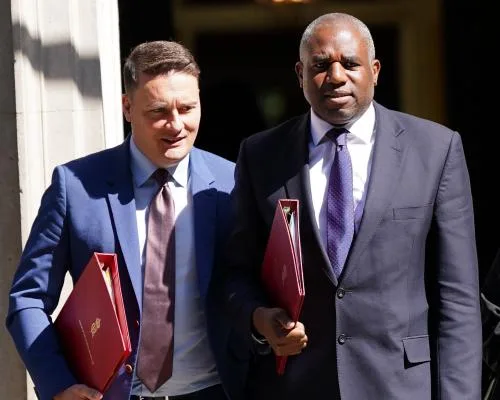
The UK's Labour party is facing a tumultuous time, with internal debates and potential byelections looming. In a recent interview, Deputy PM David Lammy dismissed Wes Streeting's call for the UK to rejoin the EU, terming it a 'sixth form debate'. This statement has sparked a mix of reactions, as some interpret it as a dismissal of a crucial issue, while others see it as a necessary focus on more pressing matters. Lammy's comment is significant because it highlights the party's struggle to find a unified stance on EU membership.
Lammy's comment comes at a time when the Labour party is dealing with the aftermath of a significant loss in the working-class heartlands. The party's performance in areas like Hartlepool, Grimsby, and Barnsley has raised concerns about its connection with its traditional base. Jonathan Hinder, a Labour MP, expressed his disagreement with Streeting's suggestion, stating that it's a 'staggering level of out of touch' given the party's recent losses. He didn't mince words, emphasizing that the party needs to focus on issues that matter to its core voters.
The UK's potential re-entry into the EU is a complex issue, with various factors at play. The Conservative party, currently in power, has confirmed its intention to field a candidate in the upcoming Makerfield byelection. This decision has been met with some opposition, as some argue that the party should stand aside to allow Reform UK to run unopposed. Matt Vickers, the Conservative party's deputy chair, has stated that the party will put forward its own candidate, emphasizing the need for voters to have a choice. He believes that voters shouldn't be limited to just one option.
Across the country in sixth forms, you can discuss what the position should be on Europe.
The byelection in Makerfield is significant, as it could potentially pave the way for Andy Burnham's return to Westminster. Burnham, the current mayor of Greater Manchester, has been rumored to be a potential candidate for the Labour party leadership. His popularity in the region could be a deciding factor in the byelection, with some polls suggesting that he might be able to sway voters in his favor. Burnham's popularity isn't limited to Greater Manchester, as he's also well-known across the UK.
The Conservative party's decision to run a candidate in Makerfield has been influenced by the potential for a deal with Reform UK. The party is considering standing aside in Aberdeen South, where a byelection is also scheduled, in exchange for Reform UK's cooperation in Makerfield. This strategy is aimed at maximizing the party's chances of winning in areas where it has a stronger presence. The party can't afford to lose ground in these areas, so it's willing to make deals to achieve its goals.
As the UK navigates its current political landscape, the debate surrounding EU membership is likely to continue. The Labour party's internal struggles and the potential byelections will be closely watched, as they could have significant implications for the country's future. With the Conservative party's decision to field a candidate in Makerfield, the stage is set for a competitive election that could shape the UK's political trajectory. The outcome of this election won't be clear until the votes are counted, but it's likely to be a close contest.
The Labour party is facing internal debates and potential byelections. Deputy PM David Lammy dismissed Wes Streeting's call to rejoin the EU as a 'sixth form debate'. The Conservative party will field a candidate in the Makerfield byelection. Andy Burnham's popularity in Greater Manchester could be a deciding factor in the byelection. The UK's potential re-entry into the EU is a complex issue with various factors at play.
These factors include the economic implications, the social impact, and the political consequences.
The situation in the UK is complex, with multiple parties and interests involved. It's crucial to consider the various perspectives and potential outcomes. The Labour party's internal struggles and the potential byelections will be crucial in shaping the country's future. As the situation continues to unfold, it's essential to consider the various perspectives and potential outcomes. The UK's political landscape won't change overnight, but it's likely to remain dynamic in the coming weeks and months.
The Conservative party's strategy in the byelections will be closely watched, as it could have significant implications for the party's future. The potential deal with Reform UK in Aberdeen South is a notable development, as it could influence the outcome of the election in Makerfield. The party's decision to field a candidate in Makerfield is a calculated risk, as it could pay off or backfire. It's difficult to predict the outcome, but it's clear that the party is willing to take risks to achieve its goals.
The UK's political landscape is complex and multifaceted. The Labour party's internal debates and the potential byelections will be crucial in shaping the country's future. As the situation continues to unfold, it's essential to consider the various perspectives and potential outcomes. The country's future won't be decided by a single election or event, but by a series of complex interactions and decisions. It's likely that the UK's political landscape will remain dynamic and unpredictable for the foreseeable future.
The party that can adapt to these changes won't necessarily be the one that wins, but it will be the one that's best prepared to face the challenges ahead.