

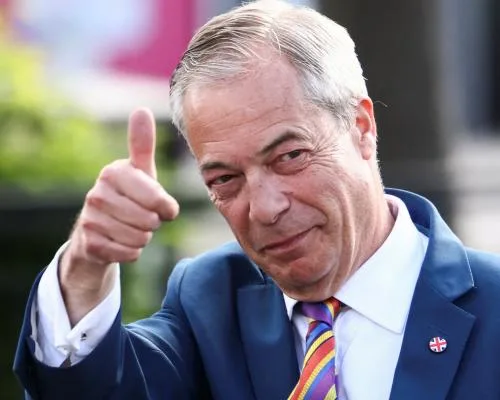
Nigel Farage, the man behind the Brexit campaign, is on the rise again, and this time, he's eyeing the top seat in the UK government. You might be wondering how someone who played a significant role in the Brexit disaster could be considered for such a position. But that's exactly what's happening, and it's a stark reminder that accountability in politics is often just an illusion. It's clear that Farage's involvement in Brexit hasn't hurt his career, and he's still a major player in UK politics.
As the biggest Brexit donor, Peter Hargreaves, a stockbroker, gave £3.2m to the leave campaign. He justified his enthusiasm by saying that the UK would become incredibly successful because it would be insecure again, and insecurity is fantastic. But for whom is it fantastic? The current TV ad for Hargreaves Lansdown, the company he co-founded, presents itself as a safe haven in times of disruptive change, including Brexit. This raises questions about who benefits from such insecurity.
It's worth asking what Hargreaves stands to gain from Brexit, and whether his interests align with those of the average UK citizen.
Nigel Farage was instrumental in the decision to leave the EU, just like Benito Mussolini was instrumental in Italy's decision to join the first world war. Both men promised miracles but delivered misery and retreat instead. Yet, they haven't been punished by the electorate. In fact, Farage's party, Reform UK, has risen to prominence, and he's now a potential candidate for the prime minister's seat. This isn't surprising, as voters don't always hold politicians accountable for their actions.
They're more likely to vote based on their current circumstances, rather than a politician's past performance.
The concept of accountability is a myth in politics. People often vote based on changes in their wellbeing, but they consistently punish incumbents for conditions beyond their control. For instance, 2.8 million people voted against Al Gore in 2000 because their states were too dry or too wet. This phenomenon, known as retrospective voting, is a fairytale. It's not based on reality, and it doesn't take into account the complexities of politics.
Voters don't always make informed decisions, and they're often swayed by factors that don't reflect a politician's actual performance.
The current leadership in the UK is no exception. They flatter their political base but not their own. Instead, they appeal to what they call 'hero voters': people they think they can lure away from the right. But these voters are almost entirely mythical. By sacrificing themselves to these wraiths, Labour alienates its own base.
The party's deliberate policy of 'hippy punching' – demonstrating its macho, pro-capital credentials by ripping down environmental protections, banning protests, cutting benefits, and launching performative attacks on immigrants – only reinforces this alienation. It's clear that this strategy isn't working, and it's time for a change.
'The animating force of Starmer's team is its extreme and irrational hostility to the Labour left,' says George Monbiot, a Guardian columnist. This hostility is a major obstacle to the party's success. When Starmer goes – and after two wasted years, he must – we should hope his replacement has some idea of how this business works. It's not that Starmer doesn't have any good ideas, but he's failed to implement them effectively. He's been unable to connect with voters and inspire them to support the party.
In the meantime, Nigel Farage is likely to succeed in shrugging off the undeclared £5m he was given by a crypto billionaire just before he decided to stand for election in 2024. Nor will people punish his party in a general election for what will almost certainly be its dismal failures in local government. It's not that voters don't care; they do. But they're busy with their lives, and their attention is yanked from one crisis to another, leaving them with no mental space to keep receipts. They won't remember the details of Farage's past, and they won't hold him accountable for his actions.
The winning formula in politics is not listing your achievements and explaining what a schmuck the other person is. It's demonstrating hope. You flatter your existing voters while attracting new ones by telling a powerful story of transformation. If you're already in government, you should spend big on public services: demonstrating in deed as well as word that life is improving. Unfortunately, the UK's government does the exact opposite, reinforcing the sense of hopelessness and decline.
They're not investing in the things that matter, and they're not giving voters a reason to be optimistic about the future.
The harsh truth is that we possess almost no capacity for attribution. We don't judge candidates on their records and vote accordingly. Instead, we punish incumbents for conditions beyond their control. This lack of accountability is what allows people like Nigel Farage to rise to power despite their role in disasters like Brexit. They're able to shrugged off their past mistakes and focus on the future.
It's a system that rewards those who generate insecurity and punishes those who try to hold them accountable.
The prospect of Farage becoming prime minister in 2029 is a stark reminder of the state of politics in the UK. It's a system that rewards those who generate insecurity and punishes those who try to hold them accountable. As we watch this unfold, we can't help but wonder what the future holds for the UK and its people. It's a uncertain time, and it's difficult to predict what will happen next. But one thing's for sure: the UK needs a change, and it needs it soon.
- Nigel Farage is the man behind the Brexit campaign
- Peter Hargreaves, a stockbroker, gave £3.2m to the leave campaign
- Farage's party, Reform UK, has risen to prominence
- The concept of accountability is a myth in politics
- The current leadership in the UK flatters their political base but not their own
- Nigel Farage is likely to succeed in shrugging off the undeclared £5m he was given by a crypto billionaire
- The winning formula in politics is demonstrating hope and telling a powerful story of transformation