

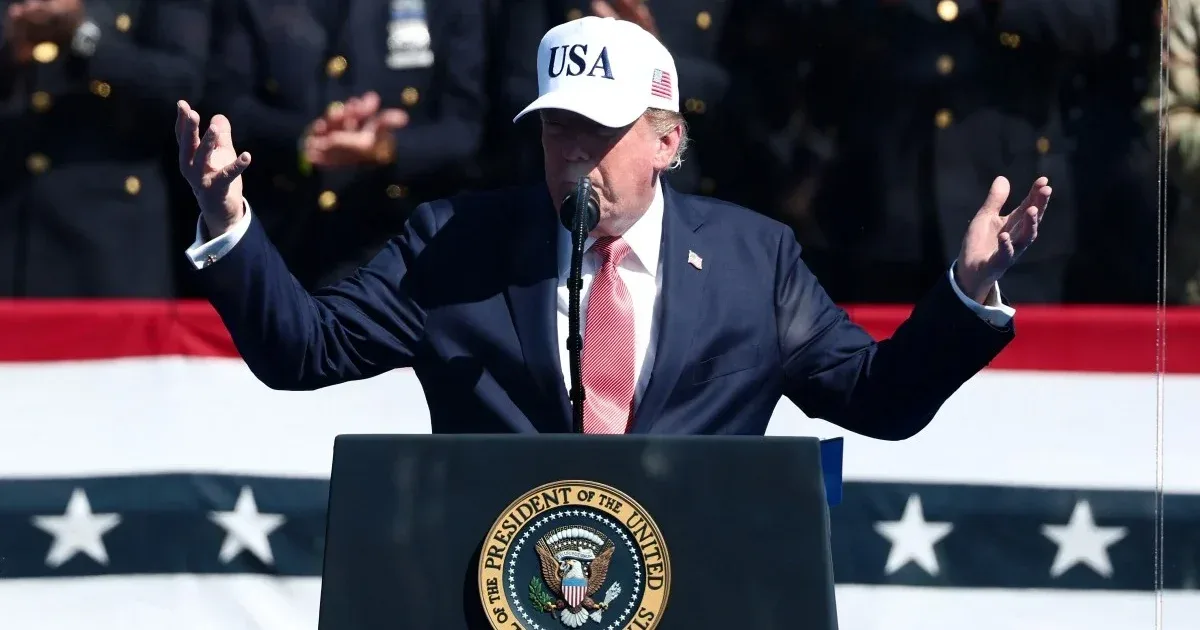
The Republican Party is holding an unusual two-day convention in Dallas this week, a gathering insiders have jokingly dubbed "Trumpapalooza." The whole point is to put Donald Trump, the party's former president, front and centre, even though most polls show him with a deeply uninspiring 33 per cent approval rating. Republicans are praying this gamble can somehow help them avoid a drubbing in the November 3rd midterm elections, where they're currently projected to lose control of the House of Representatives and face a tough fight to keep the Senate.
Trump himself has been telling his supporters to act as if he's on the ballot. "So what I really want you to do is pretend, please, that I’m on the ballot," he said at a recent rally. "Just come and vote. It’s so important." The hope, according to political science professor Matthew Green from the Catholic University of America, is to rally voters who are loyal to Trump personally, not necessarily the Republican brand. "Many Trump supporters only vote when he’s on the ballot," Green explained. "They’re not diehard Republican voters; they’re diehard Trump voters. So, in that respect, it makes some sense to feature Trump in the hopes of getting those folks to turn out in November."
Yet, Green remains skeptical. He pointed out that an approval rating in the low to mid-30s is traditionally a recipe for disaster in midterm elections. "When you’re in the low- to mid-30s, that’s traditionally associated with a very bad midterm for your party," he said of the 80-year-old former president's standing. Decision Desk HQ, a respected election analysis group, is projecting Democrats to win the House 230-205 and secure a 51-49 majority in the Senate, revising an earlier, more optimistic 50-50 prediction for the chamber.
This convention is historic because it's the first time Republicans have held a national convention specifically for a midterm election, though the Democrats did try something similar back in the 1970s and 80s. Don't expect any nominations or formal party business. Instead, organisers have essentially set up a two-night televised rally designed to promote Trump's past achievements and highlight Republican candidates. Over 100 House members and candidates are expected to show up, with more than 50 speakers lined up for each night. Trump himself is scheduled to deliver the keynote address on Wednesday and will close out the event on Thursday, with Vice President JD Vance also slated to speak.
Cabinet members, party leaders, and candidates in critical House and Senate races are also on the agenda.
Republicans plan to hammer home themes like tax cuts, tougher immigration enforcement, boosting manufacturing, and lowering prescription drug costs. They'll also be painting Democrats as extremists on the left. However, some Republicans are privately praying that Trump sticks to the script and avoids his usual litany of personal grievances and off-topic rants that often derail his appearances.
But not everyone is showing up for the party. Many Republican lawmakers who are running in competitive districts have decided their time is better spent campaigning back home with less than two months until Election Day. Professor Green noted that vulnerable Republicans have two good reasons to stay away: Trump's unpopularity and the risk of wasting precious campaign time. "If you are a Republican running in a swing district, you probably want to get as much distance from Trump as possible," he stated. Even the current House Speaker, Mike Johnson, has admitted that some members need to be in their districts because early voting is about to kick off nationwide.
And if any Republicans do make the trip to Dallas, they're expected to open their wallets. Tickets and lodging aren't cheap, with attendees asked to contribute at least $25,000. The event is also a massive fundraising opportunity, with a special roundtable with Trump costing $250,000 per person and a photo op with him going for $88,600. Even this big Trump show faces stiff competition: both nights of the convention are scheduled to overlap with the opening games of the NFL season, America's most popular professional sports league. "Spending three or four days away from your district to go to a convention is not a good way to spend your time if you’re facing a tight re-election," Green added.