

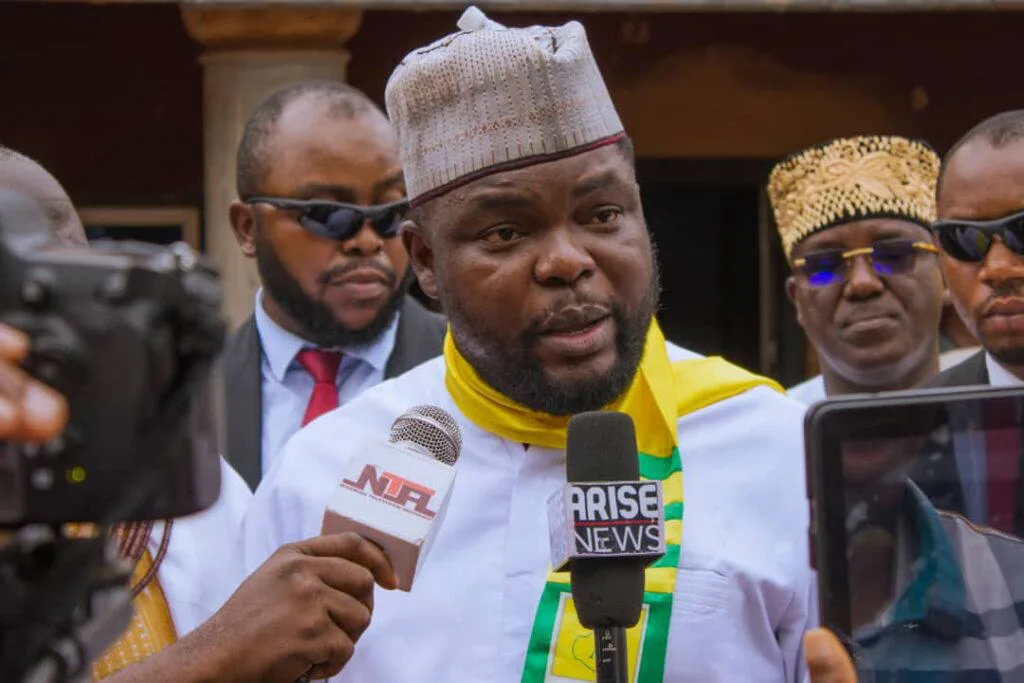
You might have missed it, but a leadership crisis has been brewing in the Accord Party, with two factions vying for control. And at the center of it all is Prof. Chris Imumolen, who insists that certified court documents are the only way to determine who rightfully occupies the national chairmanship.
Imumolen has been embroiled in a dispute with Maxwell Mgbudem, who currently claims the position. But Imumolen is not backing down, citing a 2024 court order that recognizes him as the rightful leader of the party. The order was made by Justice M.M. Adamu of the High Court of the Federal Capital Territory, Abuja, who granted an interim order directing the Independent National Electoral Commission (INEC) to recognize Imumolen as the National Chairman of Accord pending the hearing and determination of the substantive suit.
But Mgbudem's faction has challenged the order, leading to a series of appeals and counter-appeals in the court. Imumolen has now called on party members and stakeholders to rely on certified court records rather than competing claims and political statements to determine the rightful occupant of the national chairmanship.
He argued that the issue should be determined by what the courts have ordered at various stages of the dispute, rather than by declarations from either faction. Imumolen traced his claim to the national chairmanship to legal proceedings arising from the party's July 2024 national convention.
He said that on August 29 and 30, 2024, Justice M.M. Adamu of the High Court of the Federal Capital Territory, Abuja, granted an interim order in Suit No. FCT/HC/M/11850/2024 directing the INEC to recognise him as National Chairman of Accord pending the hearing and determination of the substantive suit. However, Imumolen acknowledged that the opposing faction subsequently challenged the position through further court proceedings and orders, leaving the leadership dispute unresolved.
He said the different stages of the litigation should be considered together, with a clear distinction between orders already made, decisions subsequently challenged and matters still pending before the courts. “Until the competent courts finally determine the competing claims, the proper approach is to distinguish between what has been judicially ordered, what has subsequently been challenged, and what remains pending before the courts,” he said.
Imumolen maintained that the existence of competing proceedings did not erase the judicial history behind his claim to the chairmanship. “Prof. Imumolen can therefore legitimately maintain that his claim to the National Chairmanship has a clear judicial history and cannot be dismissed as a mere self-appointed position,” he added.
He urged members of the party and other stakeholders to examine official court records rather than relying on statements issued by the rival factions. “The decisive evidence should ultimately be the certified court orders, judgments and enrolled orders from the FCT High Court, Federal High Court and Court of Appeal, rather than statements issued by either faction of Accord,” he said.
Imumolen also cautioned against interpreting the 2024 interim order as a final determination of the substantive leadership dispute, noting that it was made pending further proceedings. He said the order, nevertheless, remained part of the judicial history of the dispute and should not be ignored in assessing the basis of his claim.
The leadership crisis has also generated claims that Imumolen was expelled from the party. He dismissed the allegation as insufficient, on its own, to determine who is legally entitled to occupy the chairmanship. “The allegation of expulsion does not on its own determine who is legally entitled to occupy the position,” he said.
According to him, the legal effect of any purported expulsion would have to be determined in accordance with the Accord Party constitution, applicable electoral laws and relevant judicial decisions. Beyond the legal proceedings, Imumolen said his faction enjoys substantial support among members of the National Working Committee, but acknowledged that political support could not substitute the authority of the courts.
He also referred to recent appellate proceedings, including the reported dismissal or striking out of an appeal filed by the opposing group in July 2026. He, however, cautioned against relying on partisan interpretations of the development, saying the precise legal effect of any appellate decision could only be established from the certified judgment and enrolled orders of the court.
Imumolen reiterated that he would abide by the eventual outcome of the judicial proceedings, but expressed confidence that the certified records of the FCT High Court, Federal High Court and Court of Appeal would vindicate his position.
You would expect that such a high-stakes dispute would be resolved amicably, but that's not the case here. Imumolen's insistence on certified court documents is not just about him; it's about the integrity of the electoral process and the Accord Party's reputation.
The leadership crisis has sparked debates about the party's electoral fortunes in the next elections, with some members calling for a fresh convention to resolve the issue. Imumolen's position has also been supported by some members of the National Working Committee, who are urging the party to follow due process in resolving the leadership dispute.
But the dispute is far from over, and the future of the Accord Party hangs in the balance. Will Imumolen's faction emerge victorious, or will Mgbudem's group prevail? Only time will tell.
The single sharpest fact in this entire story may be that Imumolen is not alone in his bid for the national chairmanship. Maxwell Mgbudem, the current National Chairman of the Accord Party, has challenged Imumolen's claim in court.
The court's decision will determine the rightful occupant of the national chairmanship, but in the meantime, the Accord Party is left in disarray. The party's reputation is on the line, and the fate of its electoral fortunes hangs in the balance.
The key players in this drama are Prof. Chris Imumolen and Maxwell Mgbudem. Imumolen is a professor of political science, and he has been at the forefront of the Accord Party's leadership crisis. Mgbudem, on the other hand, is the current National Chairman of the party, and he has been accused of using underhand tactics to cling to power.
The dispute has sparked heated debates within the party, with some members calling for Imumolen's faction to take matters into their own hands. But Imumolen has insisted that his faction will abide by the decision of the court, and that the party's leadership dispute should be resolved through due process.
The leadership crisis has also raised questions about the party's electoral fortunes in the next elections. Will the party be able to present a united front, or will the leadership dispute tear it apart? Only time will tell.
The Nigerian angle in this story is that the Accord Party is a major player in the country's electoral landscape. The party's leadership crisis has the potential to affect not just its own electoral fortunes but also those of other parties that might benefit from its instability.
In this article, we have covered the key facts of the leadership crisis, including the court order that recognized Imumolen as the rightful leader and the subsequent appeals by Mgbudem's faction. We have also explored the implications of the crisis for the Accord Party and the country at large.