

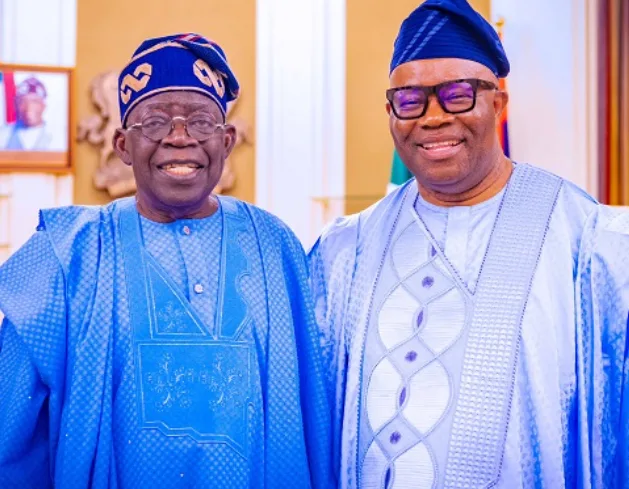
Senate President Godswill Akpabio arrived at the Lagos residence of President Bola Tinubu on Thursday with a clear message: the National Assembly is fully on board with the current economic direction. Leading a team of Senate Principal Officers, the delegation used the Sallah celebration as a backdrop to confirm their support for the administration's economic overhauls.
Akpabio pointed to the removal of multiple exchange rates and the end of what he called 'false subsidies' as the primary pillars of the president's economic strategy. He argued that these steps have finally stopped the practice of printing money without corresponding income, a cycle that had plagued the national treasury for years. The Senate President claimed that stopping this practice has shifted the country toward a more sustainable growth trajectory.
' We appreciate Mr. President for his reforms, which have done a lot to reposition Nigeria on the trajectory of growth, constrain the kind of economy we met when he came on board in 2023, ' he said.
Beyond economic policy, the Senate President touched on the issue of 'future sells,' also known as crude oil production commitments made to creditors long before extraction. By curbing this, the government aims to retain more revenue from its primary export.
He also identified the need to harmonise taxes, some dating as far back as 1939, as necessary to simplify the complex burden on businesses and citizens alike. He argued that the outdated system is in dire need of an overhaul to reflect the country's current economic reality.
Security remains a top concern, and Akpabio admitted that the country still faces guerrilla-style attacks, particularly against soft targets like schools and religious centres. However, he maintained that the security agencies have managed to prevent any insurgent group from seizing and holding territory or flying their flags anywhere in the country.
The senator noted that, in a nation with over 240 million people, localized incidents often gain outsized attention from international observers who may not fully grasp the country's scale. He said that this can sometimes create an unfair impression of the country's overall security situation.
Moving Toward State Police
To address the remaining security gaps, the National Assembly is working on a legislative framework to allow for state-controlled policing. This initiative seeks to bridge the distance between local communities and federal security apparatus. Lawmakers intend to establish a 'National State Police Commission' that will set strict standards for training, promotion, and operational conduct to ensure the system remains accountable and balanced.
The commission will oversee the training of local police personnel, set standards for operational conduct, and ensure that these units are equipped to handle modern security threats. The National Assembly will also establish rules for how these state police units will be funded and maintained.
Funding for these units will be bolstered by a dedicated strategy aimed at the national treasury. The Senate plans to divert between 0.5 percent and one percent of production account revenue into a Police Trust Fund. This money is earmarked specifically for upgrading police infrastructure and purchasing modern equipment.
In addition, the Senate expects individual state governments to provide additional backing to sustain their local operations. This will ensure that the state police units have the necessary resources to carry out their duties effectively.
With the Dangote Refinery now consuming large volumes of crude, Akpabio emphasised the need to ramp up domestic production to meet both local and export demands. The senator expressed that earning foreign exchange remains a top priority to stabilize the economy.
He expects the government to actively court foreign direct investment in agriculture, moving the country away from its historical reliance on oil exports alone. This, he believes, will not only reduce the country's dependence on a single export commodity but also create new job opportunities for Nigerian workers.