

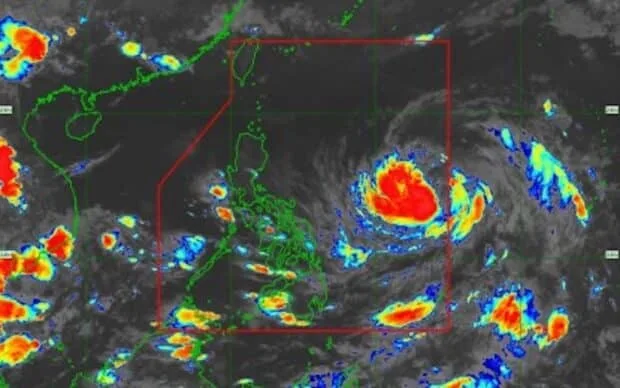
Tropical Storm Domeng made landfall in the Philippines on May 28, 2026, at 10:00 PM local time. The storm was located 1,345 km east of southeastern Luzon at 12:00 AM, moving northwestward at 20 kph. Domeng was packing maximum sustained winds of 75 km/h near the center, and gustiness of up to 90 kph.
According to the Philippine Atmospheric, Geophysical, and Astronomical Services Administration (PAGASA), no wind signal is hoisted on any part of the country. PAGASA Director Ariel Rojas stated that while Domeng is a strong storm, it's less likely to directly affect the country's weather conditions. 'We're closely monitoring the storm's movement and intensity,' Rojas said, 'But for now, it appears to be heading away from the Philippines.'
Rojas noted that while the storm is expected to bring scattered rain showers and thunderstorms in some areas, the impact will be minimal. 'But we're not expecting any significant damages or disruptions to daily life,' he said.
Domeng made landfall in the Philippine Area of Responsibility (PAR) and was given the local name Domeng. The storm is expected to pass through the PAR in the next 24 to 48 hours, and while its impact is expected to be minimal.
Key Facts
- Date: May 28, 2026
- Time: 10:00 PM local time
- Location: 1,345 km east of southeastern Luzon
- Wind speed: 75 km/h near the center
- Gustiness: Up to 90 kph
- Wind signal: No wind signal is hoisted on any part of the country
- PAGASA Director: Ariel Rojas
- Storm movement: Northwestward at 20 kph
Domeng's impact is expected to be minimal, with scattered rain showers and thunderstorms expected in some areas. Residents are advised to stay informed and prepared for any changes in the storm's movement or intensity.
Domeng, while a significant storm, is expected to bring minimal impact to the Philippines. The storm is expected to pass through the PAR in the next 24 to 48 hours.
Tropical storms are a common occurrence in the Philippines, with the country experiencing an average of 20 tropical cyclones per year. The Philippines is prone to extreme weather conditions due to its location in the path of tropical cyclones, which brings it in contact with moisture from the Pacific Ocean and warm waters of the surrounding seas.
The country has a well-equipped and well-trained disaster response team, which is expected to respond quickly and effectively to any changes in the storm's movement or intensity. This team is equipped with the necessary resources and expertise to mitigate the effects of tropical storms like Domeng.
Region
The Philippines is a tropical country located in Southeast Asia, with a long coastline and a complex terrain. The country is prone to natural disasters such as typhoons, earthquakes, and volcanic eruptions due to its location.
The country's disaster response team is led by the National Disaster Risk Reduction and Management Council (NDRRMC), which is responsible for coordinating disaster response efforts. The NDRRMC is supported by the Philippine Atmospheric, Geophysical, and Astronomical Services Administration (PAGASA), which is responsible for monitoring and predicting weather conditions.
The NDRRMC works closely with PAGASA to ensure that residents of the Philippines receive timely and accurate information about tropical storms like Domeng. This collaboration helps to minimize the impact of such storms and keeps residents safe.
Image Query: Tropical storm Domeng over the Philippine sea.