

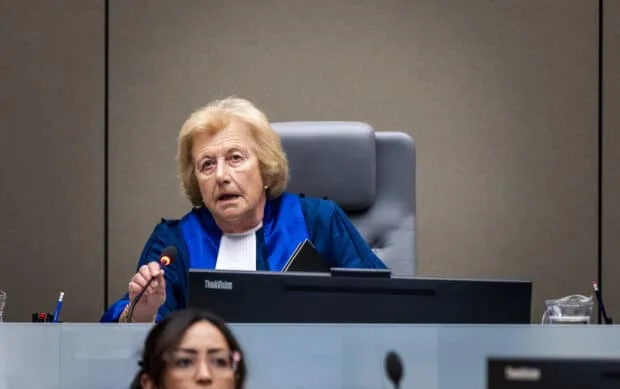
The high-stakes drama at the International Criminal Court (ICC) in The Hague has moved into a sensitive phase today, with Judge Joanna Korner presiding over Trial Chamber III. The court is currently navigating intense arguments from both prosecution and defense lawyers regarding whether families and individuals affected by the previous administration's anti-narcotics campaign can officially participate in the trial process. For the victims, many of whom have spent years navigating the maze of the Philippine justice system, this represents a crucial barrier to overcome before their voices are heard by international magistrates.
Judge Joanna Korner isn't a stranger to complex international criminal proceedings. Appointed to the ICC in December 2020, the British jurist previously served as a judge at the Crown Court of England and Wales and worked extensively as a senior prosecutor at the International Criminal Tribunal for the former Yugoslavia. Her role here involves managing the delicate balance of victim participation. This allows those harmed by alleged crimes to present their side, submit evidence, and seek reparations, rather than just acting as witnesses for the prosecution.
"The process of allowing victims to join the trial isn't just about testimony; it's about recognizing their agency in a global forum that often feels miles away from the streets of Manila or Cebu," a legal observer noted during the proceedings.
This hearing stems from the long-running probe into the 'Oplan Tokhang' operations, which were spearheaded during the presidency of Rodrigo Duterte. The campaign saw police and unidentified gunmen targeting suspected drug users and dealers, leading to thousands of deaths across the country. Official government figures often differed wildly from those provided by human rights organizations. The administration consistently claimed these operations were necessary to curb the rising influence of illegal substances like shabu.
The defense team, representing the interests of those linked to the former administration, argues that the ICC lacks the jurisdiction to intervene in what they term a purely domestic matter. They maintain that the Philippine judicial system is fully functional and capable of investigating any potential abuses on its own. The Office of the Prosecutor, currently led by Karim Khan, asserts that the country's domestic mechanisms haven't conducted genuine investigations. This necessitates the intervention of the Hague-based court to ensure accountability for crimes against humanity.
If the court decides to green-light the victims' participation, it could radically change the tempo of the trial. Victims would be granted their own legal representatives who can question witnesses and demand access to classified documents. This would effectively shift the trial from a state-versus-state battle to one that centres on the human cost of the policies implemented between 2016 and 2022. This process of victim representation is a distinct feature of the Rome Statute, the treaty that established the ICC, designed to ensure that justice isn't merely a bureaucratic exercise but a restorative one.
Data Points of the ICC Proceedings
- The ICC investigation officially covers the period from November 1, 2011, when the operations in Davao City began, up to March 16, 2019, when the Philippines formally withdrew from the Rome Statute.
- Estimates by human rights groups suggest that the death toll during the intense anti-drug drive ranges from 6,000 to over 27,000, depending on the scope of the documentation.
- Trial Chamber III is specifically evaluating the applications of several dozen victims who have stepped forward to be recognized as official participants in the trial.
- Since the Philippines pulled out of the court in 2019, the ICC has maintained that it retains jurisdiction over all crimes committed while the country was still a member state.
- The legal debate involves analyzing thousands of pages of police reports, extrajudicial killing documentation, and testimonies that have been gathered over the last four years by investigators.
The ruling's impact will echo across the Philippine political landscape. Supporters of the former leader often gather in public demonstrations to show their loyalty, while families of the deceased continue to find solace in grassroots organizations that provide community support. The proceedings in The Hague are, for many, the final hope for justice in a case that has been marked by years of silence and frustration. The process is slow and grueling, but for those seated in that courtroom, it's the only one that feels real.