

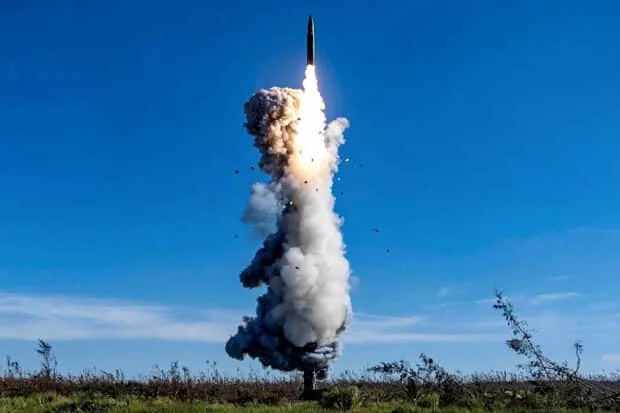
China can already strike Australia directly with missiles, and it's ability to do so is growing every year, according to a new report from the Lowy Institute, a Sydney-based think tank.
Released on Sunday, the report warns that the main threat comes from Chinese missiles fired from ships, submarines, and a new intermediate-range ballistic missile called the DF-27. That missile can reach Australia from launch sites inside China.
The DF-27 isn't yet fully deployed, but the report says its numbers will grow over the next decade. So will a conventionally armed intercontinental ballistic missile — a weapon that could cross oceans with non-nuclear warheads.
China has also been building artificial islands in the South China Sea and turning them into military outposts. Those bases could host missile systems that bring targets in Australia even closer.
Hypersonic weapons — missiles that fly at more than five times the speed of sound and can maneuver mid-flight — are another growing concern. Australia currently has no reliable defence against them.
The report doesn't predict an imminent attack. But it says the strategic balance is shifting, and Australia's military planners need to take the growing threat seriously.
The DF-27 is a new Chinese intermediate-range ballistic missile. It can carry conventional or nuclear warheads and has a range estimated at 5,000 to 8,000 kilometers. That puts the entire Australian continent within reach from Chinese territory.
China hasn't officially confirmed the DF-27's existence, but Western intelligence agencies have tracked its testing. The Lowy report says the missile is expected to enter service in the coming years.
Once deployed in significant numbers, the DF-27 would give China the ability to strike military bases, ports, and other strategic targets across Australia without needing to move ships or aircraft close to the continent.
Hypersonic missiles travel at speeds above Mach 5 and can change course during flight. That makes them extremely hard to intercept with current missile defense systems.
China has tested several hypersonic vehicles, including the DF-ZF and the Starry Sky-2. The Lowy report says these weapons are likely to be operational soon, further complicating Australia's defense planning.
Australia doesn't have its own hypersonic weapons program. The country relies on the United States for advanced missile technology and early warning systems.
China's island-building in the South China Sea has turned reefs into fortified outposts with airstrips, radar, and missile storage. These bases are within striking distance of Australia's northern approaches.
The report notes that Chinese missiles stationed on these islands could target shipping lanes, air bases, and surveillance facilities in northern Australia. The islands also give China a forward presence that complicates any military response.
Australia has been strengthening its own military capabilities. The AUKUS pact with the UK and US will bring nuclear-powered submarines to the Australian fleet by the 2040s. The country is also buying long-range strike missiles and upgrading its air defense systems.
But the Lowy report says these measures may not be enough. It calls for a national debate on Australia's strategic posture, including whether the country needs its own long-range strike capability to deter China.
The report's authors say Australia can't assume the US will always be able to defend it. As China's missile arsenal grows, the cost of any potential conflict rises for both sides.