

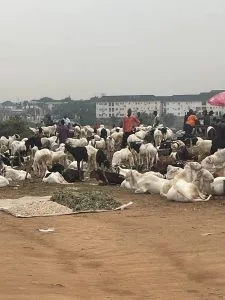
The cost of celebrating Sallah in Abuja has become a daunting task for many residents, as the prices of rams and vegetables have increased significantly. At the Galadimawa Ram Market, potential buyers are hesitant to make a purchase due to the high costs. According to Musa Abdullahi, speaking on behalf of the market's chairman, the prices of rams have become unpredictable. A small ram costs between ₦190,000 to ₦250,000. A medium-sized one ranges from ₦300,000 to ₦400,000.
A large one can reach up to ₦600,000.
The situation isn't limited to the Galadimawa Ram Market. Other markets in Abuja, such as Apo, Wuse, and Utako, are also experiencing similar price hikes. Traders in these markets attribute the increase in prices to supply chain issues, transportation costs, and heightened festive demand. A visit to these markets revealed a tense atmosphere. Buyers are cautiously negotiating prices and often walking away due to the high costs.
At the Apo Market, a basket of tomatoes now costs between ₦8,000 and ₦10,000. Pepper is selling for around ₦12,000. Irish potatoes and sweet potatoes are retailing for ₦7,000 to ₦8,000 and ₦3,000 to ₦4,000, respectively. The prices of onions have also increased. A small basket now sells for ₦4,000. These price hikes have drastically impacted the customer base. Many buyers are reducing their purchases or opting for alternative, more affordable options.
"I came with ₦200,000 thinking I could buy a large ram, but now I don't know what to do," said Ibrahim Mangal, a frustrated buyer who was forced to walk away from the market. "They told me my money can only buy a small one, and that won't even be enough for my family." He's not alone in his frustration. Many buyers are struggling to cope with the high costs.
The price increases have also affected other festive items, such as turkeys. They now cost around ₦55,000, up from ₦35,000 last month. The situation has become a challenge for many Abuja residents. They're struggling to balance their budgets and make ends meet. As Sallah approaches, the financial pressure is becoming increasingly difficult to manage. Many residents are expressing frustration and disappointment at the high costs.
Traders are warning that prices may increase further as Sallah draws closer. "If you don't buy now, the price will still increase again before Sallah," cautioned Musa Abdullahi. The warning has left many residents anxious. They're scrambling to make arrangements for the celebration. For now, the situation remains uncertain. Buyers and sellers are engaged in a tense standoff, each waiting for the other to make a move.
As the prices continue to soar, it's becoming clear that this Sallah celebration will be a costly one for many Abuja residents. The question on everyone's mind is: how much more can they afford to pay? The answer remains uncertain, as the city struggles to cope with the escalating costs of festive items.
Key Facts
- A small ram costs between ₦190,000 to ₦250,000
- A medium-sized ram ranges from ₦300,000 to ₦400,000
- A large ram can cost up to ₦600,000
- A basket of tomatoes costs between ₦8,000 and ₦10,000
- Pepper is selling for around ₦12,000
- Irish potatoes and sweet potatoes are retailing for ₦7,000 to ₦8,000 and ₦3,000 to ₦4,000, respectively
- Onions are selling for around ₦4,000 for a small basket
The situation in Abuja is a stark reminder of the economic challenges facing many Nigerians, particularly during festive periods. As the prices of essential items continue to rise, many residents are being forced to make difficult choices. They're adjusting their budgets accordingly. The impact of these price hikes is being felt across the city. Many traders and buyers are struggling to cope with the escalating costs.
The main factors driving these price increases are supply chain issues, transportation costs, and heightened festive demand. The situation is further complicated by the fact that many of these items are imported. This makes them vulnerable to fluctuations in the global market. As a result, the prices of these items can be highly unpredictable. It's difficult for traders and buyers to plan ahead.
The cost of celebrating Sallah in Abuja has become a significant burden for many residents. It's significant because it's affecting people's ability to afford basic items. The city is struggling to cope with the escalating costs of festive items. One can't help but wonder what the future holds for these residents. Will the prices continue to rise, or will they eventually stabilize?
The residents of Abuja can only hope that the situation improves soon. They're waiting to see how the prices will change in the coming days.