

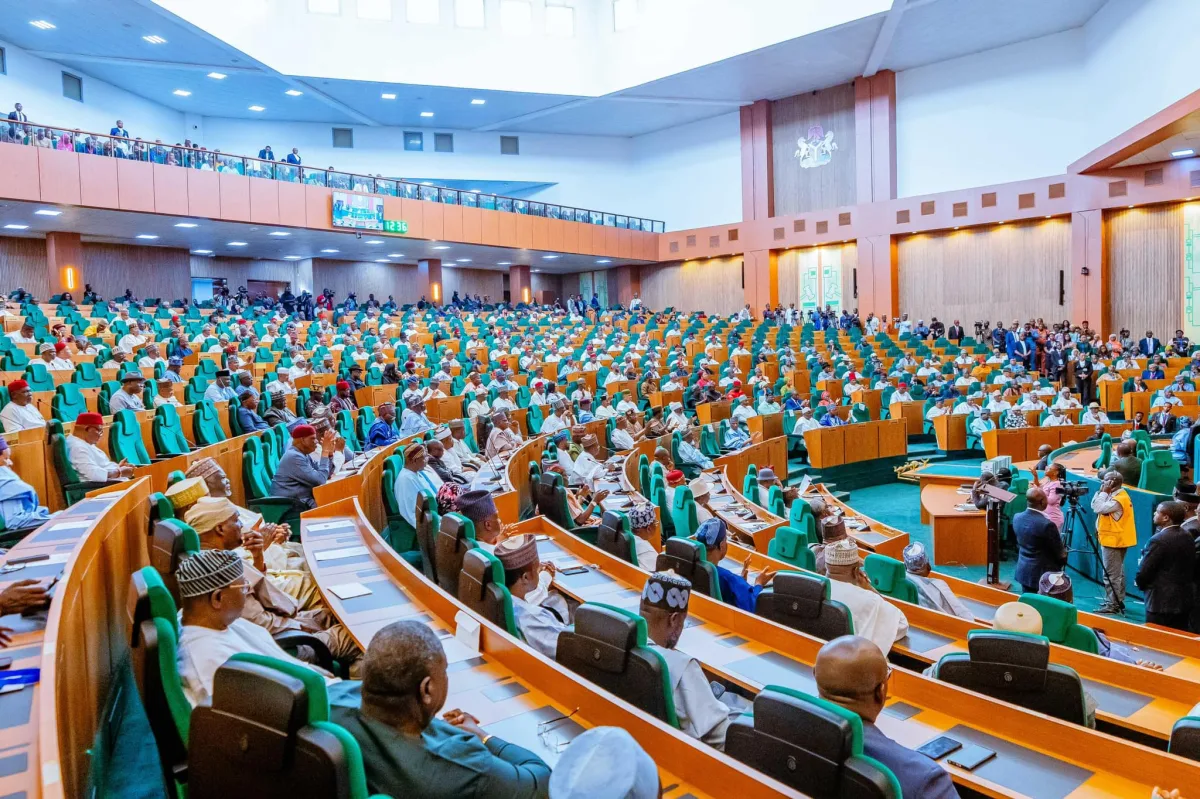
The House of Representatives on Wednesday descended into a heated and rowdy session as lawmakers clashed over an attempt to summon President Bola Tinubu to explain the poor implementation of the 2025 budget, the delayed release of appropriated funds, and worsening funding gaps affecting ministries, departments, and agencies (MDAs).
Lawmakers began their heated debate after Benedict Etanabene, who represents Okpe/Sapele/Uvwie Federal Constituency of Delta State, raised the issue under a matter of personal explanation, calling on the House to invite President Tinubu to account for the persistent failure to implement budgets despite trillions of naira approved by the National Assembly.
However, the Speaker, Abbas Tajudeen, ruled that the matter could not be debated because it was raised under a personal explanation. Under the Standing Orders of the House of Representatives, a personal explanation allows members to clarify or explain issues affecting them personally or matters requiring immediate clarification. Such statements are ordinarily not subject to debate or decision by the House.
Mr Tajudeen informed lawmakers that Mr Etanabene’s point had been noted but could not be entertained on procedural grounds, a ruling that immediately sparked protests from some members and briefly disrupted proceedings.
Shortly afterwards, the member representing Aba North and South Federal Constituency of Abia State, Alex Ikwechegh (APGA), revived the issue by bringing a motion under matters of urgent public importance, effectively reopening the debate through the appropriate parliamentary procedure. Moving the motion, Mr Ikwechegh argued that Sections 80 and 81 of the 1999 Constitution vest the power of appropriation in the National Assembly, and that the integrity of the budget process depends not merely on passing appropriations but also on the timely release, cash backing, and utilisation of approved funds.
He said disclosures made by ministers and heads of MDAs during the ongoing 2026 budget defence sessions painted a disturbing picture of the implementation of the 2025 budget. According to him, several MDAs informed lawmakers that they received little or no capital releases throughout the fiscal year, despite funds having been appropriated for critical projects.
The lawmaker said the revelations corroborated repeated protests staged by indigenous contractors throughout 2025 and into 2026 at the Federal Ministry of Finance and the National Assembly over unpaid certificates for completed and verified contracts. He recalled that some of the protests disrupted legislative activities, as contractors lamented their inability to repay bank loans taken out to execute government projects.
Mr Ikwechegh further recalled that President Tinubu had, during a Federal Executive Council meeting on 10 December 2025, directed the settlement of verified contractor liabilities estimated at N1.5 trillion. He said the Federal Executive Council subsequently approved N1 trillion to begin clearing the outstanding obligations, while the Minister of Finance also publicly announced plans to settle verified debts.
Despite these assurances, he argued that many contractors have yet to receive payment, resulting in abandoned projects, financial distress for local businesses, and broader economic consequences. The lawmaker also criticised a 29 June 2026 circular issued by the Office of the Accountant-General of the Federation, which requires contractors to obtain certificates of verification and compliance before payment, describing the directive as an additional bureaucratic hurdle that could frustrate already delayed payments.
While the written motion urged the House to commend the President for directing the settlement of verified liabilities and to call for the speedy implementation of that directive, Mr Ikwechegh went further in his presentation, urging lawmakers to invite President Tinubu to personally explain why appropriated funds had not translated into improved security and infrastructure.
Amobi Ogah (LP, Abia) proposed an amendment urging the House to postpone its planned Open Week to allow lawmakers to concentrate on resolving the budget implementation crisis. His suggestion was greeted by loud chants of “Carried” from several lawmakers.
The House of Representatives has been at odds with the executive branch of government over issues of budget implementation and appropriation. The 2025 budget was passed in February 2025 with the approval of the National Assembly, but its implementation has been hampered by several factors.
President Bola Tinubu has been under pressure to explain the slow pace of project execution and the delays in the release of funds to MDAs. The President has, however, assured Nigerians that the government is working hard to address the issues and ensure that the budget is implemented as planned.
The controversy over budget implementation has also raised concerns about the ability of the government to deliver on its campaign promises. The issue has sparked debate among Nigerians, with some calling for greater transparency and accountability in the budget process.
Nigeria's budget process has been plagued by issues of poor implementation and mismanagement of funds. The government has implemented several reforms aimed at improving the budget process and ensuring that funds are used for their intended purposes.
The debate over budget implementation in the House of Representatives is a reflection of the ongoing struggle between the legislative and executive branches of government over issues of power and accountability.
The controversy has also highlighted the importance of the National Assembly in ensuring that the government is held accountable for its actions. The House of Representatives has a critical role to play in shaping the budget process and ensuring that funds are used effectively.
In the face of the ongoing controversy, the House of Representatives has a challenging task ahead of it. The lawmakers must work together to find a solution to the budget implementation crisis and ensure that the government is held accountable for its actions.
As the debate continues, Nigerians will be watching to see how the lawmakers navigate the challenges and ensure that the budget is implemented effectively.
Key Facts:
- The 2025 budget was passed in February 2025 with the approval of the National Assembly.
- The budget approved $22 trillion for various projects and programs.
- Several MDAs have reported delays in the release of funds, which has hampered project execution.
- President Tinubu has directed the settlement of verified contractor liabilities estimated at N1.5 trillion.
- The government has implemented several reforms aimed at improving the budget process.