

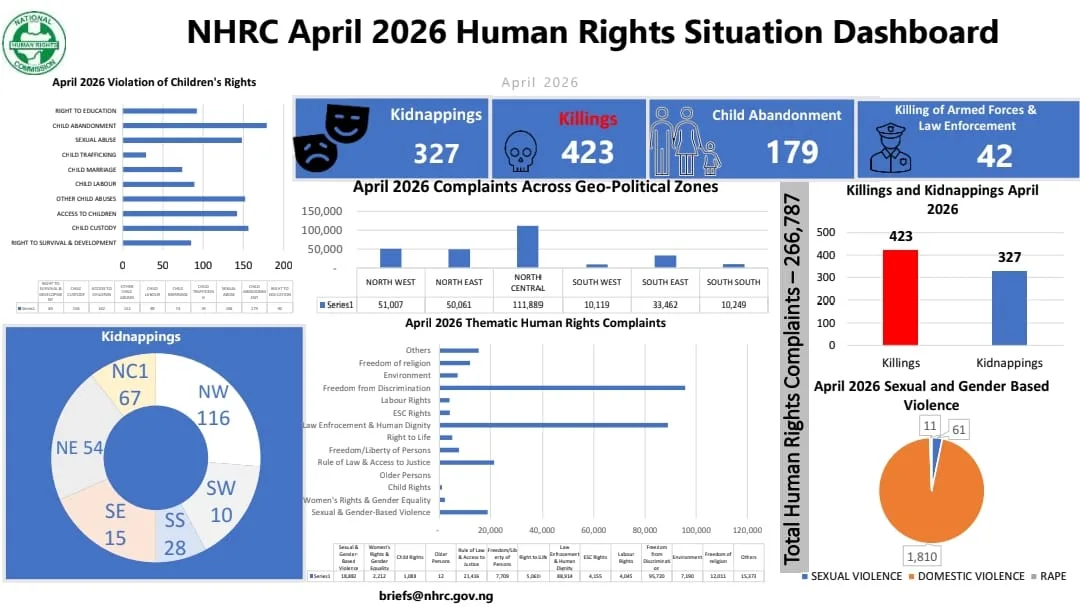
The National Human Rights Commission (NHRC) has reported a significant surge in human rights complaints, with 266,787 cases recorded in April. This represents a 10,655 increase compared to March. According to Hilary Ogbonna, senior human rights adviser to the commission, this increase is part of a pattern seen every year. He says they've noticed this trend before, and it's not surprising.
The Executive Secretary of the NHRC, Tony Ojukwu, a Senior Advocate of Nigeria (SAN), expressed concern over alleged abuses linked to law enforcement activities. He noted that in April, the NHRC observatory recorded over five such cases. Ojukwu emphasized that human life is sacred and can't be taken away by trigger-happy officers of law enforcement and security agencies. He won't tolerate such behavior from law enforcement officers.
A recent case of police impunity went viral after a police officer in Delta State killed a 28-year-old man. Despite interventions like the #EndSARS protest and the government's promise to reform the police, reports of police impunity persist. The NHRC has conducted town hall meetings on rights-based policing and oversight in the FCT for Divisional Police Officers (DPOs). During one of these meetings, the Inspector General of Police, Olatunji Disu, expressed commitment to ending impunity by police officers in Nigeria. He's committed to making a change.
To honor this commitment, the police have taken action, including the arrest of the officer who killed the man in Benue and the dismissal of officials over alleged kidnapping, armed robbery, extortion, and other criminal activities in Rivers State. The Commissioner of Police, Federal Capital Territory (FCT) Command, Ahmed Sanusi, also pledged the police's commitment to upholding human rights during the second phase of the town hall meeting. They're working to uphold human rights.
During the NHRC's dashboard presentation, Mr. Ojukwu lamented the recent airstrike incident in Borno State, which reportedly resulted in civilian casualties. Other complaints include challenges relating to discrimination, insecurity, abuse of authority, economic hardship, access to justice, violent attacks, kidnappings, communal clashes, displacement, gender-based violence, and mob actions. These issues are complex and can't be solved overnight.
On 13 May, the commission demanded an explanation from the Nigerian Air Force over recent military airstrikes that killed civilians in different parts of the country. The NHRC warned that these incidents raise serious human rights and humanitarian concerns. In April, a NAF airstrike killed civilians in a 'precision' airstrike on a market in Jilli, a community bordering Yobe and Borno states. They didn't expect civilians to be harmed.
The commission demanded an explanation after this incident on 14 April. The NAF confirmed the operation but didn't acknowledge the deaths of civilians. The NHRC noted that more than 56 persons died, and many were injured. On 10 May, military airstrikes targeting terrorists reportedly killed more than 100 civilians in Niger and Zamfara states. It's a tragic loss of life.
The North-central region recorded the highest number of complaints received in April, with 111,889. This was followed by the North-west at 51,007, North-east at 50,061, South-east at 33,462, South-south at 10,249, and lastly South-West at 10,119. The commission presented the top 10 states with the highest violations, including the Federal Capital Territory (FCT), Benue, Borno, Kaduna, Niger, Plateau, Imo, Sokoto, Bauchi, and Kogi states. These states have the most work to do.
According to Mr. Ogbonna, the FCT leads by over 35,000 complaints. He explained that this is because it's a merger between their headquarters and the Abuja Municipal Office. Freedom from discrimination and law enforcement dignity emerged as the highest form of complaints in April. They're working to address these issues.
The commission received reports of 752 women facing gender-based violence, 436 abandonment, and 362 violations of their sexual and reproductive rights. Also, 179 children were abandoned in April, during which 156 were also reported to be caught in child custody battles. There were also 148 cases of sexual abuse. It's a disturbing trend.
In the month under focus, the NHRC recorded 423 killings and 327 kidnappings. However, the commission was able to resolve 1,651 cases, visited 104 custodial centres, police stations, and places of detention. They also summoned the police 40 times and visited the military six times. They're making progress, but there's still much work to be done.
To cap the dashboard presentation, the NHRC signed an advisory on Protecting Civic Space and Human Rights. Mr. Ojukwu said it was timely and significant because across the world, civic space continues to face increasing pressure, with growing concerns relating to restrictions on freedom of expression, peaceful assembly, association, media freedom, and civic participation. It's a crucial step forward.
"Human life is sacred and can't be taken away by trigger-happy officers of our law enforcement and security agencies."
- Tony Ojukwu
The North-central region's high number of complaints underscores the need for enhanced security measures and respect for human rights in the area. As the NHRC continues to address these issues, it's clear that there's still much work to be done to ensure the protection of human rights across the country. They won't give up.
Key Facts
- 266,787 human rights complaints were recorded in April.
- 10,655 increase in complaints compared to March.
- 111,889 complaints were from the North-central region.
- 51,007 complaints were from the North-west.
- 423 killings were recorded in April.
- 327 kidnappings were recorded in April.
- 1,651 cases were resolved by the NHRC.
The NHRC's efforts to address human rights violations and promote civic space are crucial in a country where such abuses are commonplace. As Nigeria continues to navigate its complex security landscape, the importance of protecting human rights and upholding the law can't be overstated. It's essential to their mission.
In recent years, the NHRC has made significant strides in promoting human rights. They've worked tirelessly to resolve cases and promote civic space. The NHRC's report highlights the ongoing challenges faced by the country in terms of human rights. However, with the commission's dedication to resolving cases and promoting civic space, there's hope for a better future for Nigerians. They're committed to making a difference.