

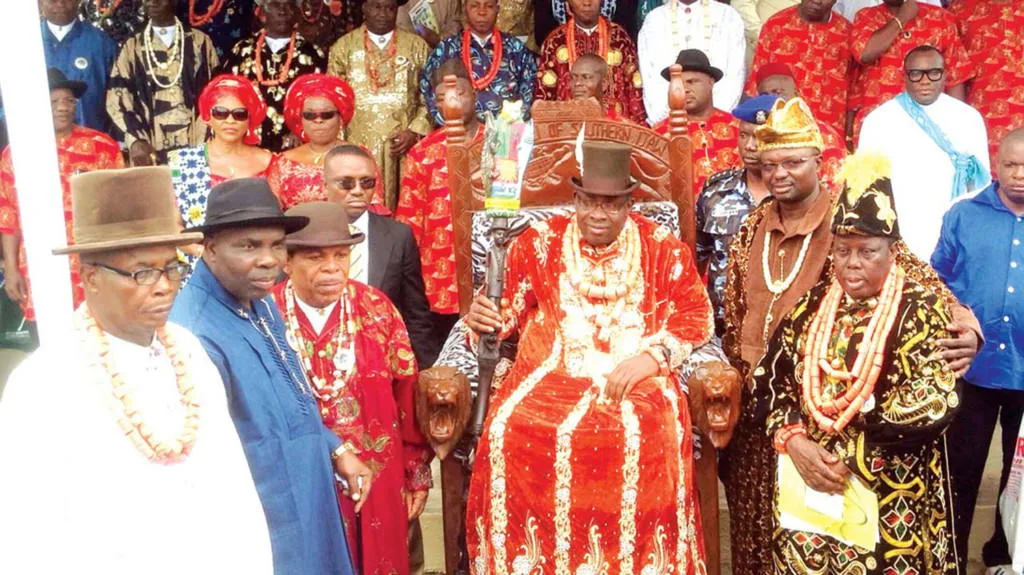
An Ijaw traditional ruler has told President Bola Tinubu that the way Nigeria handles the 13 percent derivation fund is broken — and he's proposed a fix.
His Royal Highness King Jerry Prebor (Snr.), Amananaowei of Meinbutus Federated communities, wrote an open letter asking the president to establish a 13% Derivation Fund Board and a Presidential Monitoring Committee to manage the money. The board would include representatives from host communities, traditional institutions, civil society, and government agencies.
King Prebor's central complaint: state governments in the Niger Delta receive the money but don't spend it on the communities that actually bear the cost of oil extraction. He said the current system has failed the original purpose of the fund.
"The derivation principle was conceived as a mechanism of justice, compensation and development for communities that bear the environmental, economic and social consequences of oil and gas exploitation," the monarch wrote. "Unfortunately, despite trillions of naira disbursed over the years, many oil-bearing communities remain without potable water, quality healthcare, functional schools, motorable roads and other critical infrastructure."
The 13% derivation fund comes from Section 162(2) of the 1999 Constitution. It allocates 13% of revenue from natural resources — mainly oil — back to the states where those resources are extracted. But King Prebor argued that the money was never meant for state governments alone.
"Your Excellency, the struggle for the restoration and enhancement of derivation was championed by host communities, traditional rulers, civil society organizations and respected Niger Delta leaders. It wasn't a struggle initiated or sustained by state governments," he wrote. "Therefore, the beneficiaries envisaged by the spirit of derivation are the oil-producing communities themselves."
The monarch also pushed back against the idea that the Petroleum Industry Act (PIA) had solved the problem. He said the PIA and the constitutional derivation principle are separate legal frameworks — one can't replace the other.
"I also wish to respectfully disagree with recent assertions that the Petroleum Industry Act (PIA) has sufficiently addressed concerns relating to the 13 per cent derivation fund," he said.
King Prebor made two additional requests. He asked the president to direct the Revenue Mobilization Allocation and Fiscal Commission (RMAFC) to review its position on how derivation funds are administered. And he urged that the proposed board and monitoring committee would guarantee "transparency, accountability and direct community participation" in planning and executing projects.
The letter reflects a long-standing frustration in the Niger Delta. Despite decades of oil production and trillions of naira in derivation payments, many communities still lack basic infrastructure. The monarch's proposal essentially asks the federal government to bypass state governors and channel the money directly to the people who live next to the oil wells.
- The 13% derivation fund is mandated by Section 162(2) of Nigeria's 1999 Constitution
- King Jerry Prebor (Snr.) is the Amananaowei (traditional ruler) of Meinbutus Federated communities in the Niger Delta
- He proposes a Derivation Fund Board and a Presidential Monitoring Committee to manage the money
- The board would include host community representatives, traditional rulers, civil society, and government agencies
- He says state governments have misdirected the funds, leaving communities without water, healthcare, schools, or roads
- He argues the PIA doesn't address the derivation fund issue because they're separate legal frameworks
- He also wants RMAFC to review its position on the fund's administration