

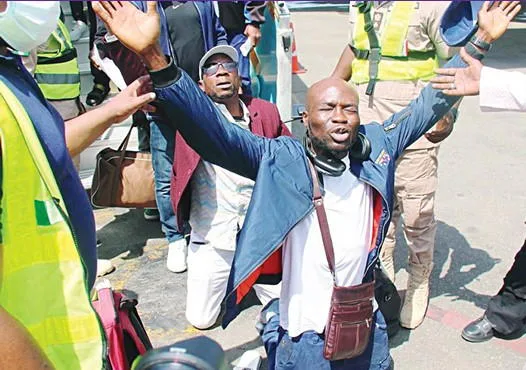
The Federal Government and 268 Nigerians flown back from South Africa yesterday have rejected Pretoria's claim that all returnees were undocumented, pointing instead at a broken immigration system that left legitimate applicants stranded for years.
Speaking at the reception of the first evacuation batch in Lagos, Nigeria's acting High Commissioner to Pretoria, Ambassador Temitope Ajayi, said the undocumented label was false and misleading. "Many of these people you're seeing here, Minister, aren't undocumented persons. Many of them became undocumented because of systemic failures of South African Home Service," Ajayi said.
Ajayi described South Africa's Home Affairs as a transactional section where backlogs and delays had left applicants waiting two, three, even five years for permit extensions. "So, because of this delay, and the general problem in the system itself, it made many people become undocumented. So, it's false and totally misleading for a body of officials to mention, to put it in the news before we landed, that 268 Nigerians that came back were undocumented in South Africa," he added.
The evacuees themselves accused South African authorities of deliberately delaying renewals of work permits and other documents to create grounds for clampdowns, while security agencies extorted them. Some also blamed the Nigerian Mission in Pretoria, saying bureaucratic bottlenecks there frustrated efforts to regularise their stay.
South Africa's Head of Immigration Enforcement, Stephen van Neel, had claimed shortly before the evacuees left OR Tambo International Airport on Wednesday: "The 268 departing first were all undocumented. None of the 268 Nigerian nationals who arrived at OR Tambo International Airport for repatriation on Wednesday are in South Africa legally. Not a single person of the 268 is legal." Van Neel also announced a five-year travel ban on the returnees.
President Bola Tinubu ordered the evacuation in April after xenophobic violence erupted, setting up a hotline with the Ministry of Foreign Affairs and the mission in Pretoria for daily updates. Ajayi said Tinubu faced pressure from world leaders and South African President Cyril Ramaphosa to halt the repatriation over the "bad optics" it gave to South Africa. "But Mr. President was always very consistent, because he knew where he was going. And he said, any attack on my people in South Africa is an attack on me, and you must bring my people back," Ajayi said.
The government arranged five Air Peace flights to bring Nigerians home. Wednesday's arrival was the first batch of 268 evacuees, including women, men and children. The next flights are scheduled for June 15, 18, 22 and 24, with the exercise expected to conclude within the month.
Ajayi said the process involved a three-stage screening coordinated with South Africa's Foreign Ministry, Home Affairs, Immigration Service, Border Management Office and Intelligence Service. This included biometric identification, immigration clearance, and issuance of emergency travel certificates for those without documents. He lamented that despite agreement with South African authorities not to speak to the press until the operation was completed, South African officials broke the protocol. "I don't want them to politicise this kind of operation because it's beyond politics. It's not something we should take the vulnerability of people to turn into spectacle," he said.
The Minister of State for Foreign Affairs, Amb. Sola Enikanolaiye, assured that the Federal Government would activate the Nigeria-South Africa Binational Commission and the newly established Early Warning Mechanism to respond faster to future threats against Nigerians in South Africa.