

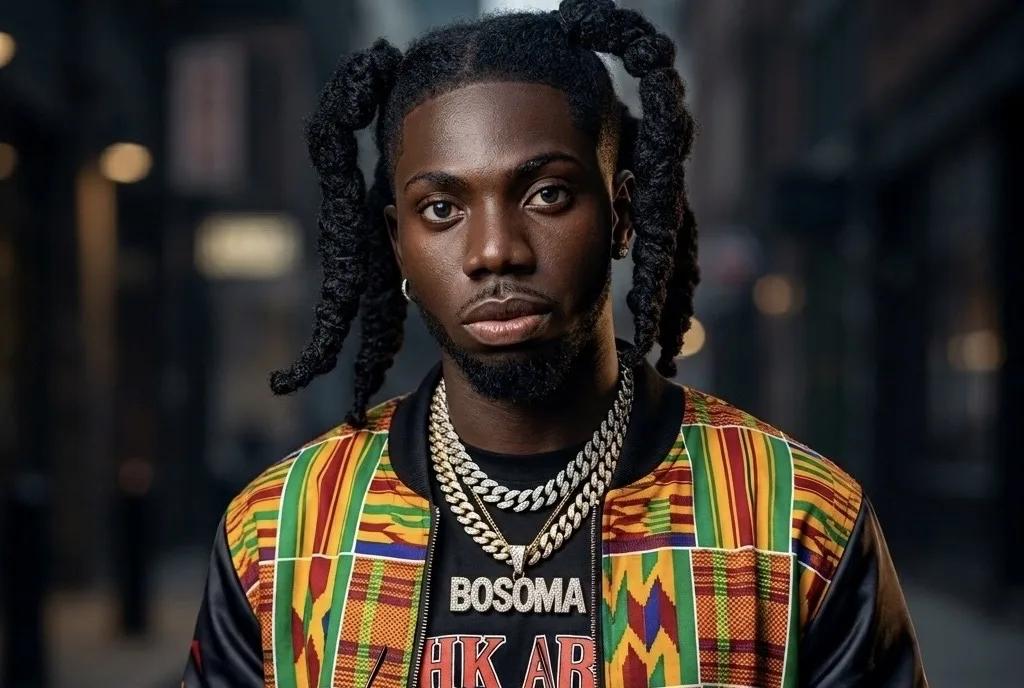
Some songs knock politely. Bosoma’s ‘Time’ walked in like it already knew where the remote control was. Without a celebrity convoy, without begging for attention, the record has clocked in at No. 4 on Ghana’s Top Trending Songs Chart — turning quiet industry whispers into loud, slightly panicked conversations.
Because when a new name climbs that fast, the question isn’t ever just “who is this?” It quickly becomes “why didn’t we see this coming?”
Ghana’s music charts aren’t known for patience. They’re fast-moving, mood-driven, and brutally competitive. One minute a song is trending, the next minute it’s replaced by something louder, newer, or more controversial. So when a track like ‘Time’ shows up and immediately plants itself inside the Top 5, it isn’t just a win. It’s a takeover attempt. Bosoma didn’t ask for permission. He simply entered the room of heavyweights and adjusted the temperature.
The Man Behind the Song
Before ‘Time’ started climbing charts, Bosoma was already doing the slow work that most viral artists avoid. No shortcuts. No overnight fairy tale. His journey reflects a new generation of Ghanaian musicians who aren’t waiting for discovery. They’re building momentum piece by piece, performance by performance, and stream by stream.
Industry insiders trace his rise to a mix of consistent independent releases, grassroots fan engagement, strong live performance energy, and a sound that refuses to stay in one genre box. Bosoma doesn’t pick a lane. He builds a highway and adds his own signage. His music blends Afro-fusion textures with street-influenced storytelling, stitched together with hooks that feel like they were designed for replay buttons. It isn’t polished to the point of predictability.
It’s rough in the right places, catchy in the dangerous places, and emotionally honest in the parts that matter.
The TGMA Unsung Launchpad
If there’s one moment that accelerated Bosoma’s trajectory, it’s his appearance in the Telecel Ghana Music Awards Unsung initiative. The TGMA Unsung platform has become a serious launchpad for emerging acts in Ghana. It isn’t a talent show in the traditional sense. It’s more like a controlled explosion for artists who are already ready but still waiting for visibility.
Bosoma was among the selected finalists in a competitive lineup that featured some of the most promising underground names in the country. His inclusion alone placed him on a radar that industry gatekeepers watch closely. But it was his performance that did the real damage. On the TGMA Xperience Concert stage, Bosoma delivered a set that felt less like an introduction and more like a warning shot. Not loud for the sake of noise, but sharp enough to cut through the crowd memory of the night.
Within days, conversations shifted. Not “he performed well,” but “we need to move on this one quickly.” That’s how momentum becomes opportunity.
The Record Deal That Turned Momentum Into Structure
Momentum is exciting, but structure is what keeps artists from disappearing after their first viral moment. Following his TGMA Unsung appearance, Bosoma reportedly secured a record deal with BKC Music, a label increasingly associated with developing emerging African talent with digital-first strategies.
This is where the story stops being just about talent and starts becoming about positioning. In today’s music industry, signing a deal isn’t just about funding songs. It’s about building systems around them. Promotion, distribution, content strategy, playlist placement, audience targeting, and long-term brand shaping all begin to matter more than the recording itself. For Bosoma, this means ‘Time’ is no longer just a song moving on its own. It’s a product moving with a machine behind it.
‘Time’ Is Not Just a Title Anymore
There’s something unintentionally poetic about all of this. A song called ‘Time’ entering the chart at No. 4 feels almost like it’s following instructions written by fate. The record itself leans into themes that resonate with a wide audience: pressure, patience, ambition, the feeling of running out of time while still trying to become something meaningful. It isn’t overly complicated music. That’s its advantage.
It speaks directly, without translation. Listeners aren’t decoding the song. They’re recognizing themselves in it. And recognition is one of the fastest ways to climb a chart.
Before the chart breakthrough, ‘Time’ was already showing early signs of movement across streaming platforms. While Bosoma isn’t yet a household name, the numbers suggest that may not last long. The question now isn’t whether he’ll be a one-hit wonder — it’s how high he can go before the industry catches up to what he’s building.