

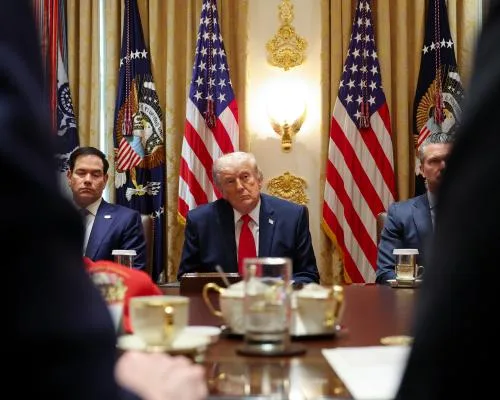
The situation in the Middle East has gone from bad to bloody, and President Donald Trump isn't hiding his frustration. During a White House cabinet meeting yesterday, the President turned his sights on Oman, a country that has long played the role of the neutral mediator. He made it crystal clear that he expects the vital Strait of Hormuz to stay open to international traffic. If Oman, which holds significant sway over the area, decides to play side-hunts with Tehran, the President says he’ll “blow up” the nation. It’s a terrifyingly blunt shift in language from an ally.
“No, the strait is going to be open to everybody. It’s international waters and Oman will behave just like everybody else or we’ll have to blow them up. They understand that, they’ll be fine.”
Esmaeil Baghaei, the spokesperson for Iran’s foreign ministry, has wasted no time firing back. He expressed solidarity with Oman, condemning the American rhetoric without directly naming the President. The tension isn't just talk; it's playing out in real-time with iron and fire. The US has launched strikes against a military facility in the port city of Bandar Abbas. They destroyed a ground control station that was preparing to launch a fifth attack drone.
This follows a successful mission where US Central Command forces downed four Iranian one-way drones that were hovering too close for comfort near the strait.
Things took a sharp turn for the worse early this morning when Iranian Revolutionary Guards hit an American base in Kuwait. The Kuwaiti army confirmed their air defences were working overtime to intercept a hail of missiles and drones just before 6am. This is a massive escalation that forces Kuwait directly into the crosshairs of this conflict. Brent North Sea crude oil prices jumped nearly 2% to $95.95 a barrel. The global market is clearly sweating the potential for an all-out shutdown of the world’s most important oil artery.
For the people living through this, the nightmare is multifaceted. In Tehran, the internet flickered back to life on Tuesday evening after an astonishing 88-day blackout. But there wasn't a party. Instead of joy, residents were met with anger and deep anxiety. Ellie, a 42-year-old artist who has been cut off from the world since late February, described the experience of hearing her favourite music again as a bittersweet reminder of a freedom she feels is currently stolen.
Others, like a photographer named Maryam, have described the government-led celebrations of the partial restoration as a nauseating joke.
- The Israel Defense Forces reported 24 soldiers killed since fighting with Hezbollah restarted on 2 March.
- A Hezbollah drone strike in northern Israel killed one soldier and wounded two others yesterday.
- Mohammed Odeh, the new leader of Hamas’ military wing, was confirmed killed alongside his wife and two children in Gaza City.
- Over 120 strikes hit southern and eastern Lebanon on Tuesday, including constant bombardment of the historic city of Tyre.
- Thousands of civilians have been ordered to evacuate southern Lebanon as the military marks a massive new combat zone.
This isn't just about regional dominance; it’s a tug-of-war over energy, nuclear ambition, and survival. Ebrahim Azizi, who heads the Iranian parliament’s national security committee, dismissed the President’s threats as a desperate attempt to break a strategic deadlock. He claims Iran isn't backing down from its demands to enrich uranium or lift international sanctions. The President, meanwhile, insists that while he wants a deal, the current offer from Tehran isn't enough. He has created pressure on the Iranian regime to re-evaluate its stance on nuclear enrichment.
Behind the headlines, the human cost remains the most jarring reality. Hospitals in Gaza are overflowing with wounded children, and the ancient streets of Tyre are under fire. For Nigerians invested in the global energy market, this volatility is a double-edged sword. While rising oil prices can signal a boost for the nation’s revenue, the broader regional instability threatens to disrupt the delicate balance of global trade that keeps the cost of imported goods, fuel, and transport in check. The strikes continue, and the ceasefire remains a fragile piece of paper waiting to be shredded.