

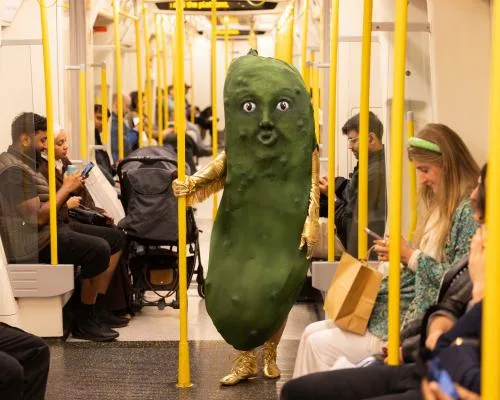
A giant green pickle is turning heads in London as it promotes the UK's first Jewish culture month. The celebration, which kicked off on May 16, includes more than 150 events across the UK, covering food, music, comedy, architecture, fashion, film, and literature.
The Board of Deputies of British Jews organised the festival, aiming to bring 'less oy and more joy' after difficult years for the Jewish community. Liat Rosenthal, the Board's director of culture, education and communities, said the project emerged from conversations with artists and cultural workers who felt Jewish life had become increasingly defined through hostility, grief, and security concerns since the 7 October 2023 attacks in Israel.
'For me, the response to antisemitism has to be this bold, proud, public moment,' she said. 'The history of British Jews is incredibly rich, and the contribution of British Jews to life across the UK spans not just arts and culture, but science, technology, innovation, psychotherapy, medicine, and politics.' It's a rich history that hasn't always been celebrated.
The events will take place in various institutions, including the V&A Museum, National Portrait Gallery, JW3, the British Library, and the National Holocaust Museum. One event, hosted by the east London pickling company Shedletsky, will be a traditional Friday night dinner, highlighting the Jewish communities' deep-rooted traditions in pickling and preserving.
James Cooper, a co-founder of Shedletsky, explained that the Jewish communities that came out of eastern Europe were deeply entrenched in pickling and preserving traditions. He didn't think it was a coincidence that these traditions have endured. His co-founder, Natalie Preston, added that food has been a way of opening conversations between communities, hoping to break down the barriers being put up at the moment. They're hoping it will bring people together.
At JW3, in Hampstead, north London, an event titled L'Chaim / L'Chaos: 50 Years of Jewish Punk will explore the enduring relationship between Jewish youth culture and Britain's 1970s punk scene. William Galinsky, JW3's director of programming, said that many young Jewish people in the 1970s were attracted to the outsider teen culture of punk. They were drawn to its energy and creativity.
The Association of Jewish Refugees will run walking tours exploring Jewish histories outside London, including in Cardiff. Debra Barnes, the head of next generations at the Association, stated that the month is partly an attempt to broaden public understanding of Jewish life beyond trauma. It's about showing that Jewish life is diverse and complex.
The National Holocaust Museum in Newark, Nottinghamshire, will host an event titled What Does it Mean to be Jewish? in which visitors will hear stories from young British Jews from across the country. Abi Levitt, the museum's chief executive, said that the exhibition is about celebrating Jewish life and asks what meaningful objects bring Jewish culture to life. It's a question that doesn't have a simple answer.
The UK's first Jewish culture month started on May 16. Over 150 events will take place across the UK. The celebration aims to bring 'less oy and more joy' after difficult years for the Jewish community. Events will cover food, music, comedy, architecture, fashion, film, and literature. The Board of Deputies of British Jews organised the festival.
The month-long celebration is intended for all, regardless of background or religion. Liat Rosenthal said, 'Everyone should get involved, learn something, and eat lots of food.' The UK's first Jewish culture month promises to be an unforgettable experience. It won't be something you'll want to miss.