

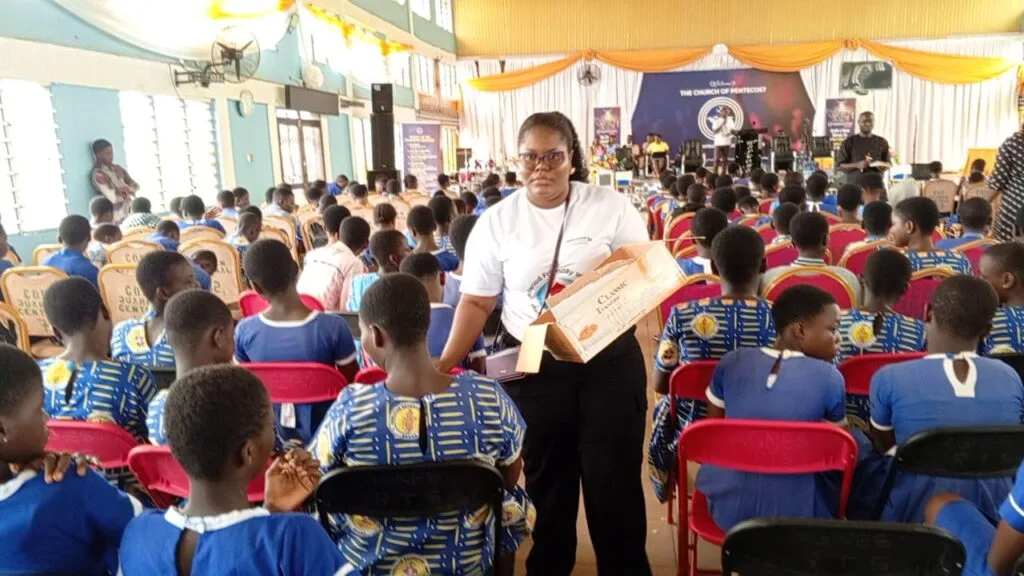
For many adolescent girls across Ghana, the monthly cycle is more than just a biological event; it's a recurring threat to their education. As the world marks Menstrual Hygiene Day, United Pension Trustees stepped into the Juaben Municipality with a clear message: silence only feeds the stigma. Working alongside the Nkɔsuoɔhene of the Juaben Traditional Area, Nana Awuah-Darko Ampem II, the firm distributed sanitary pads and soaps to over 2,000 junior high school students. The initiative covered eight local institutions, including Anglican JHS, Benevolent Islamic JHS, Presbyterian JHS, RC JHS, STEM JHS, Methodist JHS, MA JHS, and SDA JHS.
Menstrual health experts and Girl Child Education officers were on the ground to teach these young girls how to maintain proper hygiene. They didn't stop there. The program included sessions for boys, focusing on the broader aspects of reproductive health, teenage pregnancy, and the realities of sexually transmitted infections like HIV. This approach shifts the burden of menstrual education from being a 'girl-only' conversation to a shared community responsibility.
"No girl should miss school or be placed at a disadvantage because of a natural biological process. Menstruation affects every woman, yet women’s health doesn't receive the attention it deserves."
Samira Nasiru, the Head of Investment at United Pension Trustees, explained that this outreach is a core part of their social responsibility. The firm is pushing for a future where menstrual equity is the standard, not a luxury. Nasiru highlighted a painful reality: many girls in underserved communities drop out of school entirely because they lack the basic resources to manage their periods comfortably. Fear of public embarrassment and the lack of decent toilet facilities in schools are often the final straws that force these students to stay home.
The government currently runs a free sanitary pad initiative specifically for Senior High Schools, but critics and advocates argue the net isn't wide enough. The persistent high taxes on imported and locally manufactured sanitary products keep these items out of reach for the average household. Juaben Municipal Girl Child Education Officer Yvonne Telfer expressed her appreciation for the donation, which she described as a direct relief for students who were previously struggling to stay in class during their cycles. Telfer noted that the involvement of boys in these sessions is a critical step in breaking the long-standing taboos surrounding menstruation in rural communities.
Local officials are calling for more logistical support to maintain this progress. Beyond just the pads and soap, schools need dedicated training for peer educators and transportation to help expand these campaigns to even more remote areas. Telfer emphasized that without consistent resources and educational materials, the conversation on menstrual hygiene risks losing its momentum. The goal is to make these discussions a regular feature of school health programs rather than a one-off awareness day activity.
Menstrual Hygiene Day, observed annually on May 28, serves as a global reminder that reproductive health is a fundamental human right. This year, the campaign theme, “Together for a #PeriodFriendlyWorld,” captures the necessity of the work happening in Juaben. As these students return to their desks, the hope is that the combination of free supplies and open dialogue will mean one less barrier between them and their books. It’s a practical, no-nonsense approach to ensuring that biology doesn't dictate a child's future.